


Executives face a unique challenge: recovery shouldn’t mean sacrificing your career. Traditional daytime treatment programs demand time away from work, creating impossible choices between health and professional obligations.
At EveningIOP, we’ve built nighttime therapy for executives specifically to solve this problem. You can attend clinical treatment in the evenings while maintaining your job, your income, and your privacy.
Why Executives Actually Need Evening Treatment
The Math of Daytime Programs Doesn’t Work for Working Leaders
Executives managing substance use disorders face a reality that standard treatment programs ignore: daytime intensive outpatient programs require you to leave work for hours each day. A full-time executive attending a traditional program three to five days per week confronts impossible math. Three hours per day away from the office for four weeks means missing 60+ hours of work. Your team notices. Your clients notice. Your board notices.
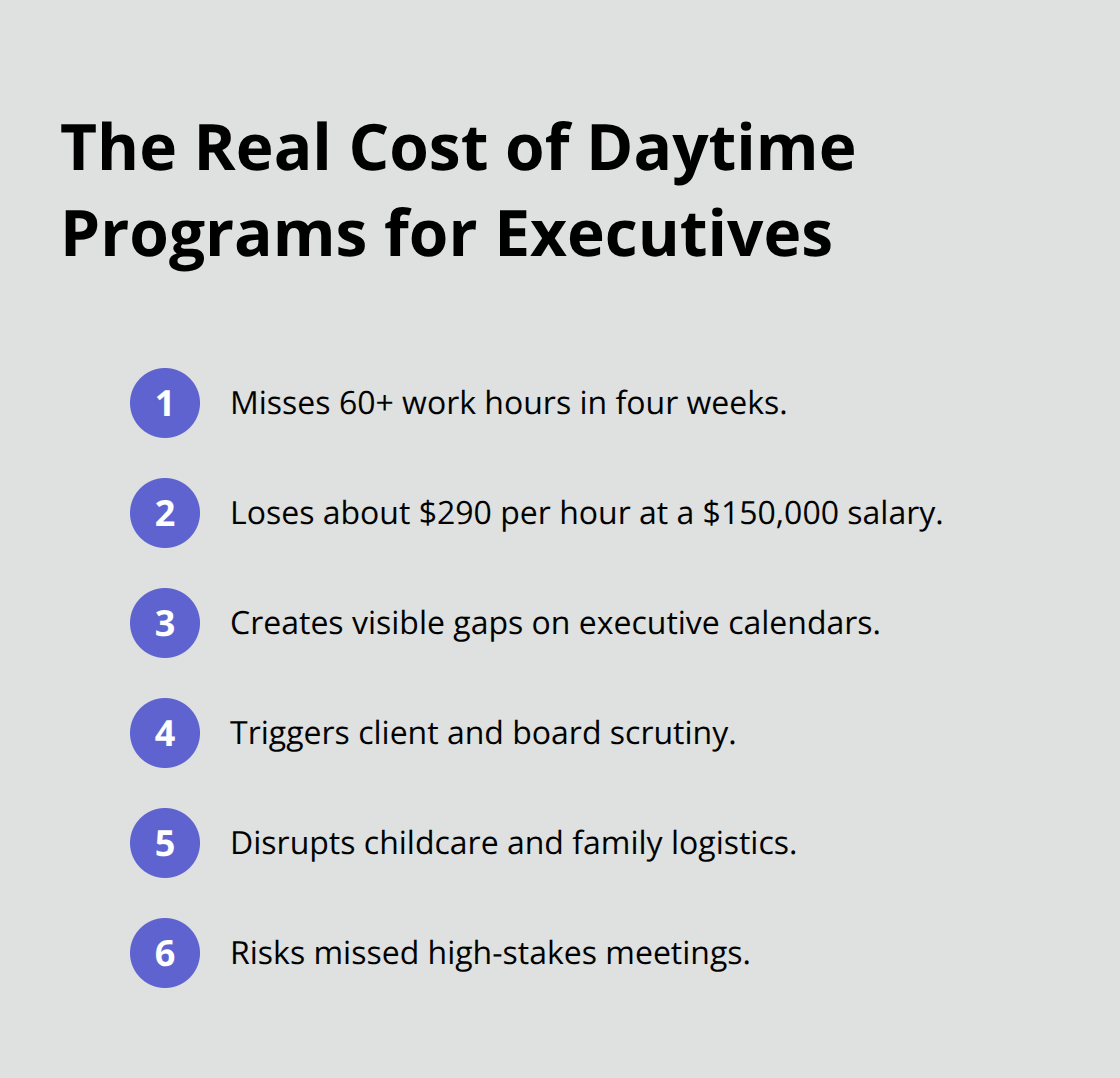
The cost isn’t just clinical-it’s professional annihilation. A senior executive earning $150,000 annually loses roughly $290 per hour in billable time. Add childcare disruptions, missed client meetings, and the visible gap in your calendar, and daytime treatment becomes a career threat rather than a health solution.
Privacy Becomes Impossible in High-Profile Roles
Privacy in high-profile careers isn’t paranoia-it’s survival. Founders, CEOs, physicians, and elected officials operate under constant scrutiny. A colleague notices you’re gone every afternoon and asks questions; suddenly rumors spread. Your reputation precedes you in every room. One careless mention to the wrong person erodes your professional standing regardless of your actual performance. Traditional programs require you to disclose treatment to HR, create paper trails in company systems, and coordinate time off that raises flags. Evening treatment eliminates these exposure points entirely. You control who knows and when they know it. Treatment happens on your schedule, in your home or a private clinic, with zero workplace notification required. This confidentiality isn’t a luxury-it’s what makes recovery possible for people whose careers depend on discretion and perception.
Evening Programs Protect Both Recovery and Career
Evening programs solve both problems at once. You attend therapy after work and maintain your professional presence while preserving the income that funds your recovery. Live group therapy and one-on-one sessions with licensed clinicians happen entirely in the evening, meaning your professional day remains untouched and your treatment remains private. This flexibility doesn’t compromise clinical quality; it removes the barriers that prevent executives from seeking help in the first place. The next section explores how evening intensive outpatient programs actually deliver the same clinical effectiveness as their daytime counterparts-without the career cost.
How Evening Programs Deliver Real Clinical Results
Scheduling Removes the Top Barrier to Treatment
Evening intensive outpatient programs work because they eliminate the primary obstacle that stops executives from seeking help. A 2023 SAMHSA report identified scheduling conflicts as the top barrier to treatment entry for working professionals, ranking above cost and stigma. Evening programs attack this barrier directly. You maintain your work schedule, your income, and your presence in the office while receiving evidence-based care identical to daytime programs. The clinical content-group therapy addressing substance use triggers, one-on-one sessions with licensed clinicians, drug and alcohol testing-stays the same. Only the timing shifts to after work ends.
Clinical Quality Remains Unchanged
DHCS-licensed and Joint Commission-accredited evening programs meet the same clinical standards as their daytime equivalents. Accreditation bodies do not differentiate between day and evening delivery. You attend live sessions, engage with licensed clinicians, participate in group work, and complete drug testing on the same schedule as daytime clients. The only difference is you complete treatment after 5 p.m. instead of during business hours. This distinction matters because the clinical model itself-evidence-based therapy, professional oversight, structured accountability-remains intact.

Evening delivery simply removes the logistical barrier that makes recovery impossible for working professionals.
The Financial Case for Evening Treatment
The financial math reveals why many executives avoid treatment altogether. Professionals earning $100,000 to $250,000 annually lose roughly $48 to $120 per hour when attending daytime appointments. Evening treatment eliminates this cost entirely while keeping your paycheck intact and your team functioning. You avoid the income loss that makes recovery feel like a luxury you cannot afford. This financial protection matters because many executives skip treatment specifically because they cannot absorb the income hit and the reputational exposure of being absent from work.
Privacy and Professional Presence Work Together
Evening programs solve two problems simultaneously. You attend therapy after work and maintain your professional presence while preserving the income that funds your recovery. Treatment happens on your schedule, in your home or a private location, with zero workplace notification required. This confidentiality is not a luxury-it is what makes recovery possible for people whose careers depend on discretion and perception. Your colleagues do not notice gaps in your calendar. Your clients do not see you missing from meetings. Your board does not question your availability. Recovery happens entirely outside your professional world, which means you protect both your health and your reputation at the same time.
Moving From Barriers to Accountability
The removal of logistical obstacles does not weaken accountability; it actually strengthens it. When executives no longer face the choice between their career and their recovery, they show up consistently to treatment. They engage more fully in group sessions because they are not mentally calculating the cost of each hour away from work. They build relationships with clinicians and peers without the resentment that comes from sacrificing income and professional standing. Evening programs make recovery logistically possible rather than theoretically desirable, which means the executives who need help most-those with the most to lose professionally-finally have a path forward. The next section explores how evening treatment integrates into your life in ways that build lasting accountability without requiring workplace disclosure.
Overcoming Stigma and Building Sustainable Recovery
Accountability Without Workplace Exposure
Accountability without exposure is the missing piece executives need to commit to recovery. Traditional programs force a choice: disclose treatment to your employer, create a paper trail through HR systems, or skip therapy altogether. Evening programs solve this by building accountability through clinical relationships and peer support rather than workplace surveillance. You show up to evening sessions because a licensed clinician knows your progress, your peers in group therapy notice your absence, and your sobriety depends on consistent engagement-not because your boss monitors your calendar. This shift matters enormously. Research on occupational therapy in recovery settings shows that when clients feel autonomous and self-directed rather than externally controlled, they report higher engagement with treatment and complete programs at significantly higher rates. Accountability operates through clinical structure: scheduled sessions, drug testing, and documented progress with your clinician. None of this requires workplace disclosure. Your employer never learns you’re in treatment. Your team never questions your evening schedule. You build genuine accountability to yourself and your clinical team instead of performing recovery for an HR department.
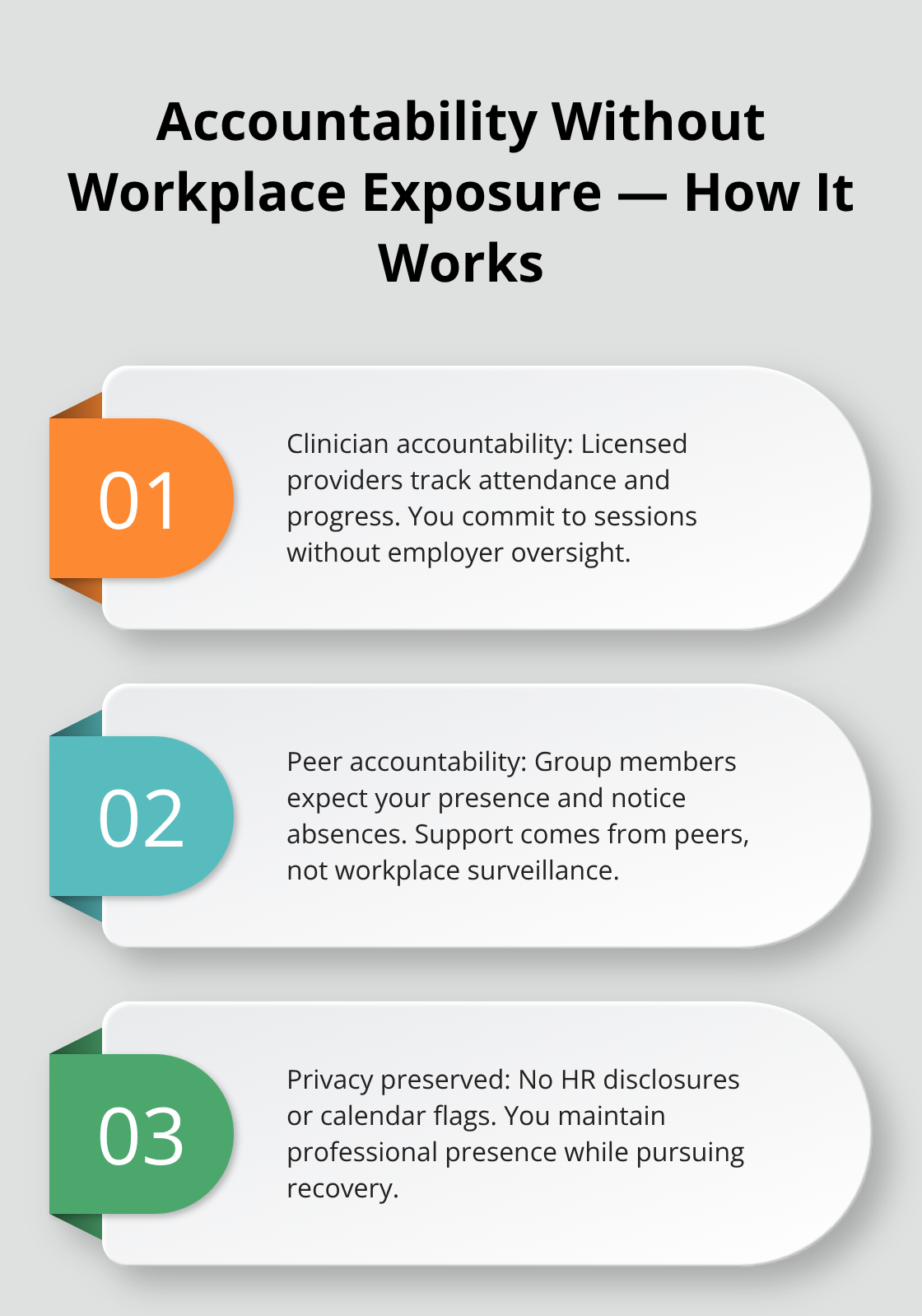
This approach works because it removes the shame and secrecy that often sabotage executive recovery. You attend treatment openly within your clinical circle while maintaining complete privacy professionally.
Evening Treatment Replaces High-Risk Hours
Evening treatment integrates into your actual routine-not some hypothetical version of your life-and this determines whether recovery sticks. Many executives fail recovery programs because they treat therapy as an additional obligation rather than a replacement for existing habits. Evening intensive outpatient programs work differently. You finish work at 5 p.m., attend a 90-minute group session or individual session between 6 and 8 p.m., then return home. This structure displaces the evening hours when substance use typically escalates. Research on behavioral substitution shows that replacing high-risk evening activities with structured clinical time reduces relapse risk compared to programs that leave evenings unstructured. Your evening becomes clinically supported recovery time rather than unmonitored risk.
Real-Life Treatment Builds Lasting Sobriety
Evening treatment aligns with how you actually live, which protects long-term sobriety. You maintain your work role, your income, and your professional identity while simultaneously rebuilding your relationship with substances. The clinical work addresses triggers specific to your life-stress from board meetings, pressure from investors, isolation in leadership roles-in real time rather than in some abstracted therapeutic context. You learn stress regulation techniques and apply them immediately to your actual job demands. This alignment between treatment and real life is why evening programs show comparable clinical outcomes to daytime programs while producing better long-term retention. Executives who work and recover simultaneously build sustainable sobriety because recovery becomes integrated into their life rather than a disruption of it.
Final Thoughts
Evening intensive outpatient programs represent a genuine clinical solution for executives who need recovery without career disruption. Scheduling conflicts stop most working professionals from entering treatment, and evening programs eliminate this barrier entirely. You receive the same evidence-based care, the same clinical oversight, and the same accountability as daytime clients-your treatment simply happens after work ends.
Nighttime therapy for executives works because it acknowledges your reality. You cannot pause your career for recovery. Your income funds your treatment. Your professional presence matters to your team and your clients. Evening programs do not ask you to choose between these realities and your health; instead, they integrate recovery into your actual life while you maintain your paycheck, protect your privacy, and build accountability through clinical relationships rather than workplace disclosure.
EveningIOP delivers this model through live, telehealth evening intensive outpatient programs that combine interactive group therapy, one-on-one sessions with licensed clinicians, and remote drug and alcohol testing-all scheduled around your work and life.