
Addiction treatment shouldn’t force you to choose between recovery and your responsibilities. At EveningIOP, we’ve built remote addiction treatment appointments around your actual life-not the other way around.
Whether you’re managing work deadlines, family obligations, or simply need privacy, evening and flexible scheduling removes the biggest barrier to getting help. Real recovery happens when treatment fits your schedule, not when your schedule fits treatment.
When Can You Actually Do Treatment
Remote addiction treatment through evening and night-time programs eliminates the excuse that recovery doesn’t fit your life. Evening sessions happen when you’re actually available, not when a clinic’s standard business hours demand you take time off. The shift matters more than it sounds.
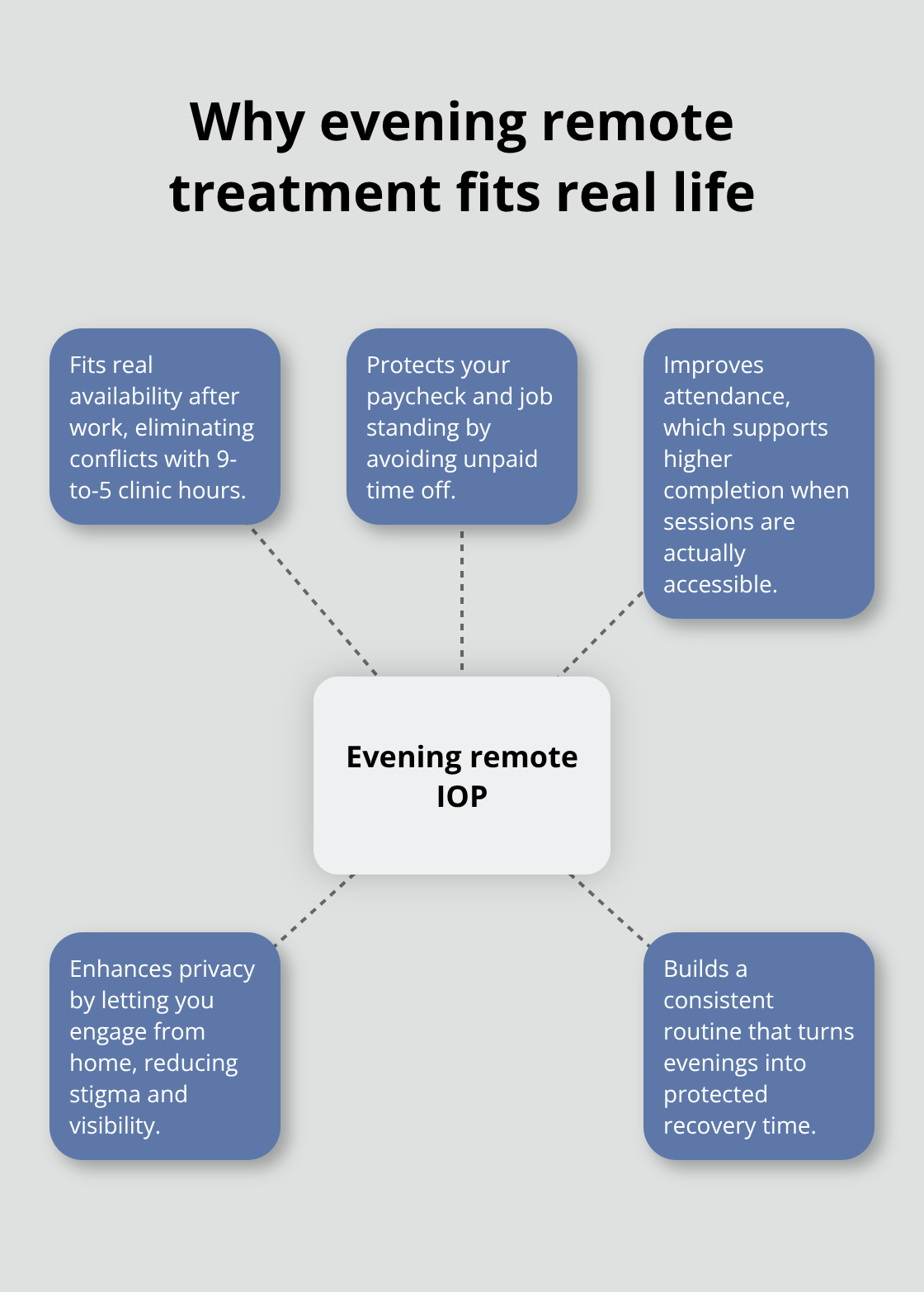
Research from Yale University in 2018 found that online addiction programs increase treatment completion rates, largely because people can actually attend when scheduled. When your treatment happens at 6 PM instead of 2 PM, you don’t have to choose between your paycheck and your recovery.
Working Professionals Need Treatment That Works Around Work
Intensive outpatient programs traditionally require 9 to 20 hours per week of clinical time, which sounds manageable until you realize most facilities schedule those hours during 9-to-5 windows. Remote treatment flips this constraint. You attend live group therapy sessions and one-on-one counseling from home or anywhere with an internet connection, meaning no commute, no time lost to travel, and no need to explain absences to your boss. The practical advantage is concrete: if your evening program runs from 5 PM to 8 PM three nights weekly, you clock out, transition to your treatment space, and handle your recovery without disrupting your professional reputation or income.
Privacy Stays Yours
Employers don’t need to know you’re in treatment, and remote care keeps it that way. You avoid requesting time off, sitting in a waiting room where a coworker might see you, or explaining a recurring appointment block on your calendar. The confidentiality piece matters psychologically too. Research from Mark and colleagues published in Psychiatric Services noted that telehealth may help engage patients through improved access and convenience but also by reducing stigma and the visibility of treatment-seeking. When your therapy happens in your home, the decision to disclose your recovery remains entirely yours. Set boundaries with your employer about your evening schedule, and your treatment stays private.
What Happens Next in Your First Session
The initial appointment sets the tone for your entire treatment journey. Licensed clinicians conduct assessments that map your specific substance use history, co-occurring mental health concerns, and life circumstances to build a personalized treatment plan.
Your First Remote Appointment: What Actually Happens
The Initial Assessment Sets Your Treatment Direction
Your initial session is a structured clinical assessment, not a casual conversation. Licensed clinicians conduct 60 to 90 minutes of evaluation that maps your substance use history, identifies co-occurring mental health conditions, and understands your work and family situation. This assessment is specific to you.
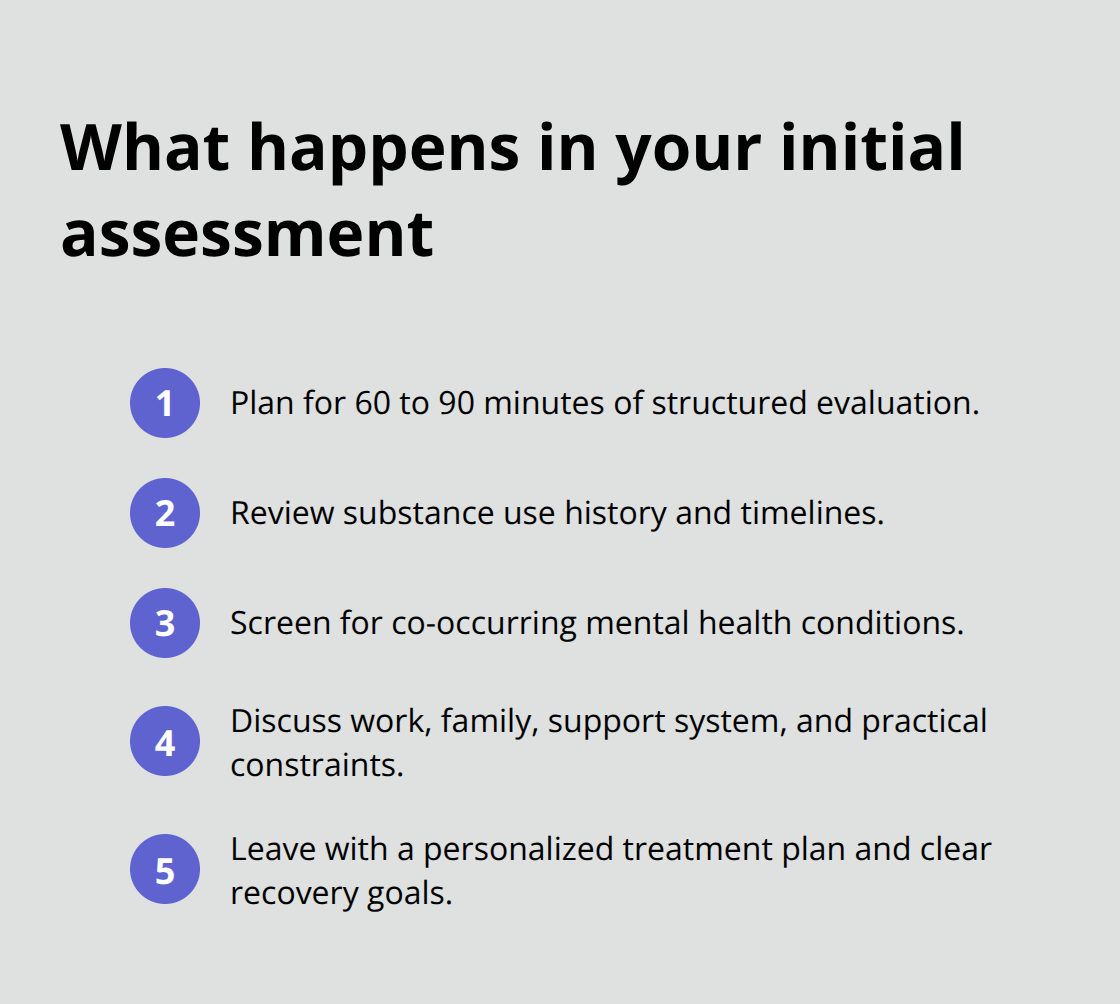
Clinicians ask targeted questions about what substances you’ve used, how often, when you started, what triggered recent use, and whether you’ve experienced withdrawal symptoms. They assess your readiness for treatment, your support system, and your practical constraints. The result is a personalized treatment plan that specifies your exact clinical needs and recovery goals, not a one-size-fits-all protocol.
Research confirms that tailored treatment plans support individually fitted care in addiction treatment. Bring documentation if you have it-previous treatment records, medical history, medications you’re taking, and insurance information. Have your calendar available to discuss scheduling. Know that everything discussed is protected by confidentiality laws; your therapist cannot disclose information to your employer, family, or anyone else without your written consent.
Live Group Sessions and One-on-One Counseling
Once your plan is set, you’ll attend live group therapy sessions with other people in recovery and one-on-one counseling sessions with your assigned clinician. Group sessions run in the evening, typically 90 minutes, and focus on coping skills, relapse prevention strategies, and building a peer recovery network. You participate actively in discussions rather than passively listening to lectures. Licensed clinicians facilitate interactive conversations where you learn practical sober strategies and hear how others handle triggers and cravings.
Individual counseling sessions happen on a flexible schedule and address personal issues-relationship stress, workplace anxiety, family conflict-that connect to your substance use. Between sessions, you may complete remote drug and alcohol testing from home using a secure platform; no clinic visit required. This continuity matters. Research shows that telehealth-based addiction treatment can support recovery, partly because the weekly structure and accessible testing kept accountability consistent.
What You Need to Bring and Know
Arrive to your first session on time, in a quiet private space with reliable internet, and with realistic expectations. Recovery is clinical work, not inspiration. You’ll feel uncomfortable sometimes. That discomfort signals the treatment is working. Your therapist will explain what happens next-how often you’ll attend sessions, what testing looks like, and how you’ll connect with your peer group. The structure you establish in week one becomes the foundation for sustained recovery.
Making Your Home and Schedule Work for Remote Treatment
Create a Treatment Space That Supports Recovery
Your treatment space determines whether you show up mentally present or distracted. The environment matters clinically, not just practically. Research on telehealth addiction treatment emphasizes that a quiet, private space with good lighting, camera at eye level, minimal distractions, and nearby water or tissues directly supports therapeutic engagement. If you live with others, this becomes non-negotiable. Tell your household that during treatment nights, your door stays closed and interruptions stop. Use headphones with a microphone to isolate your audio and protect your privacy. Position your camera so the therapist sees your face at eye level, not looking down at your screen. Poor camera angles create awkward dynamics that undermine rapport.
Test your internet connection before your first session. Restart your device, close unnecessary applications, and verify you have at least 5 Mbps download speed. Technical failures derail recovery momentum. If you experience recurring glitches, troubleshoot immediately with your therapist and document what happens so you can identify patterns. Your treatment space should feel separate from your work area and bedroom. Even a corner of your living room works if it remains consistently yours during sessions. The consistency signals to your brain that this is clinical time, not casual time. Temperature matters too. A cold room makes you shift in your seat and lose focus. A warm room keeps you settled. Small details create the conditions where you actually absorb what your clinician teaches.
Attend Sessions Consistently to Build Recovery Momentum
Consistency in your recovery schedule proves harder than showing up to a single appointment. You attend live group therapy sessions weekly, typically 90 minutes each, plus individual counseling sessions on a schedule you and your clinician establish together. Missing sessions disrupts your peer relationships and fractures the clinical continuity that supports sustained sobriety. Research shows that remote treatment improved retention partly because access and convenience removed logistical barriers. You lose that advantage if you treat evening sessions as optional.
Complete Remote Testing on Schedule
Remote drug and alcohol testing happens on a schedule your treatment plan specifies, often weekly or biweekly. Some programs use secure platforms where you complete tests from home using your smartphone or computer; others direct you to a local lab for specimen collection. Know your program’s testing protocol before week two. If your program uses home testing, clear a bathroom space where you can complete the test with privacy and proper lighting. If you use local labs, identify which lab accepts your insurance and locate it near your home or work so testing doesn’t become another barrier.
Testing serves two clinical functions: it holds you accountable and it provides objective data your clinician uses to adjust your treatment plan. Skipping tests signals avoidance to your therapist. Completed tests demonstrate commitment and give your clinician concrete evidence of your progress. Remote testing integrates with evening sessions so you maintain accountability without disrupting your schedule.
Why Remote Treatment Works
Remote addiction treatment removes the barriers that prevent people from seeking help. When you schedule a remote addiction treatment appointment through EveningIOP, you eliminate the commute that consumes 30 minutes to an hour from your evening. You attend live group therapy and one-on-one counseling from home, which means no traffic, no parking, and no waiting room visits. Research confirms that telehealth reduces travel time and stigma, with patients citing convenience as a primary benefit.
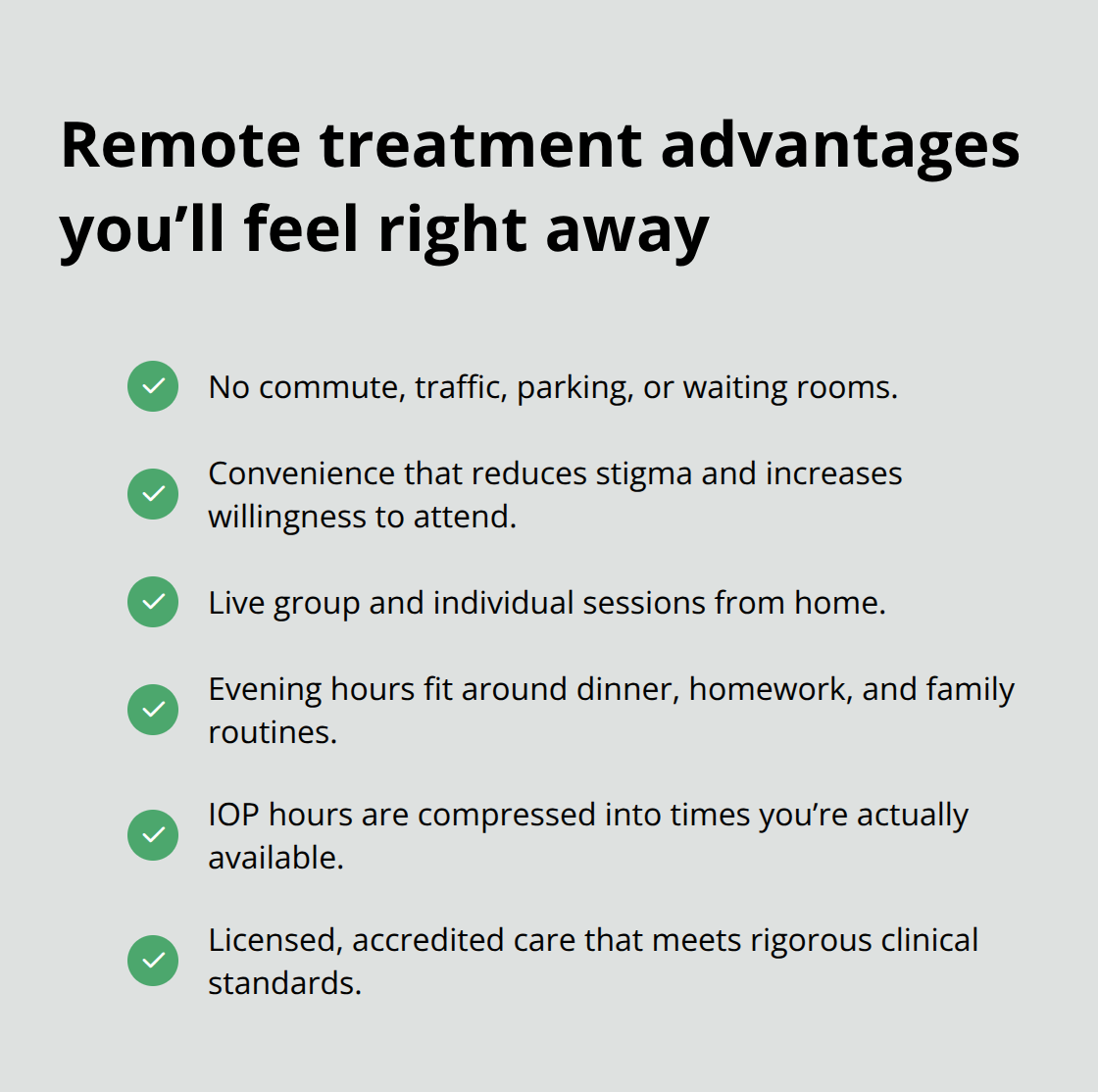
Your family responsibilities continue while you’re in treatment, and remote care respects that reality. You complete evening sessions and still manage dinner, homework help, or household tasks before or after your appointment. Intensive outpatient programs traditionally require 9 to 20 hours weekly of clinical time, but remote delivery compresses that commitment into evening hours when you’re actually available. The flexibility allows recovery to fit into your life rather than forcing you to choose between family and sobriety.
EveningIOP maintains DHCS licensing, Joint Commission accreditation, and LegitScript certification, which means the clinical care you receive meets rigorous standards whether you attend in person or remotely. Licensed clinicians conduct your sessions, your treatment plan follows evidence-based protocols, and your progress receives the same clinical monitoring as traditional programs. You gain both flexibility and quality without sacrificing the clinical foundation that supports sustained recovery.