


Addiction treatment shouldn’t force you to choose between recovery and your career. At EveningIOP, we built our program around the reality that most people can’t step away from work or family responsibilities for weeks.
Evening IOP schedule flexibility means you get clinical-grade treatment on your timeline, not ours. Sessions fit around your job, your kids, and your life.
Why Evening Programs Work for Working Professionals
Treatment That Fits Your Job, Not the Other Way Around
Treatment that demands you take weeks off work isn’t realistic for most people. The U.S. Bureau of Labor Statistics reports that the average full-time worker spends over 40 hours per week at their job, and many professionals work longer. Stepping away for inpatient or daytime programs means lost income, missed deadlines, and potential damage to your career trajectory. Evening IOP removes this false choice. Sessions happen after work hours, so you clock in, do your job, and then show up for treatment when your workday ends.
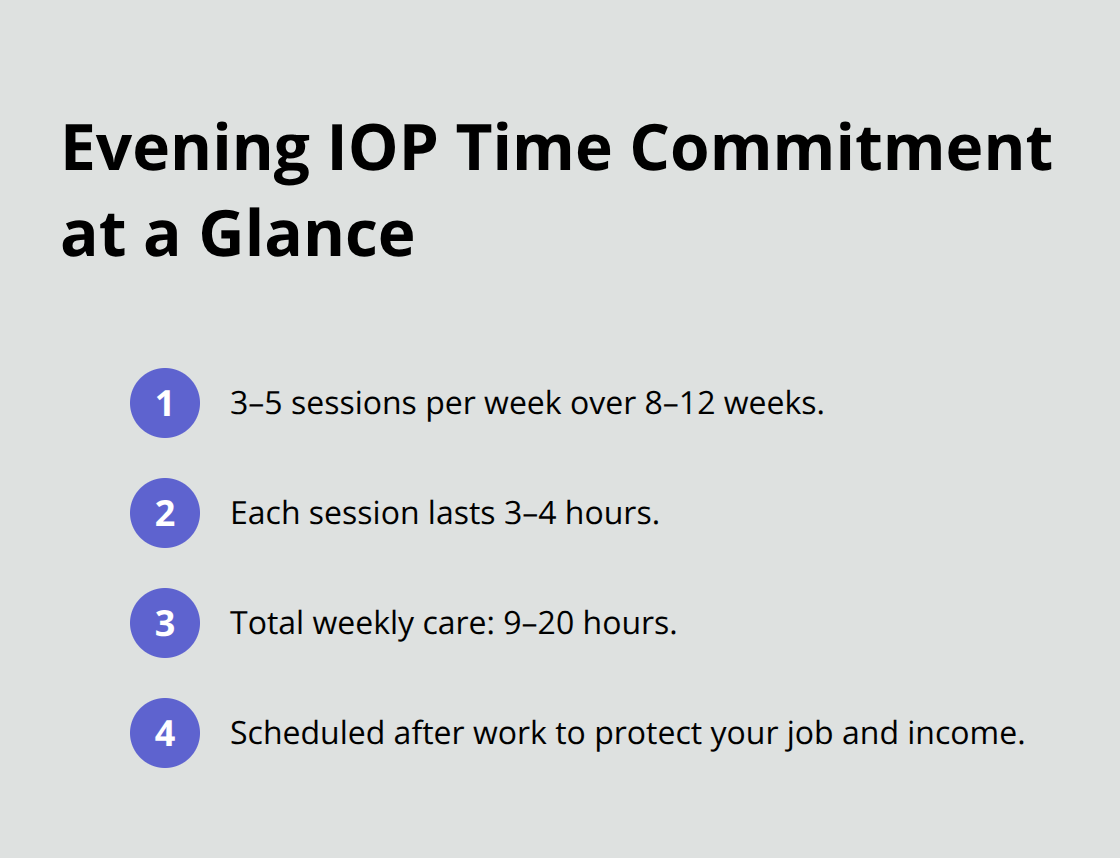
This isn’t about cutting corners on clinical intensity. Evidence-based therapies-cognitive behavioral therapy, dialectical behavior therapy, and group process work-deliver the same clinical power whether they happen during the day or evening. Research on treatment engagement shows that people stay in programs longer when scheduling fits their life. A typical evening IOP runs three to five days per week for about eight to twelve weeks, with sessions lasting three to four hours. That structure delivers 9 to 20 hours of weekly care while keeping your employment intact.
Parenting and Recovery Don’t Have to Conflict
Parents face an even sharper conflict. Daytime treatment means arranging childcare, disrupting school pickups, and potentially triggering questions from employers about frequent absences. Evening sessions let you manage your parenting responsibilities during the day and attend treatment after kids are in bed or supervised by a partner. You maintain the routines your family depends on while still getting the intensive support you need.
The same logic applies to students. Evening programs mean you finish classes, attend treatment, and maintain your academic progress without derailing your degree. Your recovery doesn’t pause your education or your career-it runs alongside both.
Accountability Without the Logistical Burden
Remote drug and alcohol testing removes another barrier. Instead of traveling to a testing facility during work hours, you complete tests from home or your office, on your schedule. This practical flexibility doesn’t compromise accountability. The clinical team still monitors your progress through standardized outcome measures and regular check-ins with your therapist.
You receive intensive, structured care-group therapy sessions where you build peer support, individual counseling to address your specific challenges, and medication management if needed-all timed around your actual life. That alignment between treatment and reality is what makes people stick with recovery instead of abandoning it halfway through. When your program works with your schedule rather than against it, you show up consistently, engage fully, and build the foundation for lasting change.
How Evening IOP Adapts to Your Schedule
Sessions Built Around Your Work Hours
Your evening IOP isn’t a watered-down version of daytime treatment crammed into after-work hours. Evening programs structure sessions across three to five days per week, with each session running three to four hours. That totals 9 to 20 hours of weekly care, matching the intensity standards that make IOPs clinically effective. Sessions run in the evening specifically because that’s when working professionals and parents can actually show up. A typical evening session might run from 6:00 PM to 9:00 PM, giving you time to finish work, grab dinner, and arrive ready to engage. The actual timing depends on your job and responsibilities, which is why customization matters. If you work retail with evening shifts, morning sessions may work better. If you’re in corporate work, evenings make sense. Treatment providers build the schedule around your reality, not around institutional convenience.
Group Therapy With People Who Understand Your Life
Group therapy forms the backbone of your treatment, and evening groups work differently than daytime ones. You sit with other professionals, parents, and working adults who face identical conflicts between recovery and employment. That peer group understands your pressures because they live them. Studies on group therapy outcomes show that peer support reduces isolation and increases treatment adherence, particularly when group members share similar life circumstances. The shared experience of balancing work stress, family obligations, and recovery creates a foundation for genuine connection. You’re not sitting in a room with people whose schedules and pressures look nothing like yours-you’re with people navigating the same tensions.
One-on-One Work That Addresses Your Specific Challenges
Individual sessions with a licensed clinician happen one-on-one, typically weekly, addressing your specific triggers, trauma history, and recovery goals. This combination prevents the trap where you only talk about work stress in group but never develop personalized coping strategies. Your therapist works with you to identify patterns unique to your situation and builds practical tools you can use immediately. The group work builds community and accountability; the individual work builds your personal recovery plan.
Remote Testing That Removes Logistical Barriers
Remote drug and alcohol testing removes the logistical nightmare of traveling to a facility during business hours. You complete tests from home or your office using a platform designed for convenience, with results tracked by your clinical team. This flexibility doesn’t sacrifice accountability. Standardized outcome measures track your progress throughout treatment, and your therapist reviews them regularly to adjust your plan if needed.
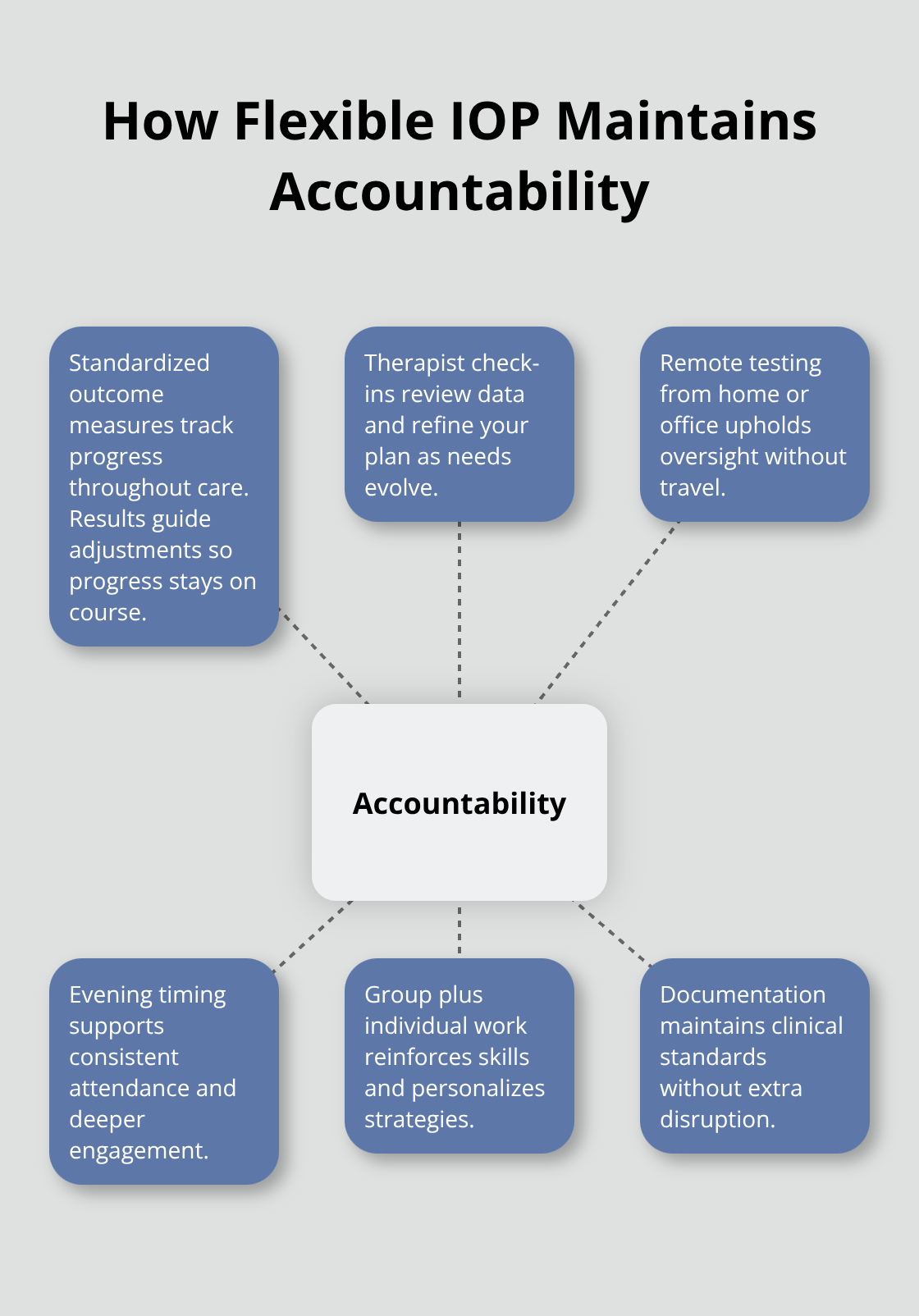
The entire structure-evening timing, group plus individual work, remote testing-exists because treatment providers refuse to pretend that people can magically step away from their lives to recover. When you move into the real-world success stories of people who’ve actually stayed in their jobs and maintained their families while completing treatment, you’ll see how this flexibility translates into lasting results.
Real-World Success With Flexible Treatment
Healthcare Professionals Who Maintained Their Careers
Evening IOP effectiveness shows up in treatment completion rates. People working full-time jobs finish evening programs at higher rates than their daytime counterparts because the schedule removes the barrier between treatment and real life. A healthcare administrator managing a team of fifteen people attended evening sessions three times per week for ten weeks while maintaining her position and salary. She handled work crises during lunch breaks, clocked out at 5:00 PM, and arrived at treatment by 6:00 PM. Her employer never learned she was in a program. The clinical outcomes matched inpatient-level intensity because she engaged fully in group therapy with other professionals facing identical workplace pressures, worked one-on-one with her therapist on stress management specific to her role, and completed remote drug testing from her home office without disrupting her schedule.
Parents Balancing Recovery and Family Care
Single parents report similar success with evening programs. A single father of two attended evening sessions four days per week while his kids finished homework with a babysitter, then returned home by 9:30 PM for bedtime routines. He maintained custody, kept his job as a warehouse supervisor, and completed the full program without his children experiencing the trauma of parental absence. Evening timing meant he stayed present for the routines his family depended on while still receiving intensive clinical support. His treatment intensity never wavered-only the clock changed.
Students Continuing Their Education
Students finishing degrees in the evening also stay enrolled longer in treatment. Evening programs align with class schedules, allowing someone to attend lectures until 5:00 PM and treatment from 6:00 PM to 9:00 PM without academic disruption. The data on treatment completion rates consistently shows that when people maintain their existing responsibilities, they invest more fully in recovery work.
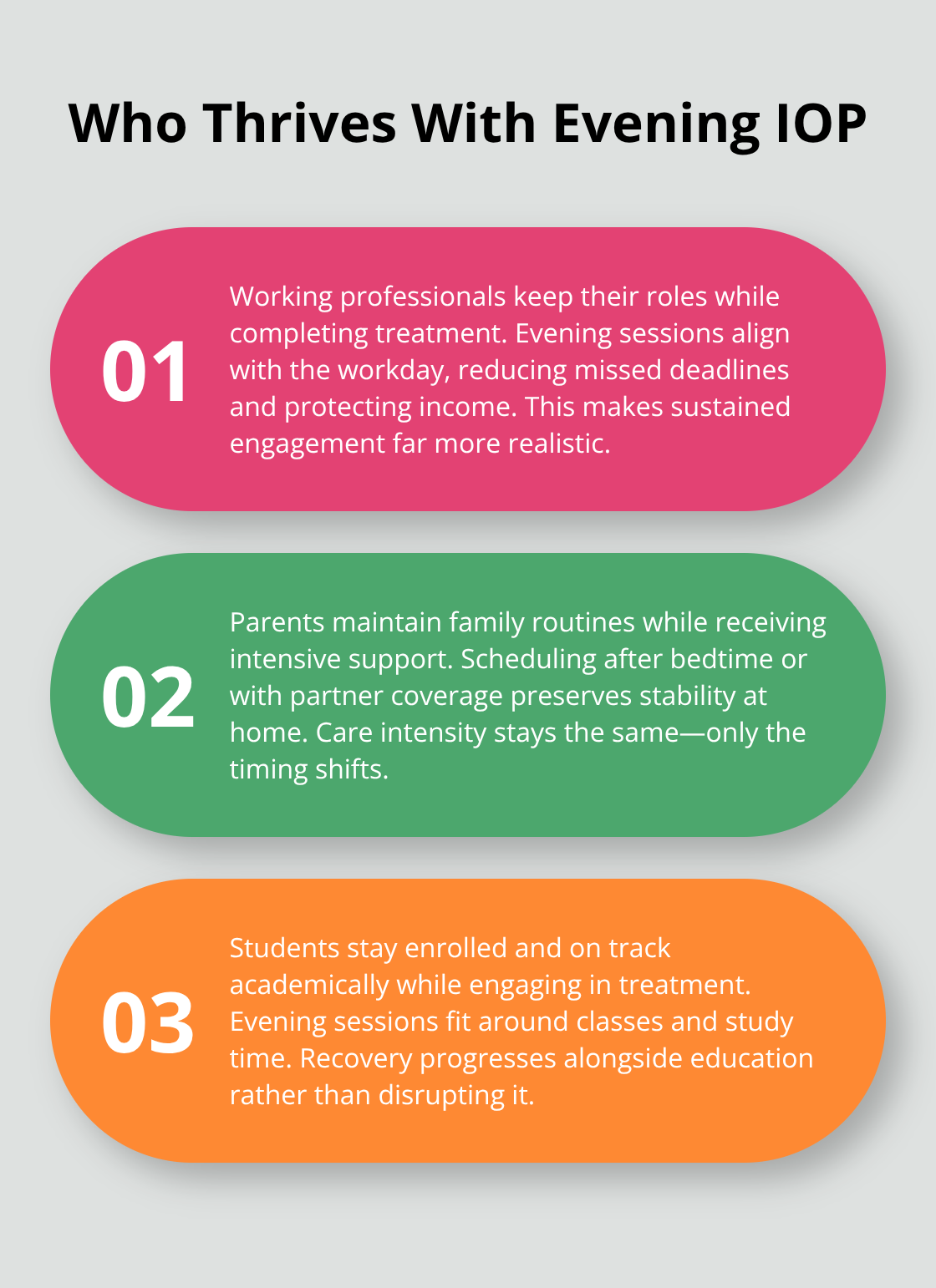
This pattern holds across professions and life stages because the underlying principle remains constant: people show up when treatment fits their actual lives.
Why Timing Matters More Than Traditional Programs Acknowledged
Evening IOP removes the false choice that treatment requires sacrificing everything else. The intensity stays intact, the evidence-based therapies remain unchanged, and the clinical structure holds firm. What shifts is only the timing, which turns out to matter far more than traditional programs ever acknowledged. When people can maintain their existing responsibilities (work, school, parenting), they invest more fully in recovery work rather than fighting logistical battles just to attend sessions.
Final Thoughts
The scheduling barrier to recovery has always been artificial. Treatment programs built their daytime schedules around institutional convenience, not around the lives of the people seeking help. Evening IOP schedule flexibility changes that equation entirely-you no longer have to choose between your paycheck and your recovery, between your job and your family, or between your education and your health. The clinical intensity remains unchanged, the evidence-based therapies stay the same, and what shifts is only the timing.
We at EveningIOP deliver clinically effective care through live telehealth group therapy, one-on-one sessions with licensed clinicians, and remote drug and alcohol testing that adapts to your actual schedule. That flexibility isn’t a compromise on quality; it’s the recognition that people recover better when treatment fits their lives rather than demanding they abandon everything to fit treatment. Your recovery doesn’t require sacrificing your career, your parenting, or your education-it requires a program willing to work around your reality instead of forcing you to work around its schedule.
Start your recovery journey with EveningIOP on your terms, at a time that actually works for you.