
You’re working full-time and managing family responsibilities. The thought of taking weeks off work for treatment feels impossible, which is why many professionals never seek the help they need.
An evening IOP near me changes that equation. At EveningIOP, we’ve built programs specifically designed so you can get clinical treatment while keeping your career and personal life intact. This guide walks you through finding and evaluating the right evening program for your situation.
Why Evening Treatment Works for Working Professionals
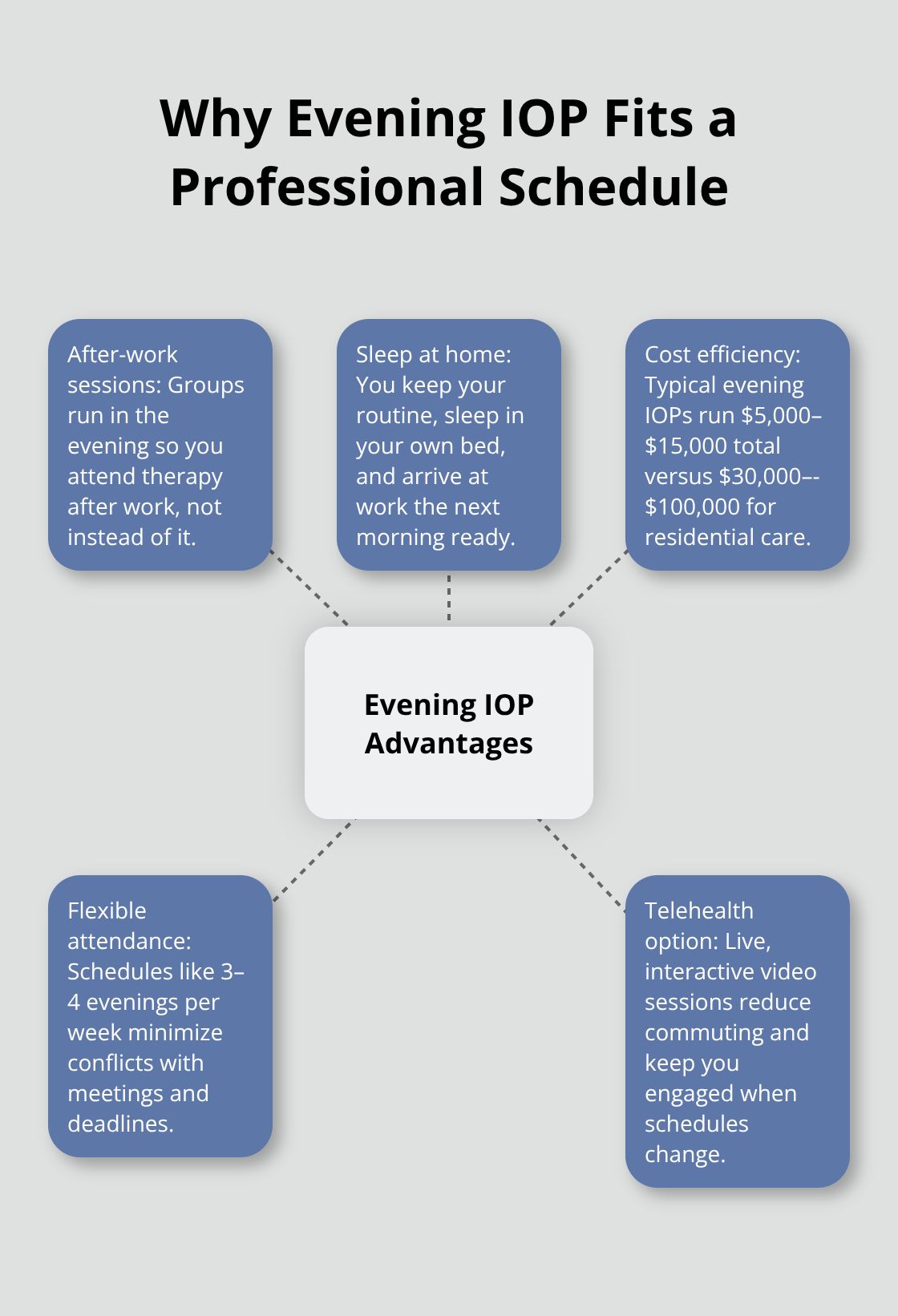
Intensive outpatient programs running 9–15 hours per week have become the standard for professionals who refuse to pause their careers for recovery. The structure matters more than the volume of hours. When sessions land between 5:30 and 8:30 p.m., you attend group therapy after work, not instead of it. You sleep in your own bed, manage your own schedule, and show up to your job the next morning. This is fundamentally different from residential treatment, which costs $30,000–$100,000 for 30–90 days and pulls you out of your life entirely. Evening IOPs typically run $5,000–$15,000 total, with insurance covering most of the cost for people with active plans. That math alone makes evening programs the practical choice for anyone still employed or managing family obligations.
Treatment That Fits Your Work Schedule
The timing of evening sessions solves a problem that stops most professionals from seeking help. You attend a DBT skills group at 6:30 p.m., discuss emotion regulation strategies with licensed clinicians, and return home by 8:30 p.m. to handle family dinner or catch up on work emails. Three or four evenings per week means you miss no client meetings, no presentations, no performance reviews. Outpatient centers have expanded significantly in the mental health and addiction treatment market, reflecting a real shift away from the all-or-nothing model.
Telehealth Removes Additional Barriers
Telehealth amplifies this flexibility significantly. Live, interactive group sessions delivered online let you participate from home if travel time or scheduling conflicts arise. You receive the same licensed clinicians, the same evidence-based therapies like CBT and DBT, without commuting to a physical location on nights when your schedule tightens. This option proves especially valuable for professionals in rural areas or those with unpredictable work demands.
Clinical Results Don’t Require Residential Settings
The assumption that serious treatment requires leaving your life behind is wrong. Intensive outpatient care produces measurable results for anxiety, depression, PTSD, bipolar disorder, and substance use disorders when delivered by qualified staff using proven methods. Joint Commission accreditation confirms a program meets clinical standards for safety, staffing, and therapeutic quality. Licensed clinicians with master’s degrees in counseling or social work deliver the core groups. One-on-one sessions with psychiatrists or therapists address your specific history and medication needs. Remote drug testing, when included, maintains accountability without requiring office visits.
The evening IOP model works because it respects your reality: you have a job, a family, and real responsibilities. Recovery happens inside that context, not outside it. Understanding what separates a quality program from a mediocre one becomes your next priority.
What Makes a Program Worth Your Time
Verify Licensing and Accreditation First
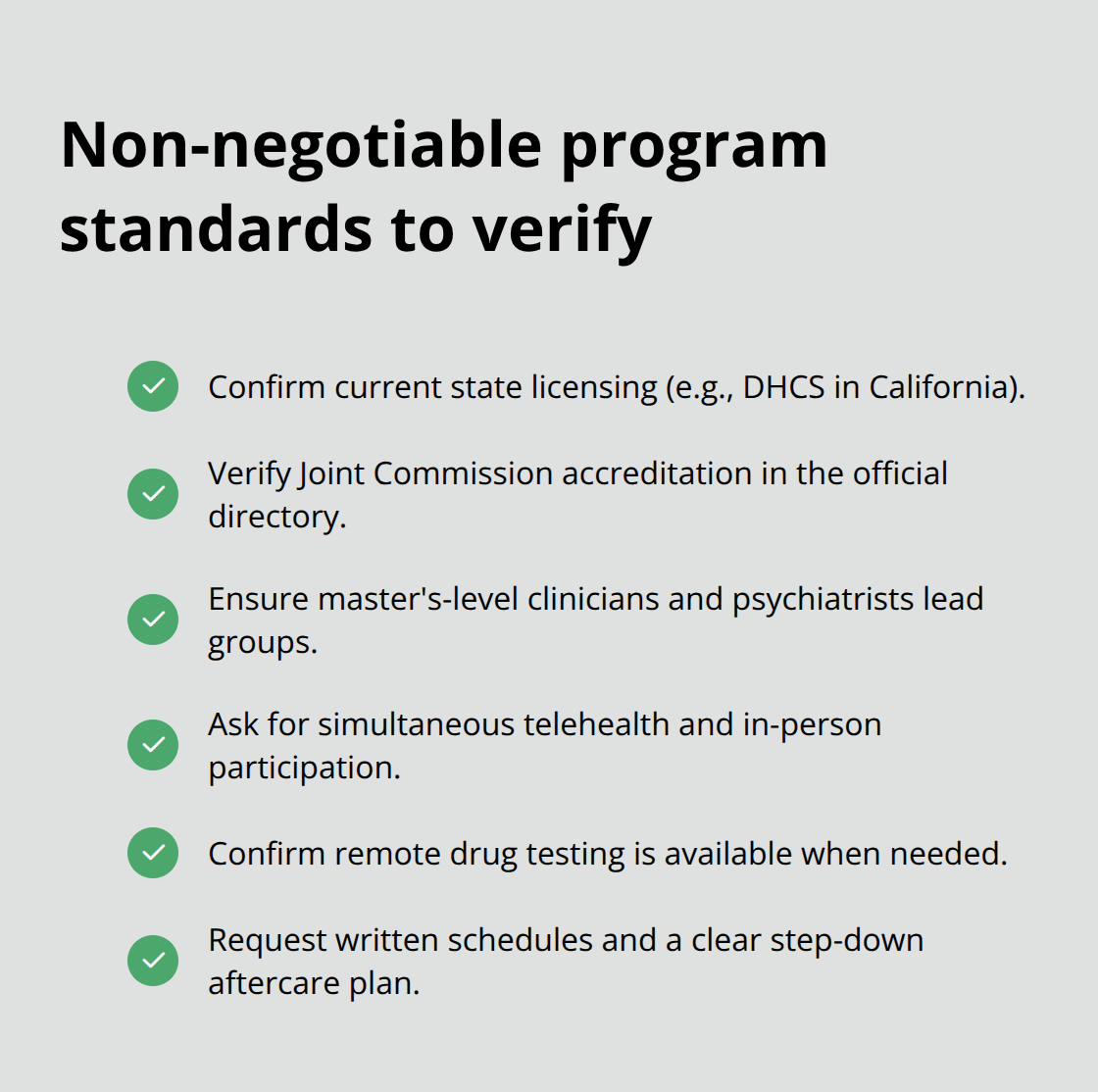
Accreditation and licensing matter far more than program marketing or slick websites. Start with state licensing-specifically DHCS certification in California or your state’s equivalent regulatory body. Joint Commission accreditation functions as the gold standard; it signals that a program meets established clinical standards for safety, staffing qualifications, and therapeutic quality. You can verify Joint Commission status directly on The Joint Commission website by searching the program name. DHCS licensing confirms the program operates legally and has passed basic compliance checks. Both credentials together tell you the program has been inspected and maintains ongoing accountability. Programs without these credentials, regardless of their reputation online, carry unnecessary risk.
Confirm Your Clinicians Hold Real Licenses
Licensed clinicians delivering treatment represent your second checkpoint. Master’s-level therapists, licensed professional counselors (LPCs), licensed clinical social workers (LCSWs), and psychiatrists with prescribing authority form the backbone of legitimate evening IOPs. Group therapy sessions must include clinicians with these credentials, not peer counselors or unlicensed facilitators running the core clinical work. When you call a program for information, ask directly: What licenses do your group therapists hold? How many master’s-level clinicians staff evening sessions? Programs that dodge these questions or emphasize peer support as a substitute for clinical leadership warrant skepticism.
Prioritize Telehealth and Remote Testing Capabilities
Telehealth delivery and remote drug testing capabilities separate programs built for actual professionals from those offering outdated models. Telehealth sessions must be live and interactive-not pre-recorded videos or asynchronous messaging. Real-time group therapy with licensed clinicians over video produces the same clinical outcomes as in-person sessions according to research. Remote drug testing removes logistical friction; you test from home rather than traveling to an office, which matters when your schedule shifts unexpectedly. Ask whether the program offers both options simultaneously-some participants attending in-person while others join virtually from the same session-because this flexibility often determines whether you can sustain attendance through completion.
Evidence-Based Therapies and Customized Treatment
Licensed clinicians using evidence-based therapies like CBT and DBT represent the clinical floor, not the ceiling. Programs should articulate how they customize treatment for your specific diagnosis and history, not deliver identical protocols to every participant. The combination of proper licensing, qualified staff, and modern delivery infrastructure separates programs that produce results from those that simply occupy your evening hours. When you contact any program, verify these elements exist before discussing costs or scheduling. Programs offering only in-person evening sessions in a single location cannot accommodate the reality of professional life-travel delays, unexpected meetings, and schedule changes happen. Telehealth availability transforms an evening program from rigid to genuinely flexible.
With these evaluation criteria in place, you’re ready to search for actual programs in your area and compare what each one offers against these standards.
Finding Evening IOP Programs That Meet Your Standards
Start Your Search with Official Treatment Locators
The SAMHSA Behavioral Health Treatment Services Locator filters by location, insurance acceptance, and treatment type. Search for evening IOP specifically rather than general outpatient programs, since many centers don’t advertise their evening schedules prominently. When you enter your zip code, you’ll see dozens of results. Most won’t match your actual needs. Narrow immediately by checking state licensing status. In California, DHCS licensure is non-negotiable. In other states, verify your equivalent licensing body has issued current credentials to the program. This single step eliminates programs operating outside regulatory oversight.
Verify Accreditation and Licensing Status
Cross-reference any program against The Joint Commission accreditation directory on their website. Joint Commission accreditation costs money and requires ongoing compliance inspections, so programs that maintain it demonstrate serious commitment to clinical standards. If a program claims accreditation but doesn’t appear in the official directory, that’s a red flag worth investigating further. You’re not being paranoid; you’re being professional about where you spend your time and money.
Confirm Clinician Credentials and Staffing
Once you’ve narrowed to programs with proper licensing and accreditation, request their current staffing roster and ask specifically about clinician licenses. Licensed clinical social workers, licensed professional counselors, and board-certified psychiatrists should staff evening groups. When you call, the intake coordinator should answer without hesitation. If they’re vague or redirect to marketing language, move on. Real programs have this information ready.
Compare Session Structure and Telehealth Options
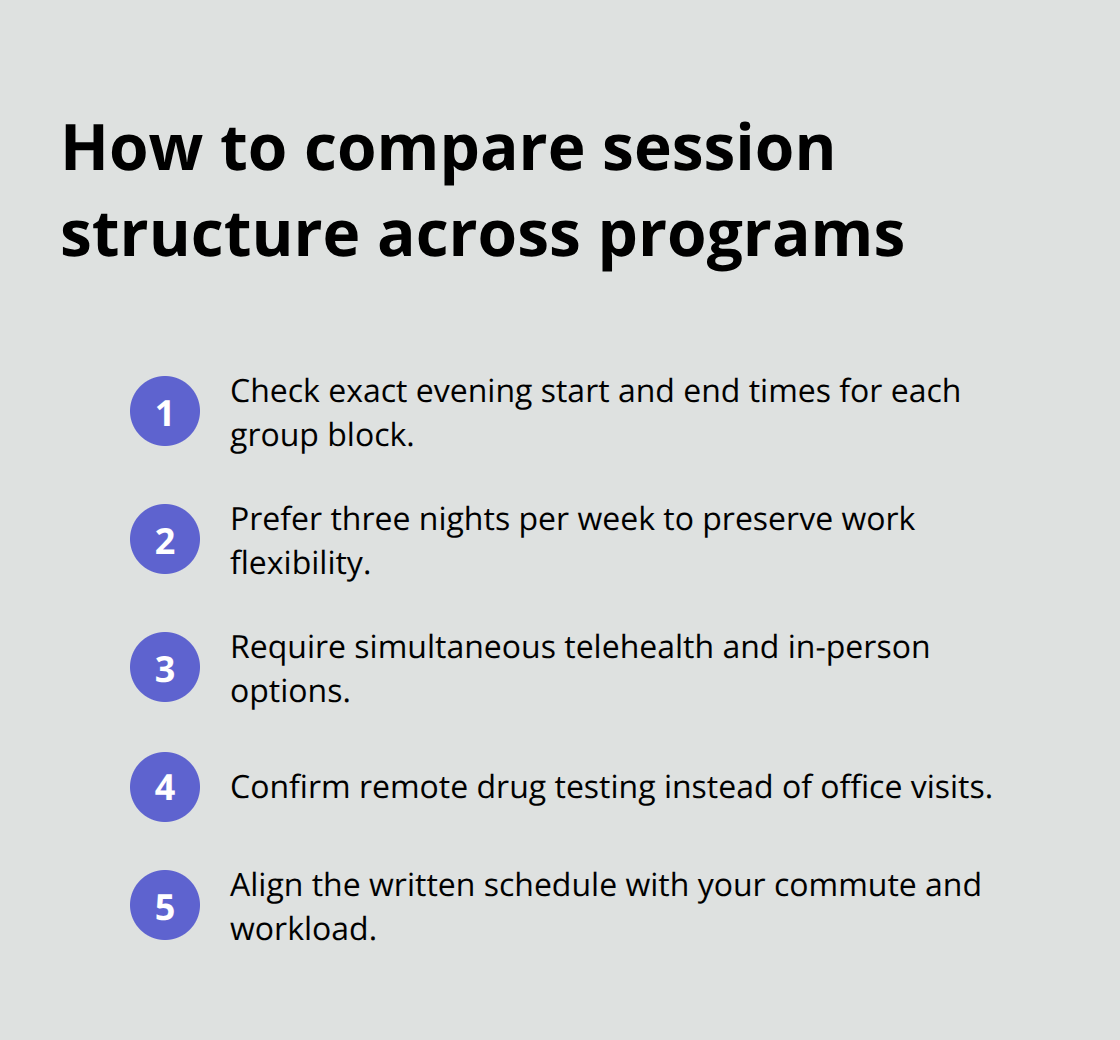
Compare the actual session structure across your shortlist. Some programs run three evening groups back-to-back from 5:30 to 8:30 p.m., while others spread sessions across multiple nights. Three nights per week works better than five for most professionals because it preserves flexibility for unexpected work demands. Ask whether each program offers telehealth participation simultaneously with in-person attendance. Programs that force you to choose between remote and in-person attendance lack real operational sophistication. Verify whether they conduct remote drug testing or require office visits, since travel to a testing facility defeats the purpose of evening scheduling.
Request Written Schedules and Aftercare Plans
Request a written schedule before committing. A program that can’t provide exact session times and content topics in writing is hiding something. You need to know whether evening means 5:30 p.m., 6:00 p.m., or 7:00 p.m., and whether that timing actually works with your commute and work schedule. Finally, ask about their step-down plan. Quality programs explain how you transition from evening IOP to standard outpatient therapy or aftercare, not how they keep you enrolled indefinitely. This forward-looking conversation separates programs designed for your recovery from those designed for consistent revenue.
Final Thoughts
Evening IOPs provide real solutions for professionals who refuse to choose between recovery and their careers. The programs that work share three non-negotiable qualities: proper state licensing and Joint Commission accreditation, licensed clinicians delivering evidence-based therapies, and telehealth capabilities that adapt to your actual schedule. These standards separate legitimate treatment from programs that simply occupy your evening hours without producing results.
When you search for an evening IOP near me, you’re looking for a program that respects your reality as a working professional. That means verifying DHCS licensing in California or your state’s equivalent, confirming Joint Commission accreditation through official directories, and requesting staffing rosters that list licensed clinical social workers, licensed professional counselors, and psychiatrists. It means asking whether telehealth participation works simultaneously with in-person attendance and whether remote drug testing eliminates unnecessary office visits.
The programs worth your time answer these questions directly and without hesitation. They don’t hide behind marketing language or vague promises. EveningIOP delivers live, telehealth evening Intensive Outpatient Programs that combine interactive online group therapy, one-on-one sessions with licensed clinicians, and remote drug testing-all designed so you pursue recovery without disrupting work or family responsibilities.