

Recovery shouldn’t force you to choose between treatment and your responsibilities. At EveningIOP, we built family-friendly recovery evenings specifically for working professionals and parents who need flexibility without compromise.
Your career, your kids’ schedules, and your recovery can coexist. This guide shows how evening intensive outpatient programs actually work with your life instead of against it.
Why Evening Programs Work for Working Families
Treatment schedules that demand daytime availability are outdated. According to the Bureau of Labor Statistics, roughly 29 percent of workers are on the clock at 7 a.m., and many more juggle unpredictable schedules that make traditional 9-to-5 treatment impossible. Standard daytime programs force an impossible choice: sacrifice your job or skip recovery. Evening intensive outpatient programs eliminate that false choice entirely.
Professionals and parents don’t need permission to take months off work. They need treatment that respects their reality. When recovery happens in the evening, you attend group therapy and clinical sessions after your workday ends, keeping your paycheck intact and your employment stable. The National Institute on Alcohol Abuse and Alcoholism reports that medical costs associated with untreated substance use disorders have been estimated at more than $120 billion annually. Staying employed during treatment prevents that financial spiral before it starts.
Evening Programs Protect Your Career Trajectory
Daytime treatment creates a visible gap in your work history that employers notice. Taking extended leave signals instability, even when recovery is the reason. Evening programs let you show up to your job consistently, maintain professional relationships, and keep your income flowing. A person attending evening sessions at 6 PM doesn’t need to explain absences to their boss or risk promotion delays. Your employer may never know you’re in treatment.
For parents, evening programs align perfectly with school schedules. Your kids go to school, you go to work, and treatment happens after 5 PM when childcare logistics are simpler. You avoid pulling children from school early or scrambling for emergency babysitters. Single parents especially benefit because evening flexibility means less disruption to custody arrangements and fewer scheduling conflicts that could trigger family tension during an already vulnerable recovery period.
Clinical Care Meets Your Schedule
Evening doesn’t mean less intensive or lower-quality treatment. Evening intensive outpatient programs combine live, telehealth group therapy, one-on-one sessions with licensed clinicians, and remote drug and alcohol testing in the same clinical framework as daytime programs. Accreditation and licensing confirm that evening-delivered care meets the same clinical standards. You receive the same evidence-based therapies, the same accountability through testing, and the same professional supervision, just scheduled when your life actually permits it.
This flexibility matters because recovery succeeds when treatment fits your schedule, not the other way around. The next section explains what actually happens during evening sessions and how telehealth removes additional barriers that working families face.
How Telehealth Evening Programs Remove Barriers to Treatment Access
Logistics Stop Families From Starting Recovery
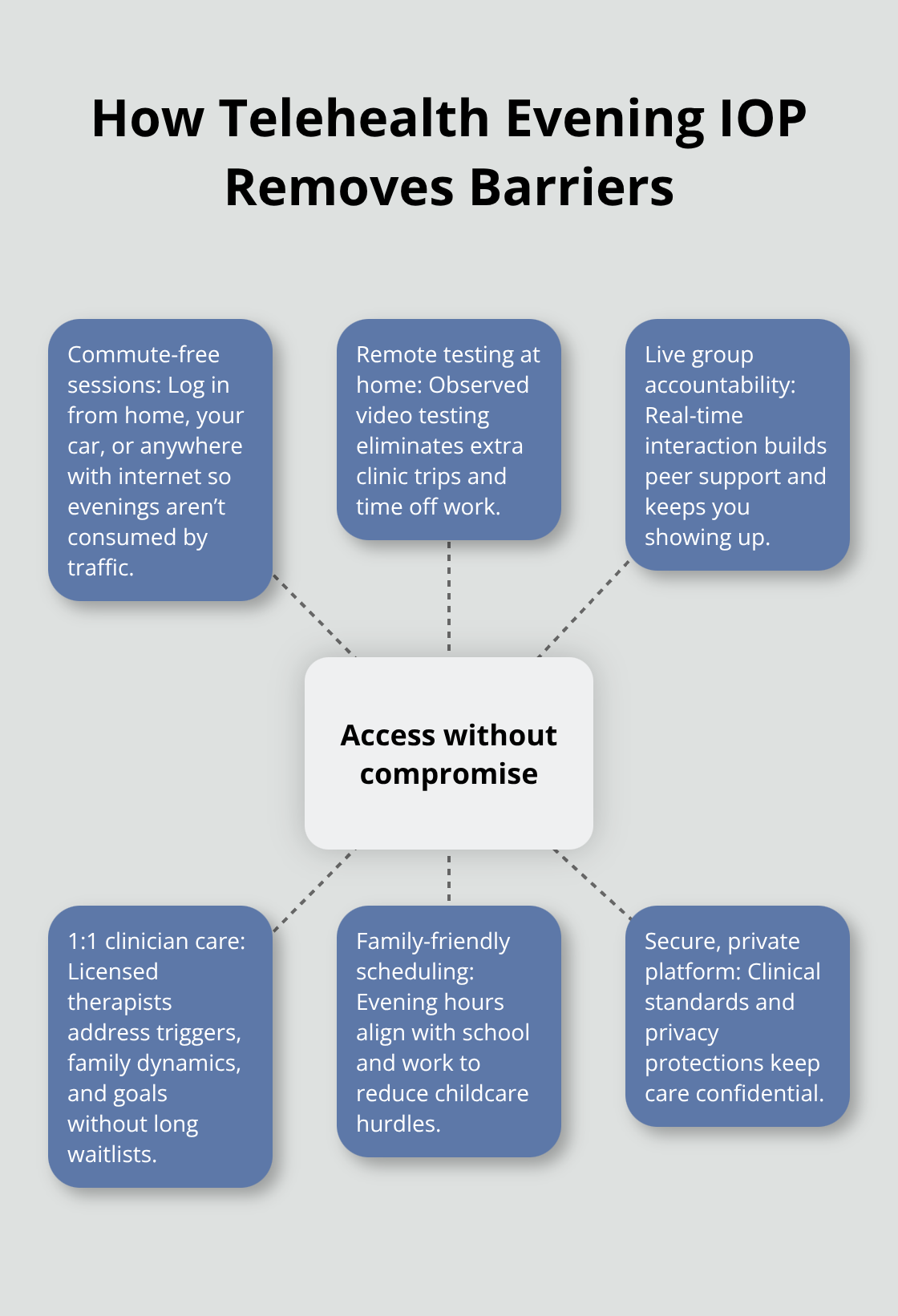
Telehealth evening programs eliminate the friction that prevents working families from accessing care. Instead of commuting to a physical location after work, you log in from home, your car, or anywhere with an internet connection. This removes travel time that would otherwise consume evening hours already compressed by work and family obligations. For a parent managing school pickup, dinner, and homework, those minutes shift the entire equation. You attend group therapy and clinical sessions without the exhaustion of driving across town in rush-hour traffic.
Remote drug and alcohol testing happens at home through observed video sessions, eliminating another appointment that would require time off or scheduling gymnastics around clinical visits. Treatment no longer demands that you rearrange your entire life to fit a clinic’s calendar.
Interactive Group Therapy Builds Real Community
Telehealth group therapy delivered live creates genuine community, not a watered-down substitute. Licensed clinicians facilitate sessions where you practice concrete coping skills alongside peers facing identical challenges. The check-in circle with a feelings wheel, thought-trigger-action drills using cognitive-behavioral techniques, and relapse prevention workshops with HALT training all happen in real time with real accountability.
These aren’t recorded videos or asynchronous modules. You interact with other people in recovery, share experiences, and build the peer support network that research shows strengthens long-term sobriety. The accountability that comes from showing up to a live group session-even from your living room-matches the accountability of sitting in a physical room.
One-on-One Clinical Care Addresses Your Specific Needs
Licensed clinicians conduct one-on-one sessions that address your specific triggers, family dynamics, and recovery goals without the delay of waiting weeks for an opening at an in-person clinic. Telehealth doesn’t reduce clinical intensity; it removes the excuse that logistics prevent you from showing up. Families who would never find childcare for evening appointments or who live 45 minutes from the nearest treatment center now access the same evidence-based care that daytime patients receive.
Higher completion rates follow because treatment becomes feasible, not aspirational. When the barrier to entry disappears, people actually start recovery instead of postponing it indefinitely. What happens during those evening sessions-the specific therapies, the structure, and the clinical tools you’ll use-determines whether you build lasting recovery skills or simply show up and go through motions.
What Evening IOP Actually Looks Like
An evening intensive outpatient program runs three to five nights per week, typically between 5 PM and 8 PM, with sessions lasting two to three hours. You log in from home at a scheduled time and attend live group therapy facilitated by a licensed clinician, participate in skill-building activities, and complete one-on-one sessions with your assigned therapist during the same evening window. The structure remains consistent week to week, which matters because predictability helps you plan around work and family obligations without surprises.
How Sessions Build Your Recovery Toolkit
One night focuses on cognitive-behavioral coping skills where you practice replacing automatic thoughts that trigger substance use with planned responses. Another night covers relapse prevention by identifying your specific triggers in four categories: people, places, things, and feelings. You learn HALT, a practical tool to recognize when you’re hungry, angry, lonely, or tired, because these states weaken your defenses.
A third night builds accountability through values alignment, where you map your weekly actions against what actually matters to you and receive feedback from peers and clinicians. The check-in circle with a feelings wheel helps you name emotions accurately rather than numb them, a skill that prevents relapse when emotional intensity hits hard. Mindfulness and breathwork sessions teach box breathing and the 4-7-8 technique for stress management you can use the same evening you learn it.
Between sessions, you complete homework assignments that reinforce what you practiced in group, such as journaling triggers or documenting coping attempts. This isn’t passive attendance; you actively build a recovery toolkit with concrete tools you apply immediately.
Remote Testing Removes Logistical Friction
Remote drug and alcohol testing happens through observed video sessions where a technician watches you provide a sample from home, eliminating the need to find childcare or take time off work for a clinic visit. Testing frequency varies based on your treatment plan, typically weekly early in recovery, then less frequently as you demonstrate stability. You receive results quickly, usually within 24 hours, so you and your clinician address positive results or discuss progress during your next one-on-one session without delay.
One-on-One Sessions Address Your Unique Needs
Licensed clinicians conduct individual sessions separate from group to address family dynamics, past trauma, co-occurring mental health conditions, and personalized recovery goals that don’t fit a group setting. These sessions happen during evening hours, so you’re not scrambling to find time during business hours. One-on-one clinicians also coordinate with your primary care doctor or psychiatrist if you’re on medication, ensuring your treatment plan is comprehensive rather than siloed.
The entire program operates through a secure telehealth platform, so your privacy remains protected and your employer never knows you’re in treatment unless you tell them. EveningIOP is DHCS-licensed, Joint Commission-accredited, and LegitScript-certified, meaning you receive clinically effective care that meets rigorous safety and quality standards, delivered when you actually have time to show up.
Final Thoughts
Recovery works when treatment fits your life, not when your life bends around treatment schedules. Evening intensive outpatient programs succeed because they respect the reality that you have a job, a family, and responsibilities that don’t pause for recovery. The clinical quality doesn’t change because sessions happen at 6 PM instead of 9 AM-what changes is feasibility, and you show up because showing up is actually possible.
Family-friendly recovery evenings remove the false choice between your career and your sobriety. You maintain employment, keep your income stable, and avoid the employment gaps that signal instability to future employers. Your kids stay in their schools, their routines remain intact, and you’re present for homework and dinner instead of explaining why you need to take months off work.
We at EveningIOP combine live group therapy, one-on-one clinical sessions, and remote drug testing in a telehealth format designed for working professionals and families. You build recovery skills without sacrificing your paycheck or your family’s stability, and that alignment between treatment and real life is what makes recovery sustainable.