


Substance use recovery works best when you’re not alone. Evening group therapy online removes the excuse that work or family obligations prevent you from getting help.
At EveningIOP, we’ve built our programs around the reality of your schedule. You’ll find real connection, accountability, and evidence-based treatment in sessions designed for people who need flexibility.
How Evening Group Therapy Actually Works
Live video sessions connect you with licensed clinicians and peers in real time-not through pre-recorded modules or asynchronous messaging. When you join, you sit in a virtual room with a licensed mental health professional and typically 6 to 12 other participants, all connecting from private spaces in their homes. Research shows that online groups achieve strong attendance rates compared to traditional in-person formats, largely because evening scheduling eliminates transportation barriers and childcare conflicts that derail recovery for working parents and professionals. The licensed clinician facilitates conversation, manages group dynamics, and applies evidence-based therapies like cognitive behavioral therapy, motivational interviewing, or dialectical behavior therapy depending on your group’s focus. You speak directly to the facilitator and other members, share your experiences, and receive real feedback within the same session. This is interactive treatment where your voice matters and your progress gets tracked.
What Happens During Your Session
Each session follows a structured format that keeps the group focused and productive. The facilitator opens with a brief check-in, introduces the evening’s topic or skill, and then guides discussion where members practice new coping strategies or process their week. Facilitators use practical techniques to maintain engagement: they call on quieter members directly, use the chat function for members who prefer written input, and employ breakout rooms for smaller peer discussions when the group is larger. One study comparing online and in-person dialectical behavior therapy groups found that facilitators and participants reported similar learning outcomes, meaning the skills you gain are just as solid whether you’re in a physical room or joining from home. Sessions typically run 60 to 90 minutes and meet weekly, creating consistency that builds accountability. Between sessions, many programs offer additional support through secure messaging with your clinician or peer coaching, so you address a crisis or breakthrough without waiting an entire week.
Why the Evening Timing Works for Recovery
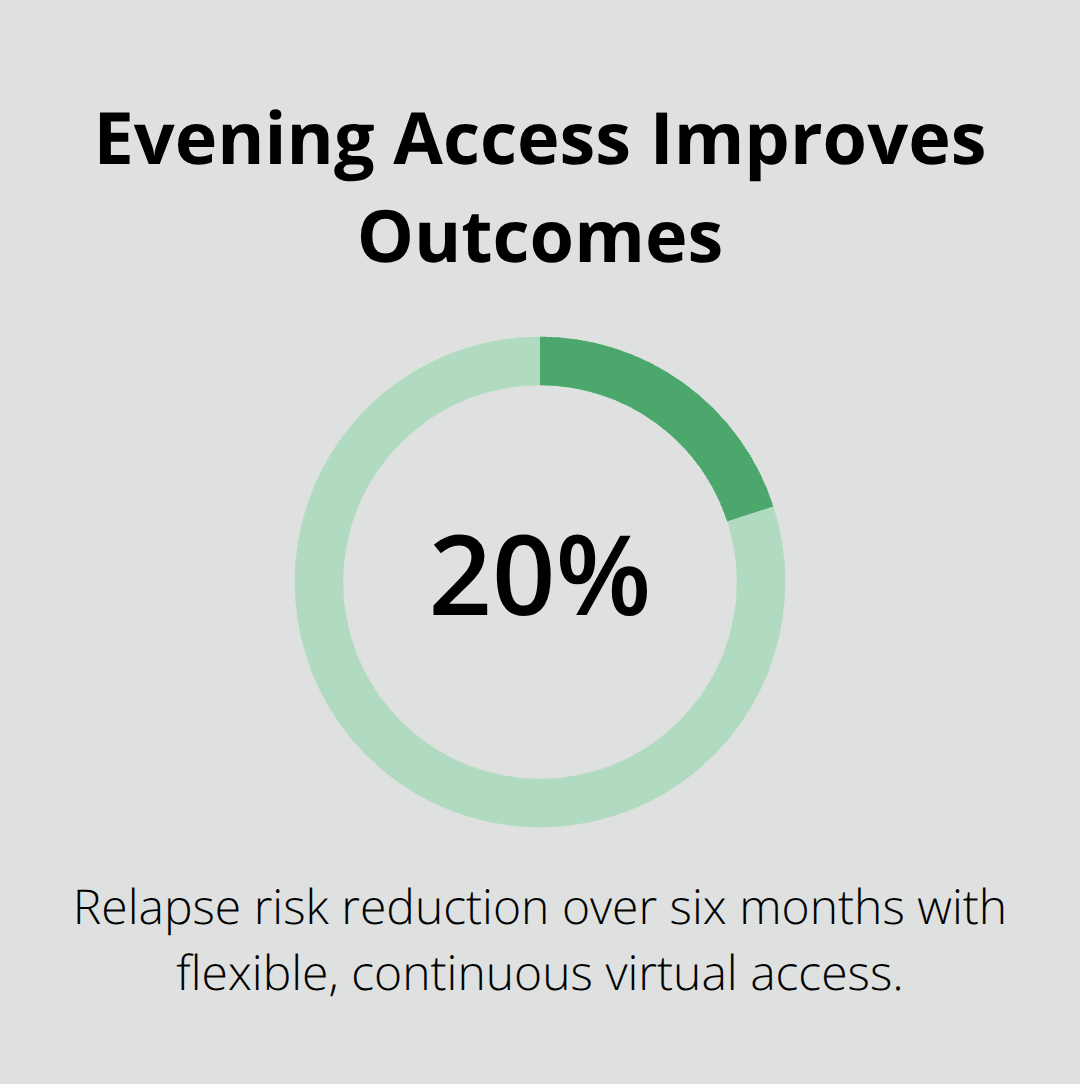
Evening groups fit into your existing life rather than asking you to rearrange everything for treatment. Working professionals often finish their day at 5 or 6 p.m., making 7 or 8 p.m. group sessions realistic. Parents manage school pickup, dinner, and homework before logging in once kids settle. This timing removes the false choice between keeping your job and getting help. Research on virtual recovery communities shows that flexible, continuous access reduces relapse risk by approximately 20 percent over six months, with sustained engagement rates between 65 and 70 percent. Evening scheduling contributes to this durability because you attend when the session doesn’t conflict with your paycheck or your family’s needs.
How Online Groups Build Real Accountability
Peer support in evening groups creates accountability that solo recovery cannot match. You show up each week and report your progress to people who understand your struggle. Other members notice when you miss a session and check in when you return. This consistent contact (week after week, month after month) strengthens your commitment to recovery. Licensed clinicians track your participation and progress, adjusting treatment approaches based on what they observe in real time. The combination of professional guidance and peer connection means you’re not just talking about recovery-you’re actively building it alongside others who face the same obstacles.
Why Evening Online Group Therapy Actually Works for Recovery
Accountability That Peers Create
Accountability in evening groups operates differently than solo recovery or sporadic check-ins with a clinician. You sit in front of the same 6 to 12 people every week, and they notice when you’re absent. This visible consistency forces genuine engagement because your peers see your progress or your struggle in real time. Licensed clinicians track attendance, participation quality, and behavioral shifts across weeks and months, adjusting interventions based on concrete observations rather than assumptions. Research from the National Institute of Mental Health shows that virtual recovery communities sustain engagement rates between 65 and 70 percent, significantly higher than many traditional programs, because the weekly rhythm creates mutual obligation. When a peer mentions they stayed sober through a difficult week, you hear the specifics of how they handled it. When someone relapses and returns, the group processes that setback together instead of letting shame fester in isolation. This transparency breeds accountability that internal motivation alone rarely achieves.
Evidence-Based Therapies Deliver Real Results
Evidence-based therapies delivered in evening online groups produce measurable outcomes because structure matters. Cognitive behavioral therapy teaches you to identify triggers and interrupt automatic thoughts; dialectical behavior therapy builds distress tolerance and emotion regulation skills through repeated practice. Motivational interviewing helps you resolve ambivalence about recovery in real conversations with a licensed professional. One study examining online versus in-person DBT groups found that participants in both formats reported comparable learning outcomes and similar satisfaction ratings, meaning the clinical effectiveness doesn’t degrade when delivered through video. Between-session support amplifies this impact. Many programs offer secure messaging with clinicians or peer coaching between meetings, so a craving or breakthrough doesn’t wait seven days. Progress tracking through mood checks, sleep logs, or relapse-prevention worksheets gives you and your clinician concrete data about what’s working.
Barriers Collapse When Evening Groups Exist
Transportation costs, childcare conflicts, inflexible work schedules, and rural isolation have historically prevented millions from accessing treatment. Evening online groups eliminate these obstacles entirely.
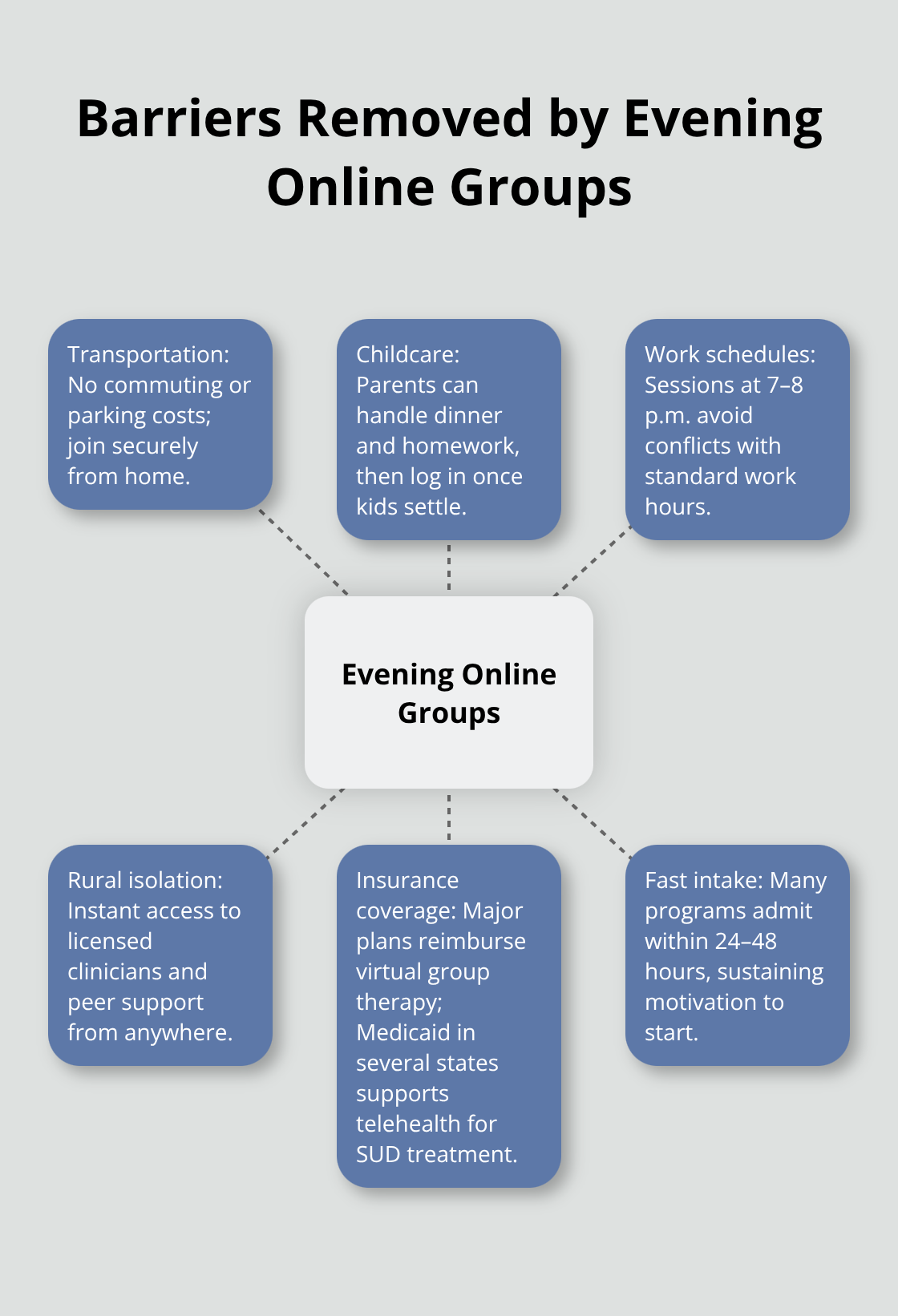
A parent finishes work at 5 p.m., handles family responsibilities, and joins a session at 7 p.m. from home without arranging a babysitter or burning gas. Someone living in a rural area with no local treatment options connects to licensed clinicians and peer support instantly. Insurance coverage has expanded significantly, with major plans now reimbursing virtual group therapy for substance use disorders, and Medicaid in several states now offering permanent telehealth access for substance use disorder treatment. Intake happens fast; many programs admit new members within 24 to 48 hours, removing the delay that often kills motivation. The combination of accessibility, speed, and clinical quality means recovery becomes a realistic option for people who previously had no viable path forward. Your next step involves understanding what actually happens when you show up for your first session.
Your First Session: What Actually Happens
Before You Log In
Your first session starts before you log in. Most programs complete intake within 24 to 48 hours of your initial request, so motivation doesn’t cool while you wait in an administrative queue. You’ll answer questions about your substance use history, mental health background, and current support system during a brief phone or video assessment with an intake specialist. This conversation determines which group fits your needs-whether that’s a DBT skills group for emotion regulation, a trauma-focused recovery group, or a general substance use support group. Ask directly whether the program requires concurrent individual therapy alongside group; some do, some don’t. Then you receive login credentials, a tech orientation (often a short video or practice session), and the group’s meeting link.
Technical Setup That Actually Matters
Test your camera, microphone, and internet connection 10 minutes before your session starts. A frozen video or audio dropout during your first vulnerable share tanks confidence immediately. Use a computer or tablet rather than a phone-smaller screens make it harder to see other group members’ faces, which undermines the whole point of real connection. Position yourself so your face is well-lit and clearly visible. Sit with your back to a wall to protect your privacy from anyone behind you.
Your internet connection needs to be stable; anything slower than 5 Mbps will cause video lag that disrupts group flow. Use a wired ethernet connection if possible rather than WiFi, which drops more easily. Wear headphones to protect confidentiality-group members’ voices shouldn’t leak into your household, and you shouldn’t hear your own voice echoing back, which is distracting. Close unnecessary browser tabs and silence your phone completely.
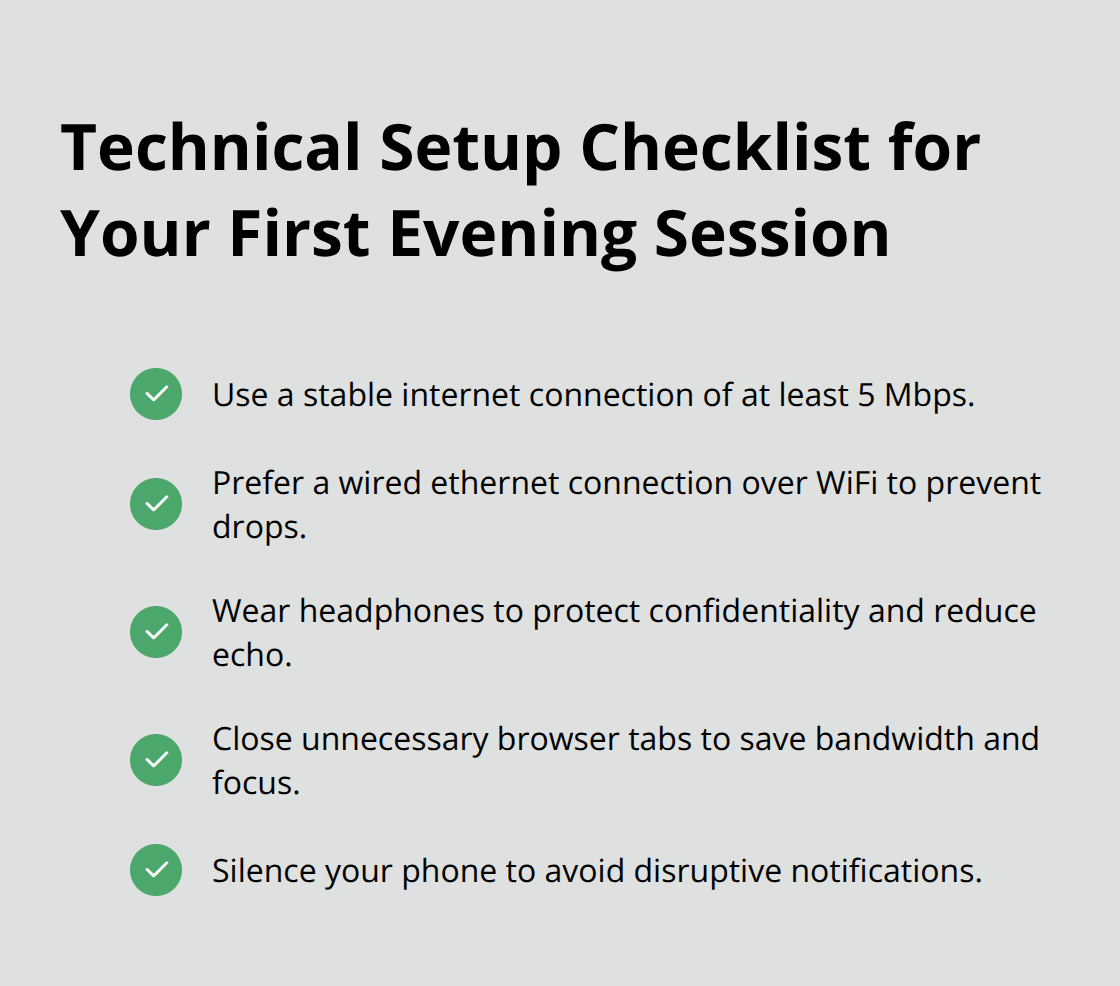
A notification ping mid-share reads as disrespectful and breaks your concentration.
The Physical Space You Choose
Choose a private space where you won’t be interrupted for the full 60 to 90 minutes. A locked bedroom works. A car in a parking lot works. Your living room with kids and a partner wandering through does not. The holding environment-the psychological safety of the space-depends on predictability and privacy.
What Happens When the Session Starts
When the facilitator starts, expect a brief welcome where they review group agreements: confidentiality is absolute, what’s said in group stays in group, no recording, cameras stay on, and everyone gets uninterrupted time to speak. The facilitator will ask you to introduce yourself and share what brought you to the group. You don’t need a polished story. Raw honesty works better. Other members will share too, and you’ll notice patterns-someone else struggled with the same trigger, another person’s family response mirrors yours. This recognition that you’re not uniquely broken happens fast in group, sometimes within the first 30 minutes.
Most sessions blend group therapy, individual counseling, and psychoeducation. You might learn breathing exercises and progressive muscle relaxation to manage physical anxiety, or discuss how regular exercise, proper nutrition, and adequate sleep support long-term recovery. The structure varies by program, but the core remains consistent: you speak, you listen, you’re witnessed.
Finding the Right Program
Finding the right program means checking three specific things: group size, clinician credentials, and between-session support. Groups with 6 to 12 participants balance interaction and safety; anything larger fragments discussion, anything smaller feels isolating. Verify that your facilitator holds a license-LCSW, LPC, LMFT, or psychologist-not just a certificate or peer specialist credential. Between-session support through secure messaging or peer coaching separates programs that sustain recovery from those that just fill time.
Insurance coverage varies wildly. Call your insurer directly and ask whether they reimburse online group therapy for substance use disorders. Don’t ask whether they cover telehealth generally; get specific about group modality. Many plans do cover it, especially if the provider is in-network. If cost is a barrier, ask about sliding scale fees or financial assistance programs; reputable providers offer them. Your first session won’t feel perfect. You might freeze up when asked to share. You might feel self-conscious about your video setup. You might wonder if these strangers actually get it. That discomfort passes. What matters is showing up again next week, and the week after that. Consistency builds trust faster than comfort.
Final Thoughts
Evening group therapy online works because it meets you where you are-you don’t rearrange your life around treatment; treatment fits into your actual schedule. Virtual recovery communities sustain engagement between 65 and 70 percent, reduce relapse risk by roughly 20 percent over six months, and deliver clinical outcomes comparable to in-person formats. Licensed clinicians guide evidence-based therapies like cognitive behavioral therapy and dialectical behavior therapy while peers hold you accountable week after week.
The barriers that once made recovery impossible-transportation costs, childcare conflicts, inflexible work hours, rural isolation-simply disappear when you join from home at 7 p.m. Your recovery doesn’t depend on perfect motivation or ideal circumstances; it depends on showing up consistently to a group that expects you, a clinician who tracks your progress, and peers who understand your struggle because they live it too. Evening group therapy online removes the excuses and creates the structure that sustains long-term recovery.
We at EveningIOP offer live, telehealth evening Intensive Outpatient Programs that combine interactive group therapy, one-on-one sessions with licensed clinicians, and remote drug and alcohol testing. Intake happens within 24 to 48 hours, and your first session is the hardest step-after that, consistency builds momentum. Recovery is possible, and it starts with one evening session.