

Getting treatment for substance use disorder shouldn’t mean putting your career on hold. That’s why Joint Commission IOP evening programs exist-they bring clinical rigor to a schedule that actually works for working professionals.
At EveningIOP, we’ve built a program that combines accreditation standards with real-world accessibility. You get the quality assurance of Joint Commission oversight without sacrificing your job, your family time, or your independence.
What Joint Commission Accreditation Actually Protects
Joint Commission accreditation isn’t a participation trophy. The organization has accredited over 4,300 behavioral health care organizations under its Comprehensive Accreditation Manual for Behavioral Health Care, setting a standard that separates legitimate treatment programs from those cutting corners. When a program earns Joint Commission approval, trained surveyors with clinical and leadership experience conduct an onsite inspection and verify that the facility meets rigorous safety and quality standards specific to its service type.
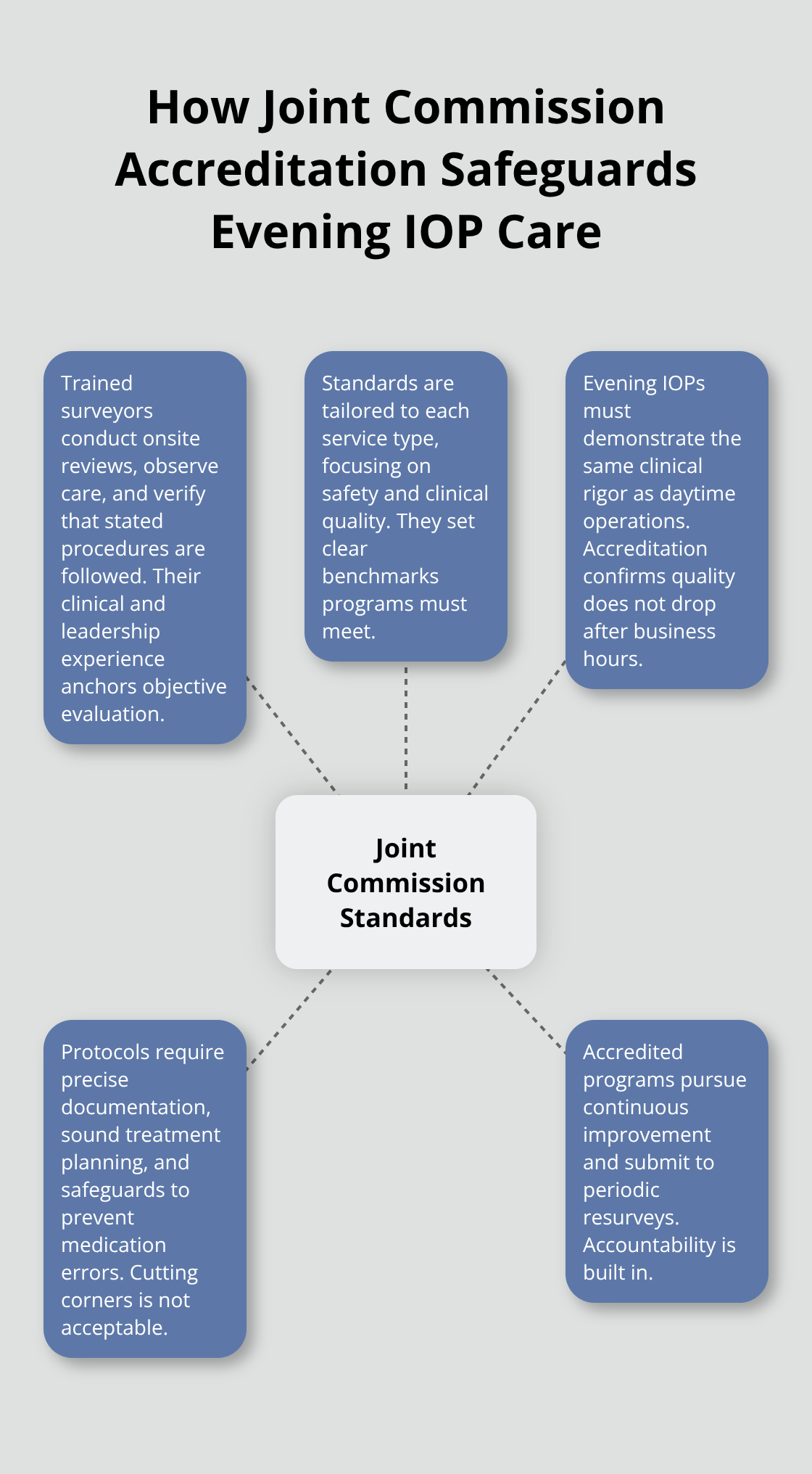
For evening IOP programs, this means the program has demonstrated it can deliver the same clinical rigor during evening hours as traditional daytime operations.
The standards cover everything from how staff handle patient records to how the program prevents medication errors to how therapists structure treatment plans. This matters because substance use disorder treatment requires precision, especially when medication-assisted treatment is involved. A program that cuts corners on documentation or skips required safety protocols puts your recovery at risk, even if the therapist seems competent.
How Surveyors Verify Quality Standards
The inspection process itself reveals something important about a program’s commitment to quality. Joint Commission surveyors don’t just review paperwork; they observe actual treatment sessions, interview staff and patients, and verify that the program follows its stated procedures consistently. Programs must pass this inspection every three years to maintain accreditation. The standards require continuous improvement, meaning accredited programs regularly assess their outcomes and adjust their approach based on what actually works for patients.
This is fundamentally different from programs that operate without external oversight. When you choose an accredited evening IOP, you select a program that has proven it meets evidence-based standards and submits to regular accountability checks.
Why Evening Programs Need the Same Standards
Evening IOP programs face unique operational challenges that make accreditation even more important. Staff fatigue, reduced administrative oversight during evening hours, and the complexity of medication management in a non-residential setting all create potential safety gaps. Joint Commission standards address these specific risks by requiring evening programs to maintain the same documentation, clinical protocols, and safety procedures as daytime operations.
The accreditation process confirms that an evening program doesn’t compromise on quality just because it operates after traditional business hours. This distinction matters when you’re evaluating whether an evening program can truly support your recovery needs. The next section explores how this accreditation translates into real benefits for working professionals and families.
Why Evening Treatment Works for People Who Work
Employment Stability Anchors Recovery
The reality of substance use disorder treatment is that most programs operate during business hours, which means choosing recovery often means choosing unemployment. A typical Intensive Outpatient Program requires 9 to 15 hours per week of structured sessions. If those sessions run from 9 a.m. to noon, you explain repeated absences to your employer, risk your job stability, or delay treatment until you lose income anyway. Evening programs eliminate this false choice.
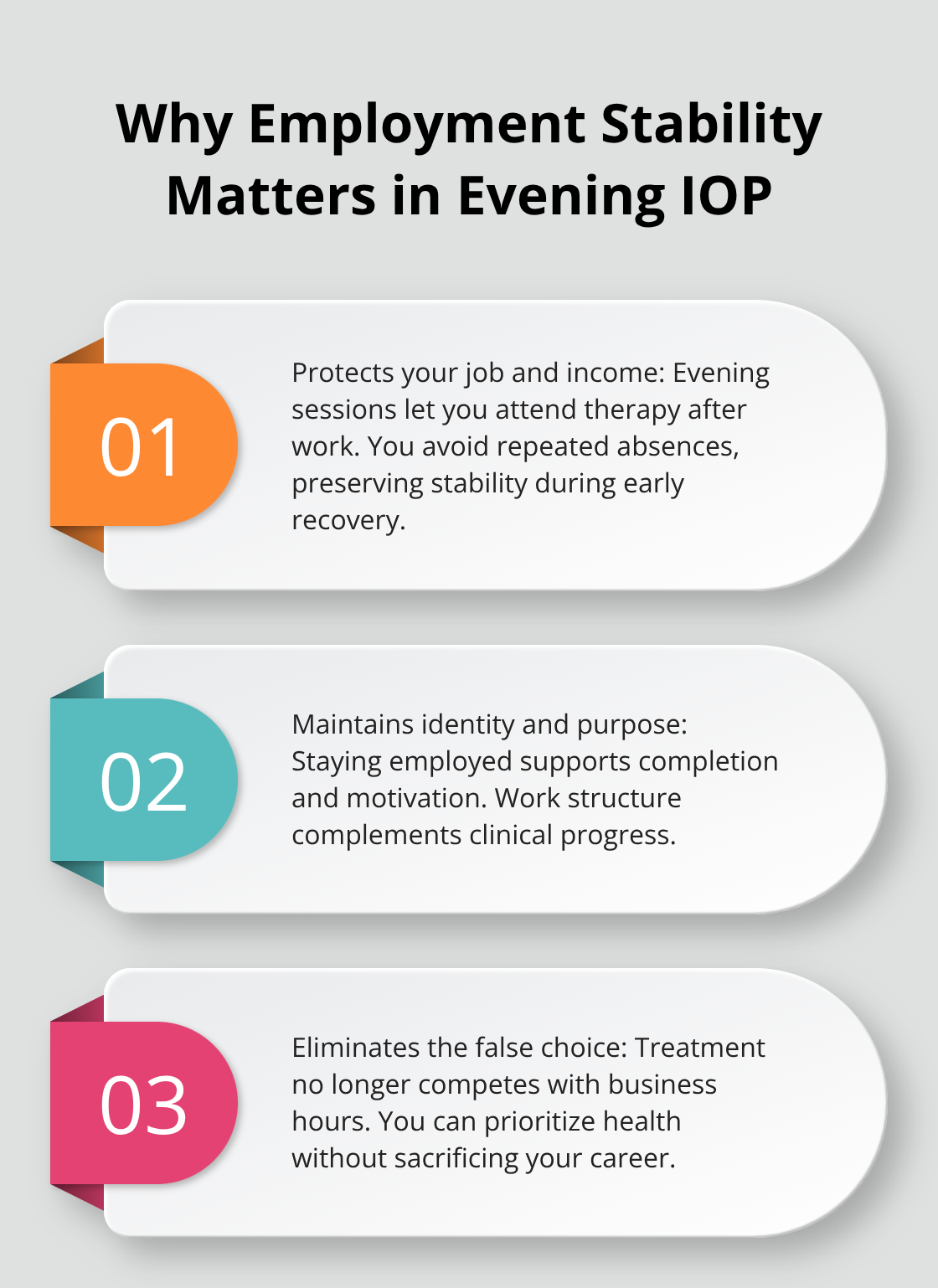
Sessions scheduled after 5 p.m. let you attend therapy without taking time off work, without fabricating excuses, and without the financial pressure that often derails early recovery. Employment stability during treatment isn’t a luxury-it’s a foundation. People who maintain their jobs during recovery report higher completion rates because they preserve their sense of identity and purpose outside the treatment environment. Your paycheck also funds your recovery plan, whether that’s transportation, childcare, or medication costs that insurance doesn’t fully cover.
Family Responsibilities Don’t Pause for Treatment
The second barrier evening programs dismantle is family disruption. Substance use disorder affects entire households, and daytime treatment forces caregivers into impossible schedules. A parent attending a 9 a.m. IOP session either arranges childcare they can’t afford, pulls children from school, or delays treatment. Evening sessions let parents attend therapy while children are in school or sleeping, preserving parental responsibilities without sacrificing clinical care.
Family involvement in addiction treatment improves outcomes-research emphasizes family and peer support as core to holistic treatment-but only if the schedule allows families to participate meaningfully. Evening programs also reduce the isolation that daytime programs sometimes create. You’re not sitting in a waiting room explaining to coworkers why you’re leaving early; you’re attending group therapy with other working professionals who understand the specific pressures of maintaining employment while addressing addiction.
Peer Support Built Around Your Schedule
This peer environment, constructed specifically around evening participation, creates accountability that generic daytime groups cannot replicate. Working professionals in evening groups share common obstacles (managing stress without substances, balancing recovery with career demands, protecting family stability) that shape the conversation in ways daytime groups miss. The group becomes a network of people navigating the same constraints, not a collection of individuals with misaligned schedules and competing priorities.
Evening IOP programs also eliminate the stigma that sometimes accompanies visible treatment. You attend sessions when most people are home with family or winding down from work, not when coworkers might notice your absence. This practical privacy removes one more barrier that keeps people from seeking help. With employment protected, family time preserved, and peer support aligned to your actual life, evening treatment addresses the structural obstacles that derail recovery before clinical factors even enter the picture. The next section examines how accreditation standards ensure this flexibility doesn’t compromise the quality of care you receive.
How Accreditation and Licensing Protect Your Evening Treatment
Three overlapping layers of regulatory oversight work together to guarantee both quality and legitimacy in evening substance use disorder treatment. DHCS licensure means the California Department of Health Care Services has verified a program meets state requirements for substance use disorder treatment, including staff qualifications, clinical protocols, and patient safety procedures. Joint Commission accreditation adds a second verification layer, confirming the program meets national standards for behavioral health care through independent surveyor inspection. LegitScript certification provides a third check, verifying the program operates legitimately and transparently in the telehealth space.
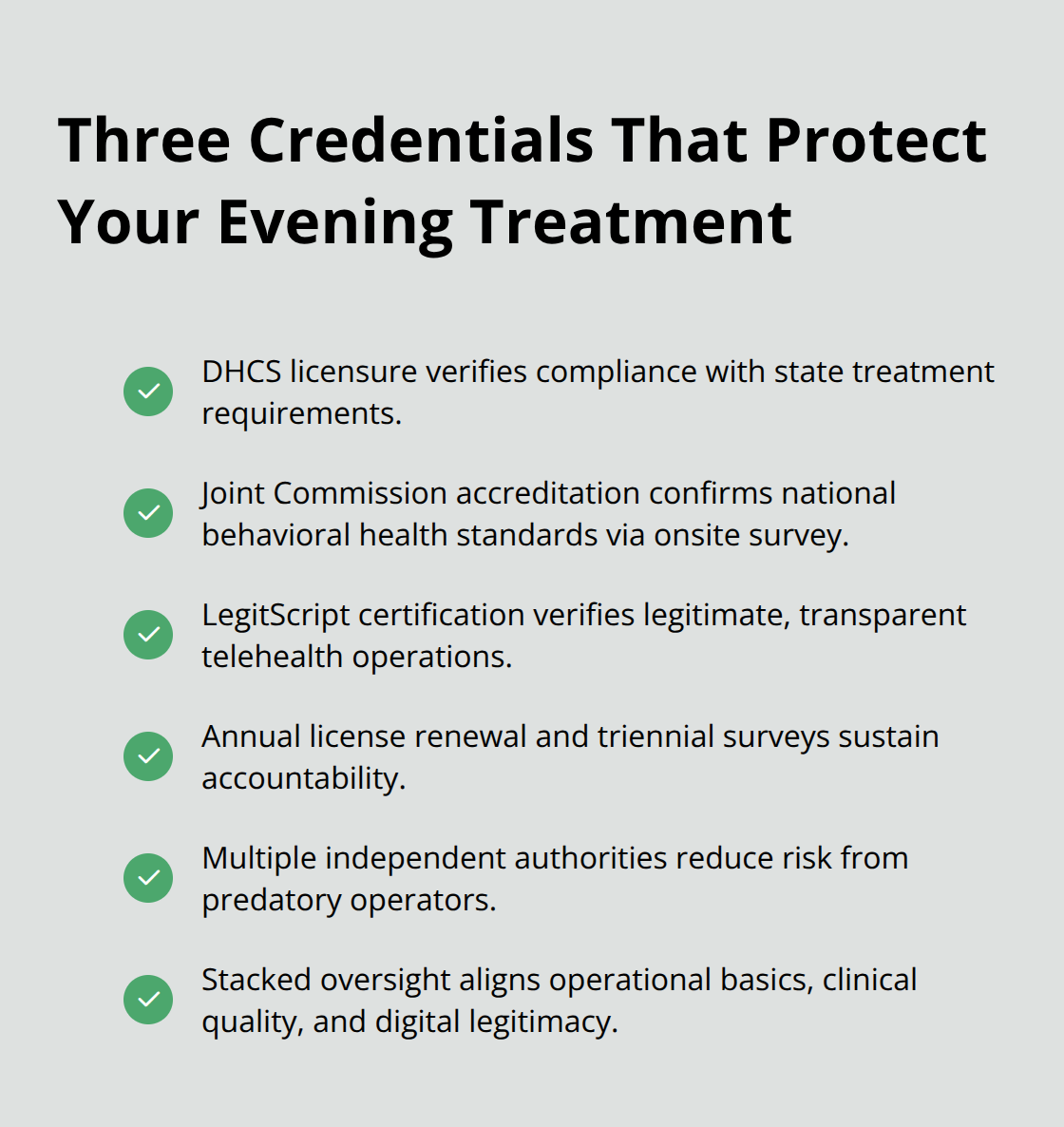
This stacked credibility matters because substance use disorder treatment attracts predatory operators who exploit people desperate for help. A program claiming to offer treatment without these three credentials operates in regulatory shadows where corners get cut and patients face harm. When you verify a program holds DHCS licensure, Joint Commission accreditation, and LegitScript certification, you know the program has passed independent inspections from multiple authorities with different expertise and mandates. The state checks operational basics, the Joint Commission checks clinical quality, and LegitScript checks digital security and legitimacy. None of these credentials are easy to obtain or maintain. Programs must renew licenses annually, pass Joint Commission surveys every three years, and continuously maintain LegitScript standards. This ongoing accountability creates pressure to actually deliver quality care rather than cut corners for profit.
Live Telehealth Therapy Delivers Real Clinical Interaction
Evening treatment requires the same clinical rigor as daytime programs, which means live telehealth sessions with licensed clinicians, not pre-recorded videos or asynchronous messaging. Live group therapy allows you to interact with other participants in real time, receive immediate feedback from therapists, and participate in the accountability that makes peer support effective. One-on-one sessions with licensed clinicians allow treatment plans to adapt based on your specific responses, medication needs, and life circumstances. This interactive format matters because substance use disorder recovery requires responsive clinical judgment, not standardized scripts. A therapist observing your tone, hesitation, or emotional reaction during a live session can adjust their approach immediately. They notice when someone in group therapy struggles with a trigger and can redirect the conversation. This responsiveness is impossible in pre-recorded or text-based formats. Remote drug and alcohol testing through verified lab partners adds accountability without requiring in-person clinic visits. You complete tests at approved locations near your home or workplace, results report directly to your treatment team within hours, and the digital chain of custody maintains the integrity that courts, employers, and treatment providers require. This combination of live clinical interaction plus remote testing removes the excuse that evening treatment means lower clinical standards. You receive the same therapist responsiveness and accountability as daytime programs, scheduled around your actual life.
Flexibility Without Compromising Clinical Standards
The operational reality of evening programs requires discipline that daytime programs sometimes skip. Evening staff fatigue is real, medication management without 24/7 nursing is complex, and the temptation to reduce documentation when administrators leave for the day is constant. Joint Commission standards specifically address these evening-specific risks by requiring the same documentation, clinical protocols, and safety procedures regardless of session timing. This means your evening therapist follows the same treatment planning requirements, your medication management receives the same oversight, and your progress notes meet the same clinical standards as a 9 a.m. session. Programs that maintain this standard through live clinician interaction and remote accountability measures replace in-person supervision with digital verification. Your treatment team reviews test results within hours, adjusts your care plan based on actual data rather than assumptions, and documents every clinical decision according to state and national standards. The evening schedule removes barriers to treatment, but the accreditation and licensing structure prevents programs from removing clinical safeguards. This distinction separates legitimate evening programs from convenience operations that sacrifice quality for scheduling flexibility.
Final Thoughts
The choice between recovery and your career, between treatment and family stability, shouldn’t exist. Joint Commission accreditation standards guarantee that evening substance use disorder programs deliver the same clinical rigor as daytime operations, eliminating the false trade-off that keeps people from seeking help. When a program holds Joint Commission accreditation alongside DHCS licensure and LegitScript certification, you know independent authorities have verified both the quality of care and the legitimacy of the operation.
Evening programs remove the structural barriers that derail recovery before clinical factors even enter the picture. Employment stability, family responsibilities, and peer support aligned to your actual life create conditions where treatment can work. A Joint Commission IOP evening program doesn’t compromise on these foundations by forcing you to choose between your job and your health.
We at EveningIOP have built this combination into every aspect of our program through live telehealth group therapy and one-on-one sessions with licensed clinicians that deliver responsive clinical interaction, remote drug and alcohol testing through verified lab partners that adds accountability without disrupting your schedule, and DHCS licensure, Joint Commission accreditation, and LegitScript certification that create the oversight structure preventing programs from sacrificing quality for convenience. If you’re ready to pursue recovery without putting your career or family on hold, EveningIOP combines clinically effective care with the flexibility your situation demands.