


Working full-time while managing your mental health feels impossible. Between meetings, deadlines, and family responsibilities, finding time for therapy seems like another burden you can’t fit in.
Evening group therapy sessions change that equation. At EveningIOP, we’ve seen how evening groups let working professionals get real support without sacrificing their careers or personal time. You’ll find people who understand your exact situation because they’re living it too.
Why Evening Therapy Works for Busy Professionals
Working professionals have between 6 and 8 hours of free time on weekdays after accounting for work, commute, and sleep. Daytime therapy appointments consume work hours, forcing you to leave early, reschedule clients, or fabricate excuses about your whereabouts. Evening sessions eliminate that conflict entirely. Scheduling therapy at 6 or 7 PM allows you to finish your workday normally, handle dinner and family time, then attend a session that fits your actual life. Research shows that workers who don’t have to negotiate time off for healthcare appointments report lower stress levels.
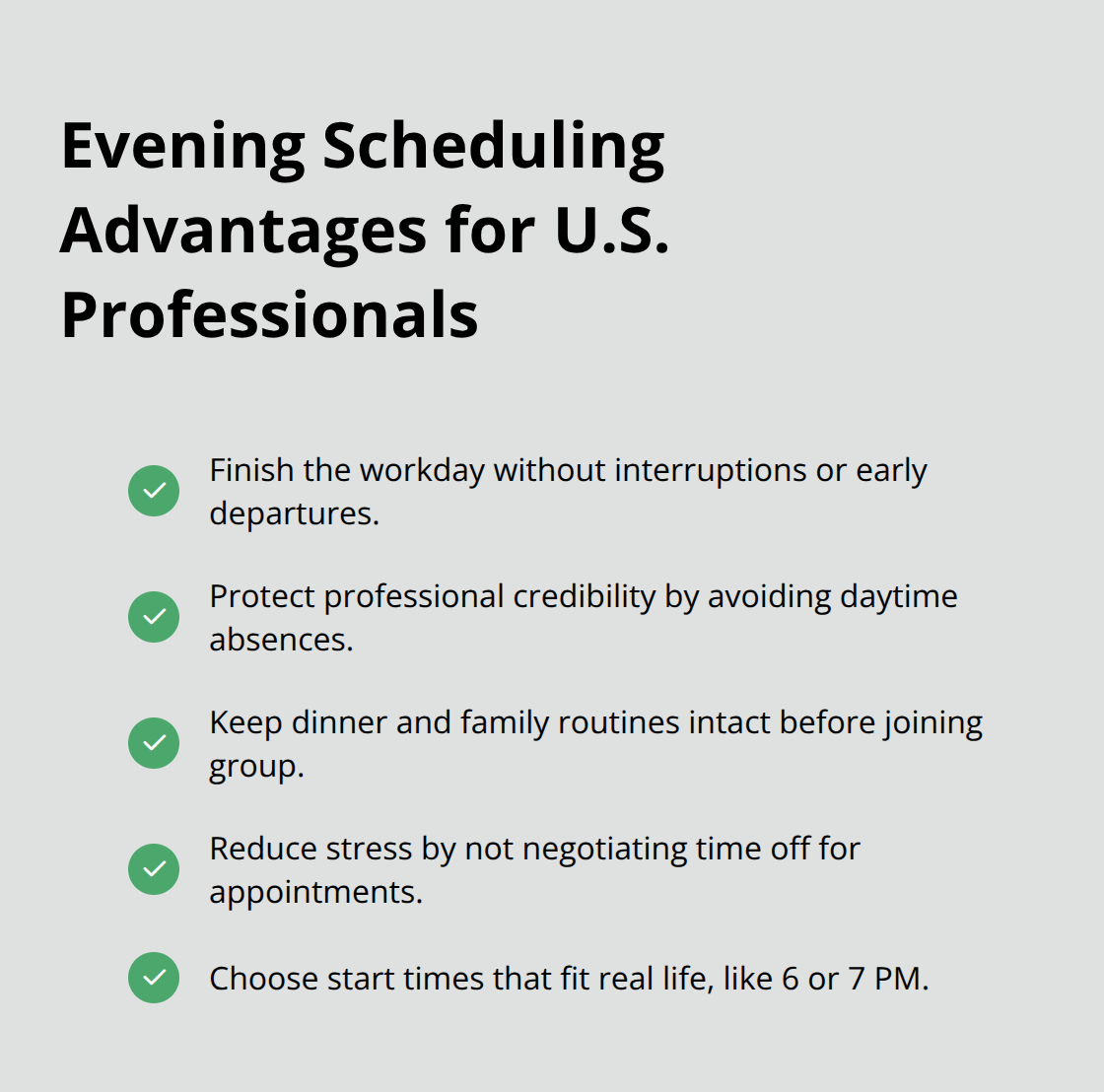
That’s not theoretical-that’s what happens when therapy stops competing with your paycheck and your credibility at work.
Peer Accountability Changes Everything
Group therapy works differently than one-on-one sessions because you’re surrounded by people who won’t accept your excuses. A therapist gets paid to listen. Your group members show up because they need what you need. When someone in your evening group misses a session, others notice and ask about it the next time you meet. This peer accountability proves stronger than any clinician intervention because it comes from shared experience, not authority. Research has found that participants in peer-led group settings had higher session attendance rates than those in individual therapy alone. That attendance matters because consistency drives recovery-not through breakthroughs in single sessions, but through showing up week after week alongside people who understand exactly why you relapsed last Tuesday or why you almost called your old supplier yesterday.
The Stigma Advantage of Evening Groups
Evening groups attract working professionals who have jobs, mortgages, and reputations to protect. You’re not sitting in a clinical waiting room next to someone from your office building during business hours. Instead, you’re joining a call at night with accountants, managers, teachers, and nurses who manage the same struggles. That demographic shift matters enormously for how you perceive yourself and how you show up. Studies on social identity and recovery show that seeing yourself reflected in your peer group increases treatment engagement. You stop seeing recovery as something broken people do and start seeing it as something functional people manage. The evening timing naturally filters for people building real lives, which means fewer stories about rock bottom and more conversations about maintaining sobriety while handling quarterly reviews and school pickups.
What Happens Next in Your Evening Group Experience
Understanding why evening groups work sets the stage for what actually happens inside them. The structure, the role of licensed clinicians, and how individual sessions complement group work all combine to create an environment where real change takes hold.
What Actually Happens in Your Evening Session
The 90-Minute Structure That Keeps Everyone Engaged
Evening group therapy sessions follow a structured format that maximizes participation and accountability. Sessions run 90 minutes and start with check-ins where each participant shares their week in 2-3 minutes, creating immediate peer connection and establishing who needs extra support that night. The facilitator then introduces a specific topic relevant to recovery and professional life-managing workplace stress without relapsing, handling family dynamics during early recovery, or navigating social situations where substances are present.
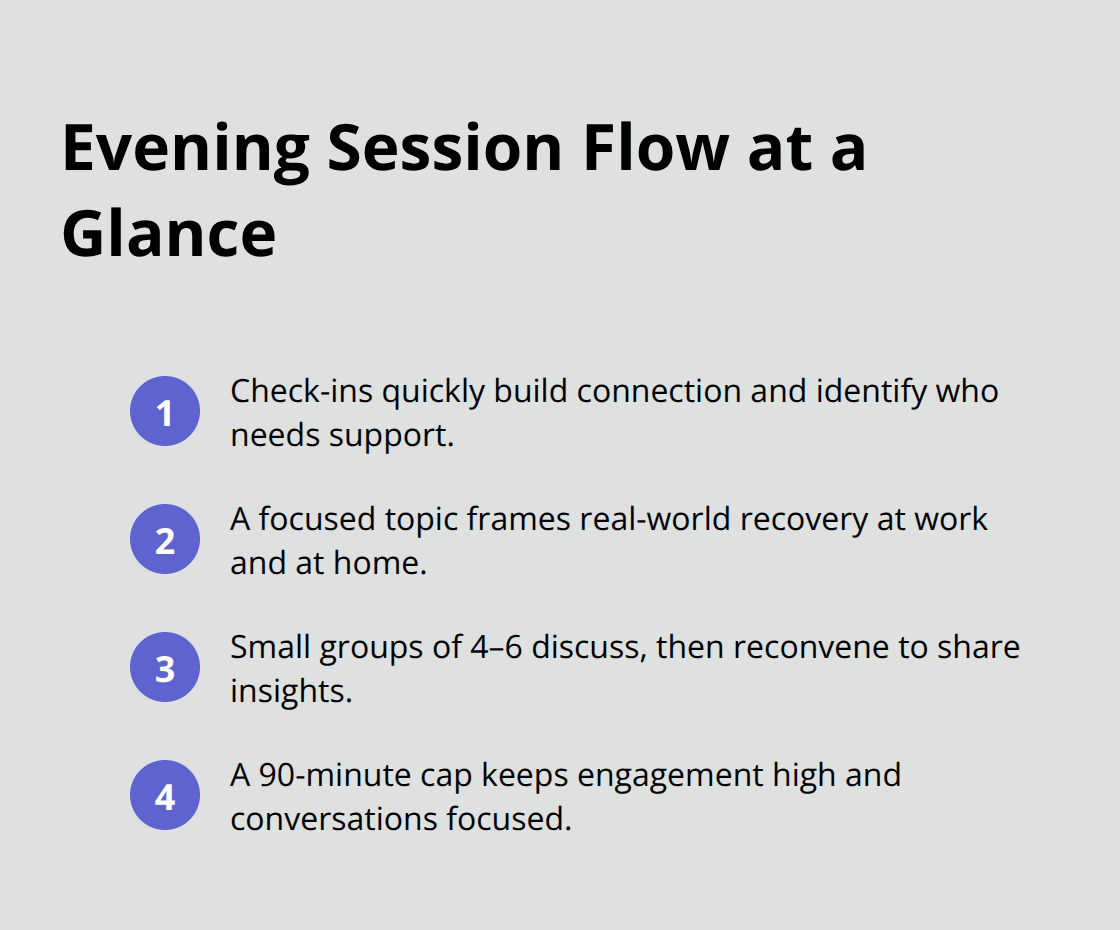
Small group discussions follow where participants break into groups of 4-6 to explore the topic through their own experiences, then reconvene to share insights. This structure prevents sessions from becoming either clinical lectures or unfocused conversations.
How Licensed Clinicians Watch for Warning Signs
Licensed clinicians facilitate each session and watch for patterns in what people share, noting who’s struggling, who’s isolating, and who needs individual attention. They intervene strategically when someone’s thinking shows early warning signs of relapse, offering concrete tools rather than generic advice. A clinician might notice that someone minimizes their cravings during group and pull them aside afterward to explore what’s really happening. This observation catches problems before they escalate into missed sessions or substance use.
Individual Sessions Address What Group Cannot
One-on-one sessions with licensed clinicians happen separate from group time and serve a different function entirely. While group work builds accountability and normalizes your experience, individual sessions address what’s unique to your situation. You might work through trauma triggers that group wouldn’t address, navigate medication management with a clinician, or process family issues that require confidentiality beyond group settings. Research on integrated treatment shows that participants receiving both group and individual therapy have higher abstinence rates than those in group alone.
Testing and Accountability Work Together
The combination works because group provides the social reinforcement and peer accountability that sustains long-term recovery, while individual sessions provide the clinical depth needed to address root causes. Remote drug and alcohol testing happens regularly and serves as another form of accountability (with results reviewed during individual sessions so clinicians adjust treatment if needed). This isn’t punitive testing-it’s objective data that removes guesswork from recovery progress and helps you see concrete proof of your commitment when motivation dips.
Understanding how these components fit together reveals what separates surface-level support from genuine transformation. The real power emerges when you move beyond the structure itself and start building the actual relationships that carry you through the hardest moments.
How Your Evening Group Becomes Your Real Support Network
Recognition Builds Trust Faster Than Sporadic Sessions
The people sitting in your evening group session aren’t strangers for long. Within three to four weeks, you’ll recognize patterns in how others talk about their struggles, and they’ll start asking about specific situations you mentioned weeks earlier. This recognition is where genuine support networks form. Unlike one-time therapy appointments, evening groups create consistency through the same people showing up at the same time every week.
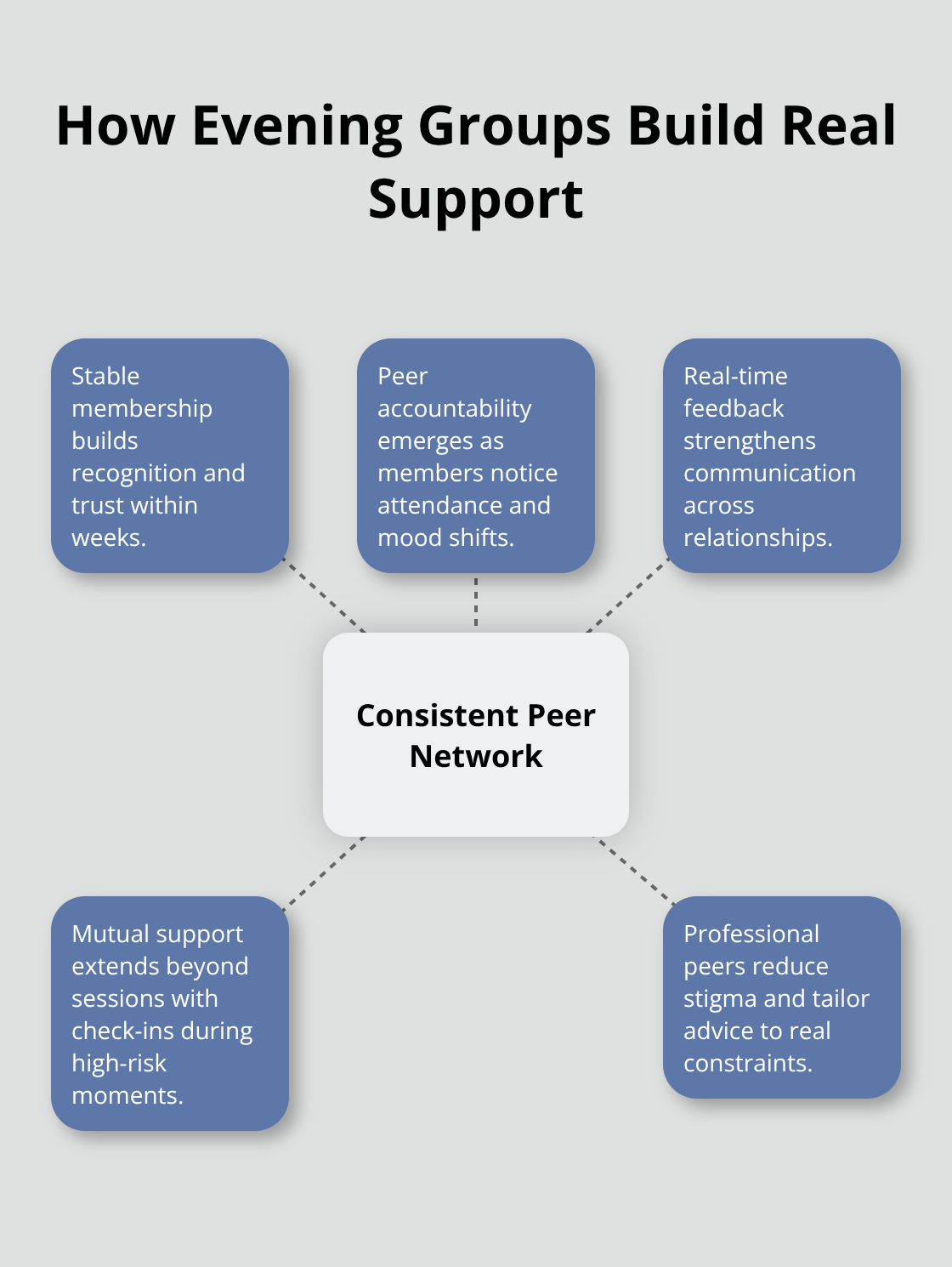
That repetition builds trust faster than sporadic individual sessions because accountability requires visibility.
You can’t hide progress or relapse when the same eight people see you every week. Research from the Journal of Substance Abuse Treatment found that participants in ongoing group therapy with stable membership showed higher abstinence rates at six months compared to those in groups with rotating members. The stability matters because it forces you to show up as your real self, not a version of yourself you think a clinician wants to hear.
Peer Recognition Creates Accountability That Advice Cannot Match
When someone in your group shares that they almost relapsed after their boss criticized them in a meeting, you immediately connect that to your own workplace stress. That specific recognition of shared experience creates accountability that generic advice from a clinician simply cannot match. The accountant struggling with weekend isolation relates to your experience differently than a therapist who learned about isolation from textbooks.
This peer recognition extends beyond the session itself. People exchange contact information and text each other during high-risk moments, creating informal support outside structured sessions. In evening groups, you’ll find people at similar life stages managing recovery while keeping their jobs and families intact, which means the advice they offer comes from someone actually living your constraints.
Real-Time Feedback Teaches Communication Better Than Worksheets
The communication skills you develop in group sessions directly impact how you navigate relationships outside the group. When someone shares a conflict with their spouse during group, the facilitator doesn’t lecture about communication theory but instead helps the group explore what actually happened and what they’d do differently. You hear five different perspectives from people managing similar relationships, then watch the person apply those suggestions the following week and report back.
This real-time feedback loop teaches communication more effectively than any worksheet. People in evening groups learn to give direct feedback without judgment because they’ll see each other again next week, which creates incentive for honesty and compassion. You can’t be cruel to someone in your group and then ignore the tension for months because you’ll face them every session.
Mutual Support Strengthens Everyone’s Commitment
The accountability partnerships that form often extend into accountability for non-recovery goals. Someone in your group might help you practice what you’ll say in a difficult conversation with your manager, or you might help another member prepare for a family dinner where alcohol will be present. These partnerships work because both people benefit from the mutual investment.
The act of supporting someone else reinforces your own commitment and reminds you why recovery matters. Evening groups create the conditions for this mutual support naturally because the timing attracts working professionals who have practical problems to solve together, not just theoretical recovery discussions.
Final Thoughts
Evening group therapy sessions work because they eliminate the false choice between recovery and your career. You don’t sacrifice your professional reputation or your paycheck to get the support you need. The professionals in your evening group finish their workday normally, handle dinner and family time, then join a session that fits into the life they’re actually living.
The research shows what happens when you build a real support network with stable membership. Participants in ongoing group therapy with the same people show higher abstinence rates at six months compared to those in sporadic individual sessions. That difference comes from consistency, recognition, and accountability from people who see you every week and won’t let you disappear into isolation-not from willpower or motivation alone.
The peer accountability in evening group therapy sessions operates differently than anything a clinician can provide on their own. When the same eight people notice you’re quieter than usual or remember a difficult situation you mentioned weeks earlier, they ask about it. They care because they’re managing their own recovery alongside you, which creates the mutual investment that drives lasting change. Visit EveningIOP to explore how evening Intensive Outpatient Programs can fit your schedule and support your recovery.