

Addiction doesn’t pause when the workday ends, and neither should your recovery. At EveningIOP, we know that traditional daytime treatment programs don’t fit everyone’s life.
Evening alcohol rehab online gives working professionals the flexibility to heal without sacrificing their careers or family time. This guide walks you through how flexible recovery actually works.
Why Evening Programs Actually Work
Flexibility Drives Treatment Completion
People who attend treatment around their existing commitments complete recovery programs at significantly higher rates than those forced into rigid daytime schedules. Low barrier care can increase access to treatment and improve recovery-based outcomes for individuals and communities affected by substance use disorders. Evening sessions eliminate the false choice between recovery and financial stability. When you attend sessions from 6 to 9 pm on Monday, Tuesday, and Thursday, you don’t sacrifice nine hours of work each week. You don’t burn through savings or face termination because you need treatment.
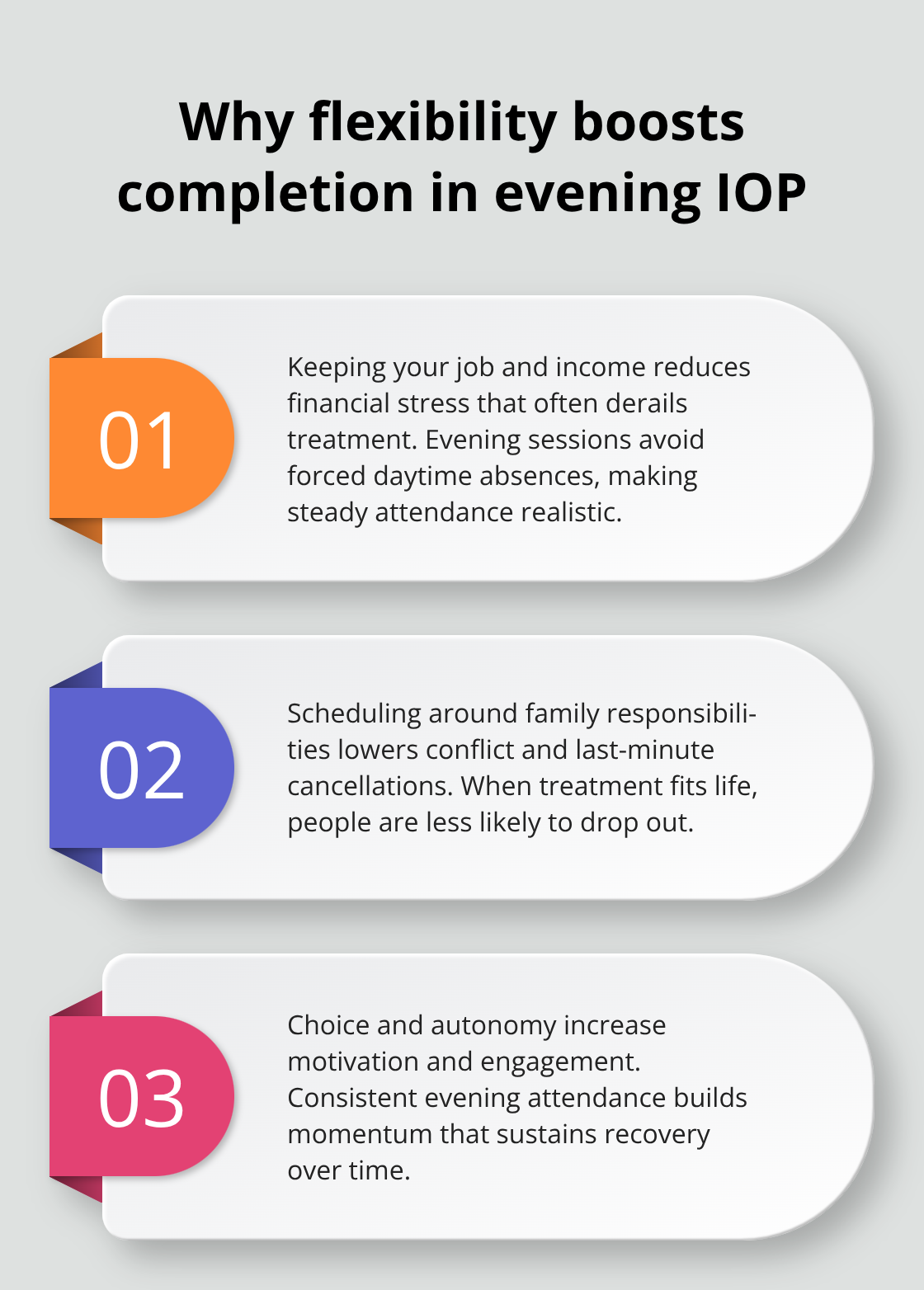
A nine-hour weekly commitment to evening IOP means you keep your paycheck, maintain your role in your family, and show up to recovery as someone with skin in the game rather than someone forced into a corner. This matters psychologically. People who sustain their employment and housing during treatment show better long-term outcomes than those who lose both.
Clinical Intensity Remains Constant
The American Society of Addiction Medicine recognizes that the intensity of care matters far more than the time of day it happens. Evening IOP delivers the same clinical intensity as daytime programs-structured group therapy, individual sessions with licensed clinicians, and evidence-based modalities like CBT and DBT-just when working adults can actually attend. EveningIOP combines interactive online group therapy with one-on-one sessions and remote drug and alcohol testing integration, so your progress remains clinically documented without added burden.
Telehealth Removes Barriers
Virtual evening IOP removes geographic barriers entirely. You attend from home, which means no commute, no childcare coordination, no explaining to your employer why you’re leaving at 2 pm every other day. Telehealth for addiction treatment produces outcomes comparable to in-person care while eliminating logistical friction that derails people before they even start. The adoption of teletherapy has held because it works.
Cost-Effectiveness Without Compromise
Inpatient rehab costs significantly more than IOP while producing similar long-term recovery rates according to randomized trials and naturalistic analyses. When people in IOP studies report abstinence at follow-up, matching or exceeding inpatient outcomes, the choice becomes obvious for anyone with employment to protect. You’re not choosing a cheaper option; you’re choosing an equally effective one that lets you keep working.
What Comes Next
Understanding why evening programs work sets the foundation for knowing what to expect when you actually start treatment. The structure, the testing protocols, and the clinical standards behind evening IOP deserve closer examination.
What to Expect from Evening Intensive Outpatient Programs
The Structure Behind Evening Sessions
Evening IOP operates on a structured schedule that mirrors daytime intensity while fitting around your work hours. Sessions run from 6 to 9 pm on Monday, Tuesday, and Thursday, totaling nine hours weekly. This nine-hour framework isn’t arbitrary-the American Society of Addiction Medicine defines intensive outpatient care as requiring a minimum of nine hours per week across multiple sessions.
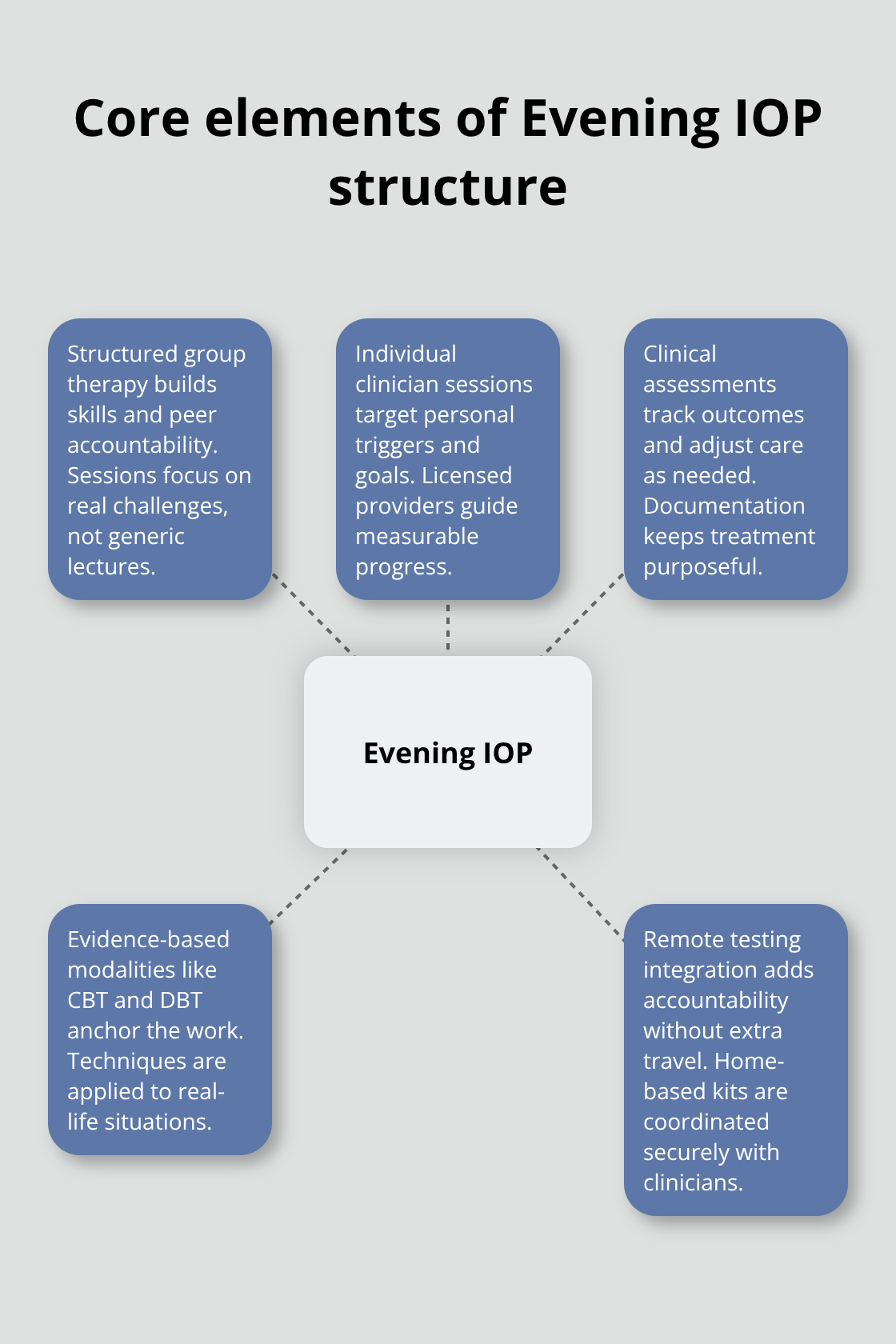
Each three-hour block combines group therapy, individual clinician sessions, and clinical assessments without filler or busy work.
Group therapy typically occupies the first portion, where you work through real challenges with peers facing identical struggles. Licensed clinicians lead these sessions using evidence-based approaches like Cognitive Behavioral Therapy and Dialectical Behavior Therapy, not motivational speeches or generic addiction education. Individual sessions follow, giving you one-on-one time with a licensed clinician to address your specific triggers, mental health conditions, and recovery goals. This split between group and individual work matters because research shows that programs combining both modalities produce stronger outcomes than either alone.
How Testing and Accountability Work
Remote drug and alcohol testing integrates seamlessly into the evening schedule. Rather than requiring separate trips to a lab, testing happens through secure home-based collection kits coordinated with your clinician. This removes excuses and keeps accountability real without adding hours to your week. The testing protocols should feel intrusive enough to matter-random and frequent enough that they create real accountability without becoming punitive.
Credentials That Actually Matter
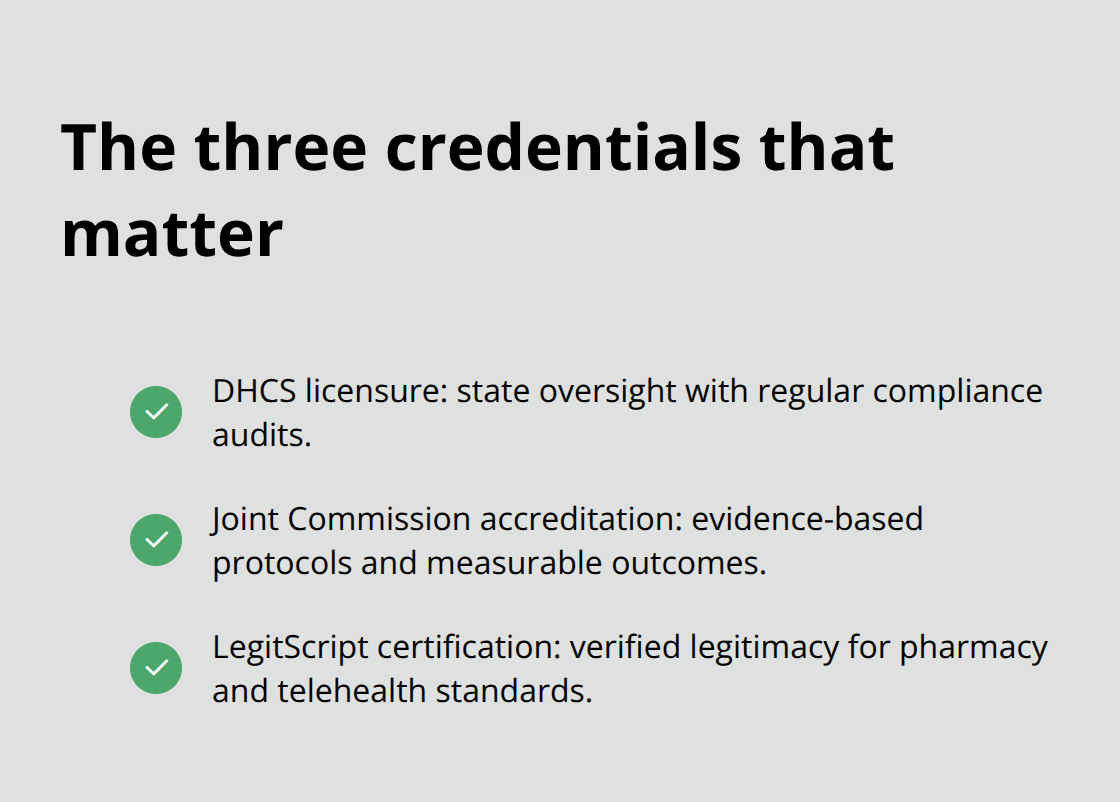
Clinical credibility matters more than program marketing. When you evaluate an evening program, verify specific credentials directly rather than trusting claims on a website. Ask whether the program holds DHCS licensure, Joint Commission accreditation, and LegitScript certification-credentials that matter because they require ongoing compliance audits and documented clinical standards. Joint Commission accreditation specifically demands that programs maintain evidence-based treatment protocols and measurable outcomes tracking. These aren’t optional checkboxes; accredited programs face unannounced inspections and must demonstrate that their interventions work.
Questions That Separate Quality Programs from Mediocre Ones
Investigate whether the program’s clinicians hold relevant licensures (LCSW, LMFT, or addiction counselor certifications vary by state). Ask whether psychiatrists or nurse practitioners manage medication decisions. Request whether the program tracks abstinence rates beyond the first 30 days. Programs unwilling to share these specifics should raise red flags.
The structure you receive during evening sessions should feel clinically rigorous, not convenient. Convenience is the scheduling benefit; the clinical work remains demanding and measurable. Individual sessions should involve active treatment planning with documented progress, not just weekly check-ins where you describe your week. Group therapy should challenge you, not coddle you. If evening IOP feels too easy, you’re likely in a program prioritizing retention over recovery.
Moving From Evaluation to Action
Once you understand what quality evening IOP actually looks like, the next step involves finding a program that meets these standards and fits your specific situation. The right program combines clinical rigor with genuine flexibility, and knowing how to evaluate that fit determines whether you start treatment with confidence or hesitation.
How to Identify a Program Worth Your Time
The Three Credentials That Matter
Separating legitimate evening alcohol rehab programs from mediocre ones requires knowing exactly what credentials matter and which questions expose weak programs. Start with the three non-negotiable certifications: DHCS licensure, Joint Commission accreditation, and LegitScript certification. DHCS licensure means the program operates under state behavioral health oversight and faces regular compliance audits. Joint Commission accreditation requires programs to maintain documented evidence-based protocols and measurable outcome tracking through unannounced inspections. LegitScript certification verifies that the program operates legitimately and meets pharmacy and telehealth standards.
If a program claims to offer evening IOP but lacks these three credentials, the flexibility it offers won’t matter because the clinical foundation is weak.
Verify Clinician Licenses and Medication Management
Ask directly whether clinicians hold relevant state licenses-LCSW, LMFT, or addiction counselor certifications vary by state, so verify that licenses match your state’s requirements. Psychiatrists or nurse practitioners should manage medication decisions; if a program relies on nurse aides or unlicensed staff for clinical decisions, that’s a disqualifying red flag. Request abstinence data beyond the first 30 days. Most programs track early completion rates because they’re easier to achieve. Legitimate programs track whether people remain abstinent at 90 days, six months, and a year post-discharge. Programs that refuse to share these metrics are hiding poor outcomes.
Evaluate Treatment Planning and Group Structure
Quality evening programs document progress through active treatment planning, not vague weekly check-ins. During your first intake call, ask whether individual sessions involve written treatment goals with measurable objectives or whether sessions feel like informal conversations. Group therapy should challenge you to apply skills in real situations, not just listen to lectures about addiction. Try groups with six to twelve participants-groups smaller than six struggle with peer accountability, while groups larger than twelve dilute individual attention.
Assess Medication, Family, and Language Support
Request information about how the program handles medication-assisted treatment if you need it. Programs offering Vivitrol, naltrexone, or other MAT options should explain how medication integrates with counseling rather than treating them as separate services. Ask whether family therapy is available and included in the nine-hour weekly commitment or offered separately. Strong programs recognize that relationships often drive relapse, so family involvement shouldn’t cost extra. Verify whether the program offers Spanish-language options if needed, since language barriers create unnecessary obstacles during treatment.
Confirm Aftercare and Long-Term Support
Ask about aftercare structure before you enroll. Programs that disconnect you on graduation day are designed for short-term enrollment metrics, not long-term recovery. Legitimate programs offer alumni groups, ongoing outpatient options, and resilient sober lifestyle planning that extends beyond your final evening session.
Final Thoughts
Evening alcohol rehab online removes the barrier that stops most people from seeking help: the demand to choose between recovery and survival. Research consistently shows that people who sustain employment and stability during treatment achieve better long-term abstinence than those who lose both. You attend sessions from home at 6 pm instead of requesting time off work, keep your paycheck, maintain your housing, and show up to recovery as someone with genuine stakes in the outcome.
Starting treatment requires one concrete action: contact a program that meets the standards outlined in this guide. Verify DHCS licensure, Joint Commission accreditation, and LegitScript certification, confirm that clinicians hold relevant state licenses, and ask whether the program tracks abstinence beyond 30 days. These questions separate programs designed for real recovery from those designed for enrollment metrics.
We at EveningIOP combine interactive online group therapy, one-on-one sessions with licensed clinicians, and remote drug and alcohol testing into a program that runs when working professionals can actually attend. Start your first session with EveningIOP and verify coverage with your insurance today. The flexibility you need and the clinical intensity you deserve exist in the same program.