


Millions of people skip therapy because traditional daytime sessions clash with work, family, and life itself. Mental health crises don’t wait for business hours, yet most therapists do.
At EveningIOP, we’ve seen firsthand how nighttime behavioral therapy access transforms treatment outcomes. When therapy fits your schedule instead of forcing your schedule to fit therapy, recovery becomes possible.
Why Daytime Therapy Doesn’t Fit Real Life
Work Schedules Demand Evening Flexibility
Work schedules are inflexible. A therapist appointment at 2 p.m. forces you to leave your job, risking your boss’s scrutiny or costing you billable hours you cannot afford to lose. Retail, hospitality, and shift workers face an impossible choice-therapy or employment. The traditional therapy model assumes stable daytime availability, but that assumption collapses the moment life becomes complicated.
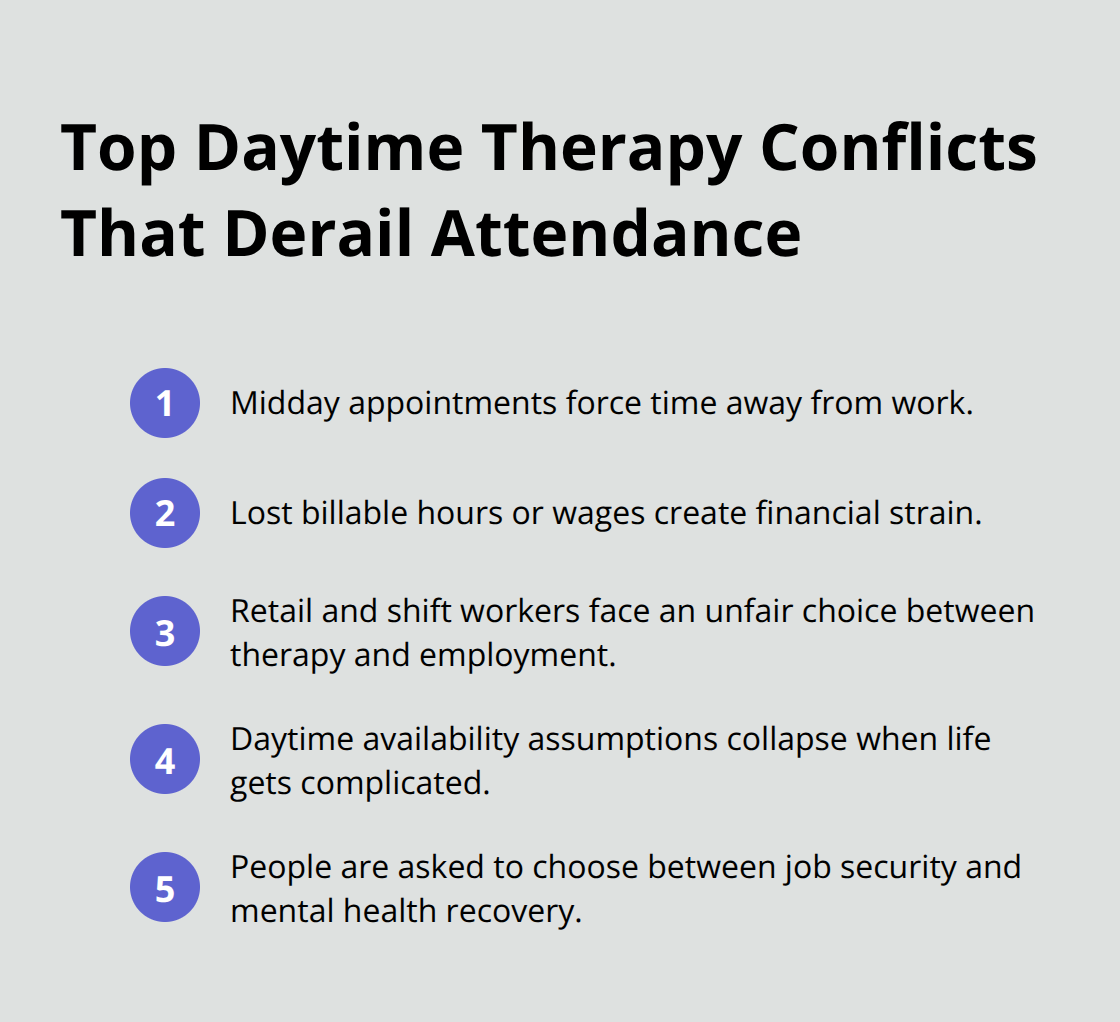
EveningIOP recognizes that forcing people to choose between their job and their mental health recovery is a broken system.
Family Responsibilities Create Scheduling Walls
Parents juggling school pickups, childcare, or aging parent care hit the same barrier. One missed session because your child got sick or your car broke down compounds the guilt, and consistency crumbles. Night-shift workers sleep during therapy hours. Gig economy workers cannot block out predictable time slots. Mental health crises arrive on their own timeline, not during therapist office hours. A panic attack at 10 p.m. or suicidal thoughts at midnight do not pause until Monday morning.
The Cost of Missing Sessions
When therapy conflicts with work, people stop attending. Research on treatment adherence shows that consistency matters more than frequency, yet traditional daytime scheduling guarantees inconsistency for working adults. Each missed appointment delays progress, resets momentum, and deepens the belief that recovery is not possible right now. The result is that therapy becomes a luxury for people with flexible jobs, which is why evening and nighttime access is not a nice-to-have feature-it is a clinical necessity.
Skipping treatment because of scheduling conflicts is not a personal failure; it is a system failure. Evening therapy directly solves this problem. The next section explores how telehealth and after-hours providers are reshaping access to care.
Where Evening Therapy Actually Exists Today
Telehealth Transformed After-Hours Access
Telehealth fundamentally changed what evening therapy means. Before 2020, after-hours care meant a crisis line or the emergency room. Today, licensed clinicians conduct real therapy sessions from 6 p.m. onward through video platforms, eliminating the need for patients to travel or take time away from work. This shift matters because a person working until 5:30 p.m. can now attend a session at 7 p.m. without commuting across town. The logistics suddenly become workable. Platforms like Zoom, Thera, and SimplePractice made this scalable, allowing providers to manage evening schedules without building expensive brick-and-mortar locations in every neighborhood. The technology removes excuses; what remains is actual access.
Providers Now Compete on Evening Availability
Provider adoption accelerated faster than many expected. Mental health organizations now compete directly on evening availability rather than treating it as an afterthought. Therapists who once worked 9 a.m. to 5 p.m. now structure practices around 6 p.m. to 9 p.m. slots because demand is undeniable. This demand reflects reality: working adults with substance use disorders, anxiety, or depression cannot attend daytime programs without risking employment.
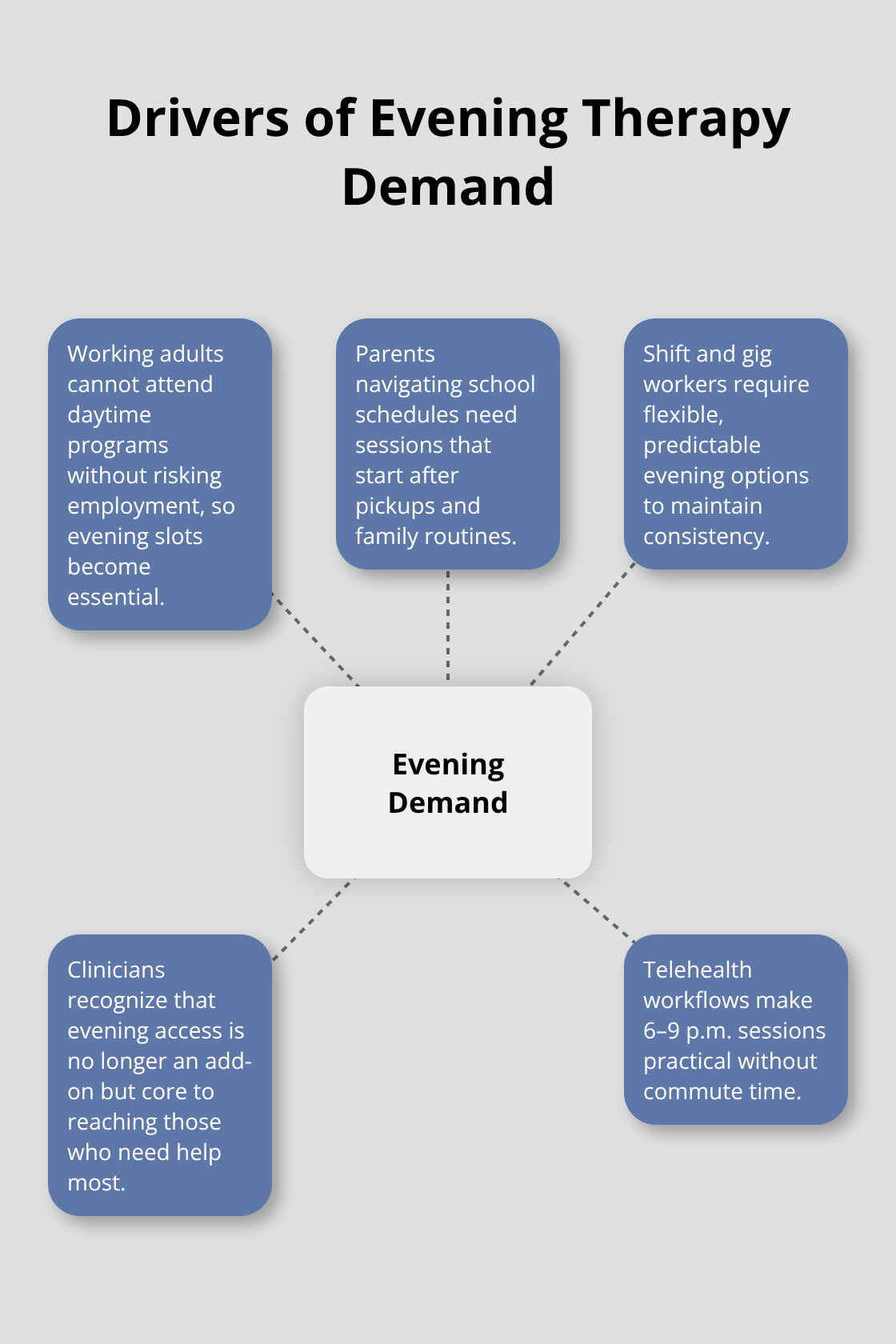
Parents managing school schedules, shift workers, and gig economy participants finally have legitimate options instead of choosing between recovery and financial survival.
Why Attendance Consistency Improves
When providers offer evening access, attendance consistency improves measurably because the scheduling conflict disappears. Evening programs address this reality directly. Industry standards shift when enough practitioners recognize that evening availability is not a luxury add-on but the price of entry for reaching people who need help most. Working adults with substance use disorders, anxiety, or depression now have programs designed around their actual lives rather than around therapist convenience.
What Evening Programs Look Like in Practice
Live video sessions connect you with licensed clinicians and peers in real time, combining interactive online group therapy, one-on-one sessions, and remote drug and alcohol testing. This model demonstrates how evening programs function in real practice: they integrate multiple therapeutic modalities into flexible time slots that accommodate work schedules and family responsibilities. Other providers have adopted similar structures, recognizing that evening access requires more than simply moving office hours. It requires rethinking how therapy itself is delivered.
The question shifts now from whether evening therapy exists to how people actually find and access the right program for their specific needs and circumstances.
Evening Therapy Reshapes Recovery Outcomes
Consistency Becomes Automatic When Schedules Align
When therapy schedules match your actual life instead of forcing your life to match therapy schedules, everything changes. Attendance consistency becomes automatic rather than a constant struggle. Someone working until 5:30 p.m. who attends a 7 p.m. session every Tuesday and Thursday maintains momentum without sacrificing income or job security. That consistency compounds.
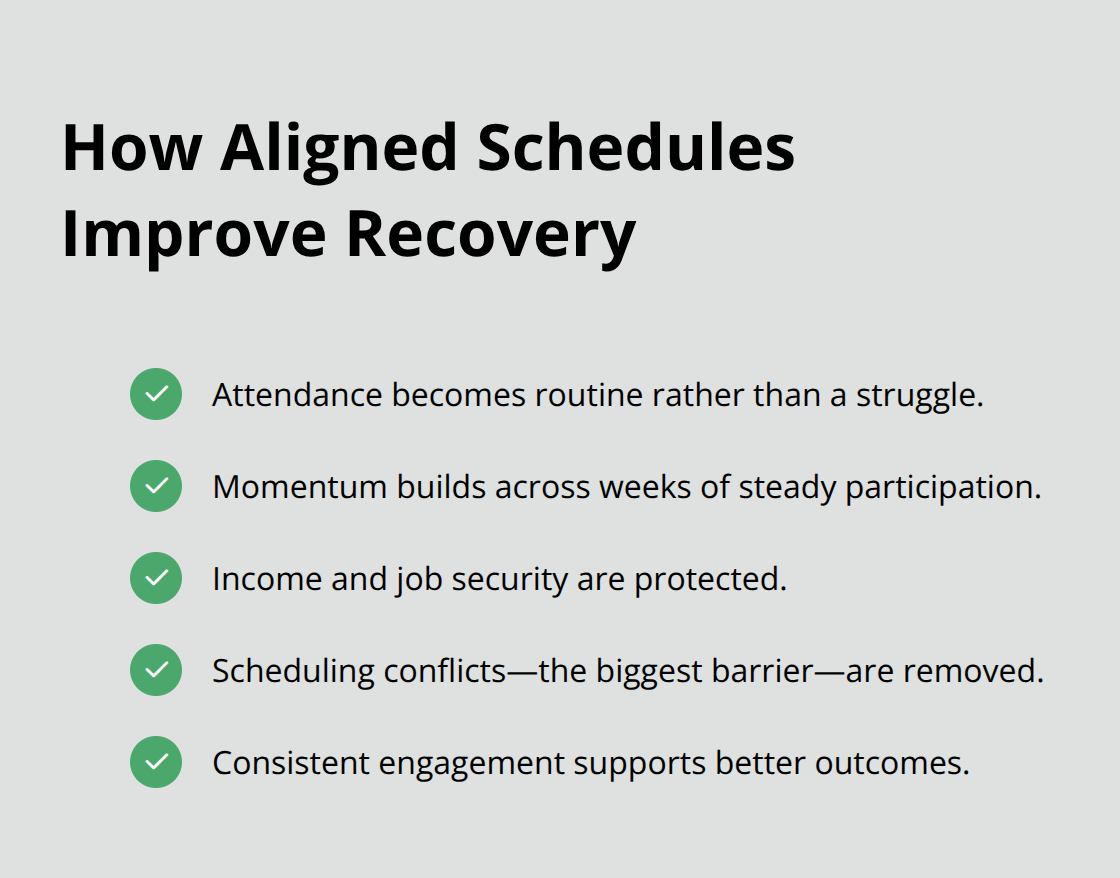
Research on substance use treatment shows that regular attendance directly correlates with better outcomes, and evening programs eliminate the single largest barrier to that consistency: scheduling conflict.
Stress Relief Extends Beyond Simply Showing Up
Working adults managing recovery alongside employment experience measurable psychological relief when they no longer face the choice between attending therapy and keeping their job. That relief matters clinically because anxiety and stress actively undermine treatment effectiveness. When a parent no longer scrambles for childcare coverage or calls in favors to attend appointments, they arrive at sessions mentally present rather than distracted by logistics. Shift workers who previously missed appointments entirely because daytime sessions conflicted with sleep schedules now maintain consistent engagement.
Engagement Deepens Through Peer Connection and Accountability
One-on-one sessions combined with group therapy in evening formats create accountability through peer connection while respecting work and family demands. Clients report higher engagement in sessions, deeper participation in therapeutic work, and stronger commitment to treatment goals when the program itself removes the friction that made consistency impossible before. Evening access fundamentally alters how effectively therapy works for working adults and families managing complex schedules.
Final Thoughts
Evening therapy removes the false choice between recovery and employment. When nighttime behavioral therapy access becomes available, working adults stop sacrificing mental health for financial stability. Parents stop missing sessions because of school pickups, and shift workers stop sleeping through daytime appointments. The barrier that made consistency impossible simply disappears, and treatment becomes clinically viable for people whose lives do not fit traditional office hours.
This shift directly improves outcomes because consistency compounds over time. When people attend sessions regularly without logistical stress, they engage more deeply in their own recovery. The psychological relief of not choosing between therapy and work removes a significant source of anxiety that actively undermines treatment effectiveness. Peer connection in evening group settings creates accountability while respecting the reality of working life.
Finding the right evening program requires looking beyond availability alone. The program should offer licensed clinicians, evidence-based treatment modalities, and accountability structures that support long-term recovery. EveningIOP combines interactive online group therapy, one-on-one sessions with licensed clinicians, and remote drug and alcohol testing, all scheduled during evening hours when working professionals and families can actually participate.