
Substance use disorder treatment shouldn’t drain your bank account. At EveningIOP, we’ve designed programs that fit your schedule and your budget, proving that affordable evening SUD care doesn’t mean compromising on quality.
Working professionals often skip treatment because they think recovery requires leaving their job. We’re here to show you that’s not the case.
Why Evening Programs Cost Less Than Traditional Inpatient Treatment
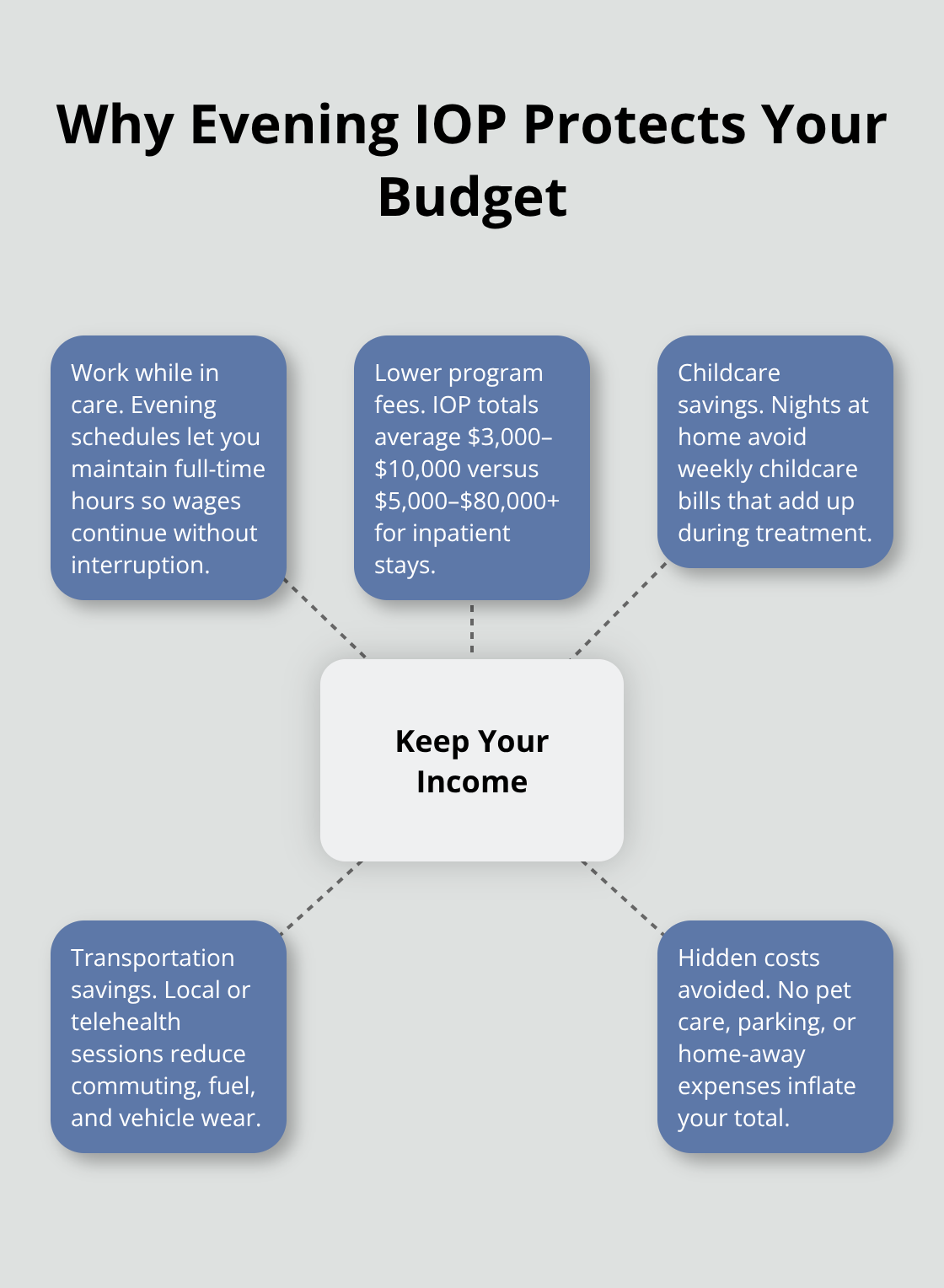
Evening Intensive Outpatient Programs cut treatment costs dramatically compared to residential facilities. Inpatient addiction treatment runs $5,000 to $80,000+ depending on stay length, while IOP programs average $3,000 to $10,000 total. The difference isn’t just a few hundred dollars-it’s tens of thousands. Evening programs eliminate the expense of 24/7 facility operations, meals, overnight staff, and bed space. You attend sessions at night, then return home. That operational efficiency translates directly to your wallet.
Your Paycheck Stays Intact During Treatment
The real financial advantage of evening treatment extends far beyond program fees. Inpatient care forces you to stop working. A person earning $50,000 annually loses roughly $4,167 per month during a 30-day residential stay. Evening programs let you work full-time while you receive treatment, which means your paycheck continues uninterrupted. If you work part-time or freelance, evening scheduling becomes even more valuable-you control which clients you serve and when.
This income continuity matters far more than most people realize when you calculate true treatment costs. Research shows that maintaining employment during recovery increases long-term sobriety rates, so evening programs actually improve outcomes while you keep money in your pocket.
Childcare and Transportation Costs Disappear
Inpatient treatment forces you to arrange childcare for weeks or months, which costs $150 to $300+ per week depending on your area. Evening programs mean you return home by bedtime, so your children stay in their regular routine. You skip the extra childcare expense entirely. Transportation costs also shrink. You don’t travel to a distant residential facility; you attend sessions locally, often through telehealth options. Live telehealth evening sessions eliminate commute costs altogether for some clients. If you have a car payment and gas budget, evening treatment means fewer miles, lower fuel costs, and less vehicle wear. For people without reliable transportation, telehealth evening options remove that barrier completely.
Hidden Savings Add Up Faster Than You Think
These indirect savings-childcare, gas, parking-accumulate to $200 to $500 monthly for many families, which rivals the program fee itself. A parent who pays $250 weekly for childcare during a 12-week inpatient program spends $3,000 on care alone. Evening treatment preserves that money. You also avoid the costs of arranging time off work (lost wages beyond your salary), pet care, and home maintenance while you’re away. When you add program fees ($3,000 to $10,000), lost income ($4,167+ monthly), childcare ($3,000+), and transportation ($500+), inpatient treatment easily exceeds $15,000 to $25,000 out of pocket. Evening programs cost a fraction of that total expense. The financial case for evening care becomes clear once you account for what you actually spend, not just what the facility charges.
These cost advantages make evening treatment accessible to working professionals who thought recovery was out of reach. The next section shows what you actually receive in these affordable programs-and why clinical quality doesn’t suffer when costs drop.
What You Actually Get in Affordable Evening Treatment
Clinical Quality Matches Inpatient Standards
Affordable evening SUD care delivers genuine clinical services, not a watered-down alternative. Evening programs provide live telehealth group therapy sessions led by licensed clinicians, individual counseling with addiction specialists, and remote drug and alcohol testing-all integrated into your evening schedule. You pay less because evening programs eliminate the overhead that inpatient facilities carry, not because you receive inferior treatment. The American Society of Addiction Medicine standards apply equally to evening programs and residential centers. Your clinician holds the same credentials, your therapies follow the same evidence-based protocols, and your treatment plan addresses the same clinical needs. The difference is operational, not clinical.
How Extended Treatment Improves Your Outcomes
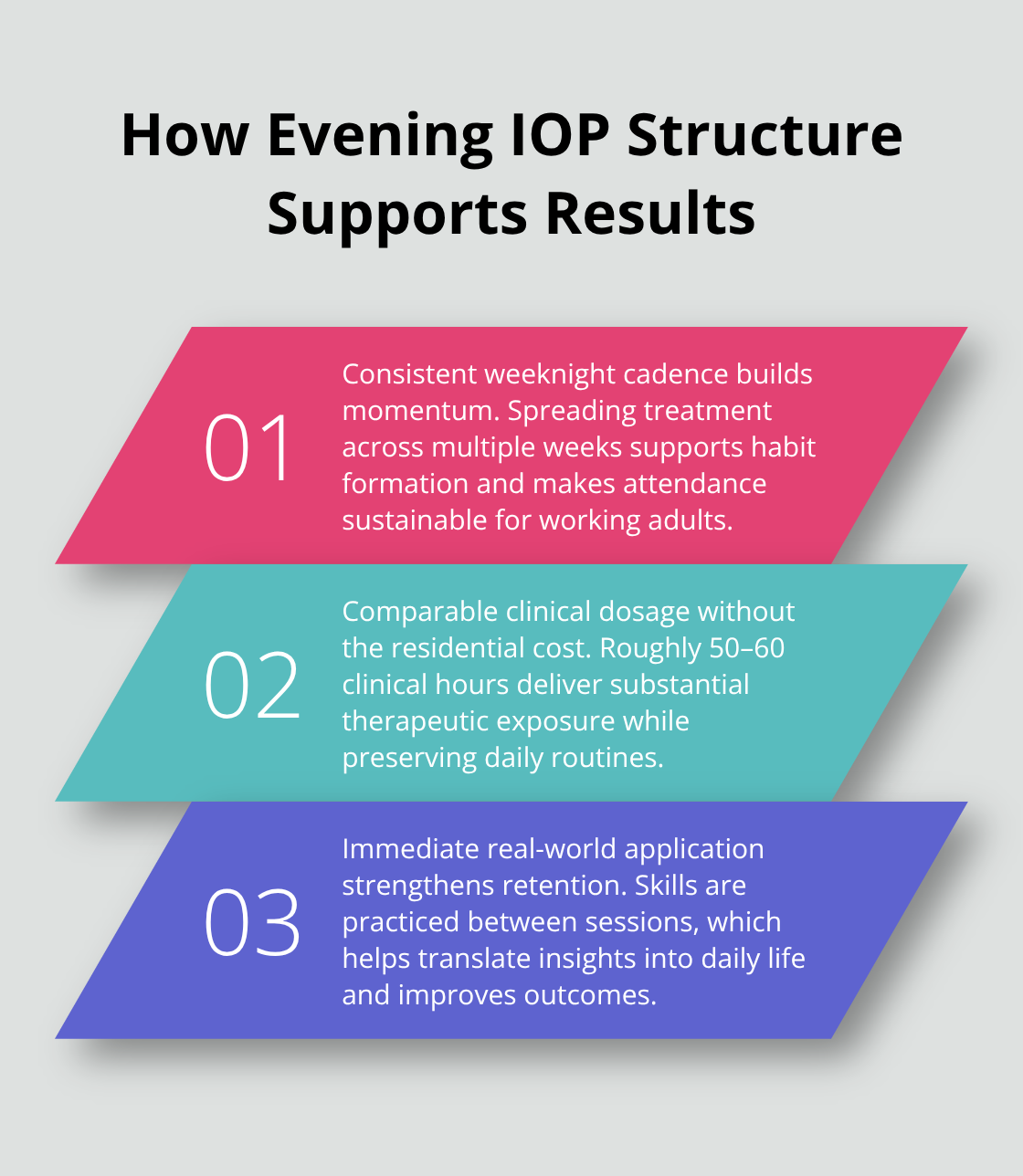
Evening programs typically run three to five nights per week for 9 to 12 weeks, with each session lasting two to three hours. This structure delivers roughly 50 to 60 clinical hours over the program duration-comparable to shorter inpatient stays but spread across weeks instead of concentrated into days. Research shows this extended timeline actually improves retention and outcomes because you apply what you learn immediately to your real-world environment rather than returning home and struggling to translate residential insights into daily life.
Testing and Supervision Remain Part of Your Fee
Drug and alcohol testing forms part of your program fee rather than a surprise additional charge. Most evening programs include weekly or twice-weekly urinalysis or breathalyzer testing within the base cost of $3,000 to $10,000 total. Some facilities charge separately for testing, so verify this during your intake call-ask specifically whether testing is bundled or if you’ll see separate invoices. Licensed clinical supervisors oversee your entire treatment journey, which means your progress isn’t managed by paraprofessionals or peer counselors alone. You receive direct contact with addiction medicine doctors or master’s-level licensed clinical social workers who adjust your treatment plan based on your response to therapy.
Evidence-Based Therapies Address Your Specific Needs
Group sessions focus on cognitive behavioral therapy, motivational interviewing, and relapse prevention-the same evidence-based modalities used in inpatient settings. Individual sessions address co-occurring mental health issues like depression or anxiety that often accompany substance use disorder. Licensed clinicians tailor these interventions to your circumstances, not a one-size-fits-all protocol. This personalized approach (combined with evening flexibility) creates conditions where you actually stick with treatment and apply skills to your daily life.
Insurance Coverage Simplifies Your Payment
Insurance frequently covers these services at the same rate as inpatient treatment because they meet the same clinical standards. Medicaid expansion states now cover IOP services for low-income individuals, and private insurance plans typically include outpatient addiction treatment as a covered benefit under mental health parity rules. Contact your insurer before enrollment to confirm your specific coverage level and out-of-pocket responsibility. Once you understand what your insurance covers, the next step involves finding a program that matches both your clinical needs and your financial reality.
How to Find Evening Programs Worth Your Money
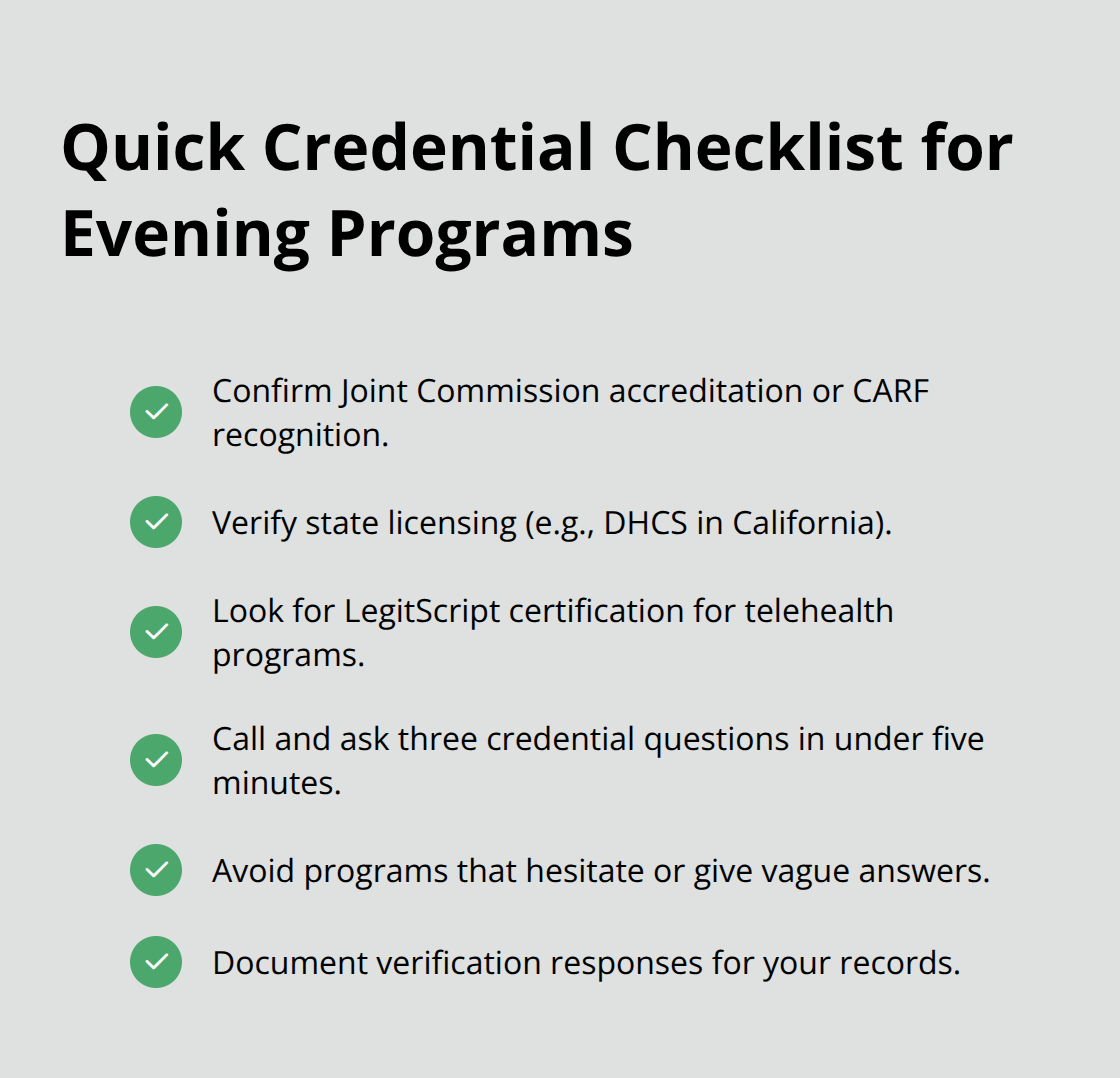
Finding a legitimate evening SUD program requires you to verify three concrete details before you enroll: accreditation status, actual service offerings, and what your insurance actually covers. Start with accreditation because it’s your clearest signal of quality. Search for programs accredited by The Joint Commission or CARF (Commission on Accreditation of Rehabilitation Facilities), which means independent auditors have verified that the program meets clinical and operational standards. CARF is the only entity approved by the American Society of Addiction Medicine to certify residential substance use disorder treatment services. Ask the program directly about their accreditation status-if they hesitate or give vague answers, move on. DHCS licensing (in California) or equivalent state licensing in your location confirms the program operates legally and meets state requirements. LegitScript certification indicates the program follows legitimate telehealth practices, which matters for evening programs delivered online. You can verify these credentials in under five minutes by calling the program and asking three questions: Are you Joint Commission accredited? Are you state-licensed? Do you hold LegitScript certification? A quality program answers yes to all three without defensiveness.
Demand Specifics About What Your Program Includes
Next, request specifics about what the program actually includes in its fee. Don’t accept vague descriptions like comprehensive care or evidence-based treatment. Ask whether drug and alcohol testing is bundled into the stated price or billed separately, how many individual sessions per week you receive versus group sessions only, whether a licensed physician reviews your treatment plan, and whether the program adjusts your care if you’re not responding to therapy. Request the program schedule in writing-nights and days of operation matter because some evening programs only run three nights weekly, which may not fit your schedule. Compare what three different programs offer at similar price points because a program charging $8,000 for 12 weeks should deliver more contact hours or additional services than one charging $4,000 for the same duration. The Retreat in Minnesota offers their 18-week Evening Program as a low-barrier alternative grounded in Alcoholics Anonymous principles, which tells you exactly what you’re receiving and for how long. When programs provide specific details upfront, they’re confident in their service quality. When they stay vague, they’re hiding something.
Verify Your Insurance Coverage Before You Commit
Contact your insurance company directly before you commit to any program, not after. Call the number on the back of your insurance card and ask whether they cover outpatient addiction treatment, what your coinsurance or copay percentage is, and whether the program you’re considering is in-network. Out-of-network programs may still be covered, but you’ll pay more out of pocket. Ask specifically whether telehealth sessions receive coverage at the same rate as in-person care, since some plans limit telehealth reimbursement. If you have Medicaid, confirm whether your state expanded Medicaid coverage for addiction treatment and whether the program accepts your specific Medicaid plan. If you’re uninsured, ask the program about sliding-scale fees or payment plans-many programs adjust costs based on your income. SAMHSA’s FindTreatment.gov database lets you filter programs by insurance accepted and cost level, which cuts your research time significantly. The Partnership to End Addiction’s hotline at 1-800-662-4357 also helps you navigate insurance coverage and locate affordable programs in your area. Programs that refuse to discuss payment options upfront or pressure you to commit before you understand your insurance coverage are not worth your time. EveningIOP, which is DHCS-licensed, Joint Commission-accredited, and LegitScript-certified, coordinates with your insurance and explains your financial responsibility clearly during intake, making the enrollment process transparent and straightforward.
Final Thoughts
Evening programs deliver clinical effectiveness at a fraction of inpatient costs because they eliminate unnecessary overhead, not clinical quality. You receive the same evidence-based therapies, the same licensed clinicians, and the same rigorous supervision as residential treatment while you keep your job, your paycheck, and your family routine intact. The financial advantage compounds when you account for avoided childcare, transportation, and lost wages-a 12-week evening program costs $3,000 to $10,000 total, while inpatient care easily exceeds $15,000 to $25,000 when you factor in indirect expenses.
Affordable evening SUD care works because it matches how working professionals actually live. You attend sessions at night, apply what you learn to your real-world environment immediately, and return to work the next morning. Insurance covers these services at the same rate as inpatient care, and sliding-scale options exist for uninsured individuals, making treatment accessible to low-income adults who previously had no realistic option.
Taking the first step means verifying three concrete details: accreditation status, specific service offerings, and your insurance coverage. Call SAMHSA’s helpline at 1-800-662-4357 if you need guidance navigating these decisions, or explore EveningIOP’s live, telehealth evening Intensive Outpatient Programs that combine interactive group therapy, one-on-one sessions with licensed clinicians, and remote drug and alcohol testing-all designed to fit your evening schedule.