

What You Should Know
- Evening Intensive Outpatient Programs (IOPs) are a great option if you want to continue working or taking care of your home while receiving treatment. They are best for those who have a solid support system in place.
- Residential treatment gives you round-the-clock support in a controlled environment. It’s most suitable for those who have severe substance use disorders or unstable living conditions.
- Your personal circumstances, such as the severity of your condition, your support network, and your previous treatment history, should guide your decision about which treatment to choose.
- An ASAM offers personalized assessments to help you figure out which level of care is best for your recovery needs.
- The most effective treatment plan often involves moving between levels of care as you progress on your recovery journey.
Choosing the right treatment option can be stressful when you’re already dealing with addiction or mental health issues. The choice between an Evening Intensive Outpatient Program (IOP) and residential treatment isn’t always clear-cut.
Deciding on the best treatment method can significantly impact your path to recovery from addiction. Addiction Resource Center offers thorough evaluations to help you decide if an Evening IOP or a residential treatment is more suitable for your unique needs and situation. This way, you can begin your recovery journey with the most fitting level of care.
Understanding the Differences Between Evening IOP and Residential Treatment
There are a variety of treatment programs available, each with different levels of intensity and structure. Evening IOP and residential treatment are two such programs, each unique in their own way. By understanding the differences between these two programs, you can make a more informed decision about which one might be the best fit for you.
Evening IOP: Receiving Treatment While Living at Home
Evening Intensive Outpatient Programs usually require you to attend treatment sessions 3-4 times per week, each lasting around 3 hours. These programs are deliberately scheduled in the evenings to allow for work or school commitments during the day. You’ll take part in group therapy, individual counseling, and learn about addiction and recovery, all while continuing to live at home and manage your daily responsibilities.
The structure offers substantial clinical support while letting you apply recovery skills in your real-life environment right away. This combination of treatment with everyday life can be both difficult and advantageous, as it aids in bridging the gap between therapy and practical application.
Residential Treatment: Round-the-Clock Structured Support
Residential treatment means staying at a treatment facility full-time, usually for a period of 30 to 90 days, based on your specific requirements. Your days are extremely structured with a schedule that includes individual therapy, group sessions, educational workshops, and recreational activities. The environment is controlled to reduce triggers and distractions, allowing you to concentrate solely on recovery.
When you opt for residential treatment, you’re provided with 24/7 support from clinical staff who can help you manage your medication, deal with emotional crises, and build healthy routines. This all-inclusive approach creates a safe space where you can lay the groundwork for recovery before you have to face the challenges of the real world.
Different Time Commitments
There is a significant difference in the time commitment required for these two options. Evening IOP usually requires 9-12 hours of direct treatment per week. The sessions are scheduled in such a way that they do not interfere with work or family commitments. This allows you to continue working, going to school, and taking care of your family while you receive treatment.
On the other hand, residential treatment is a full-time commitment where you temporarily step away from external responsibilities to focus solely on recovery. This 24/7 immersion provides approximately 40+ hours of structured therapeutic activities weekly, plus constant access to support during evenings and weekends.
Who Evening IOP Programs Are Best Suited For
Evening IOP is a great fit for many people, but it’s not for everyone. Some situations and personal traits make this type of care especially beneficial.
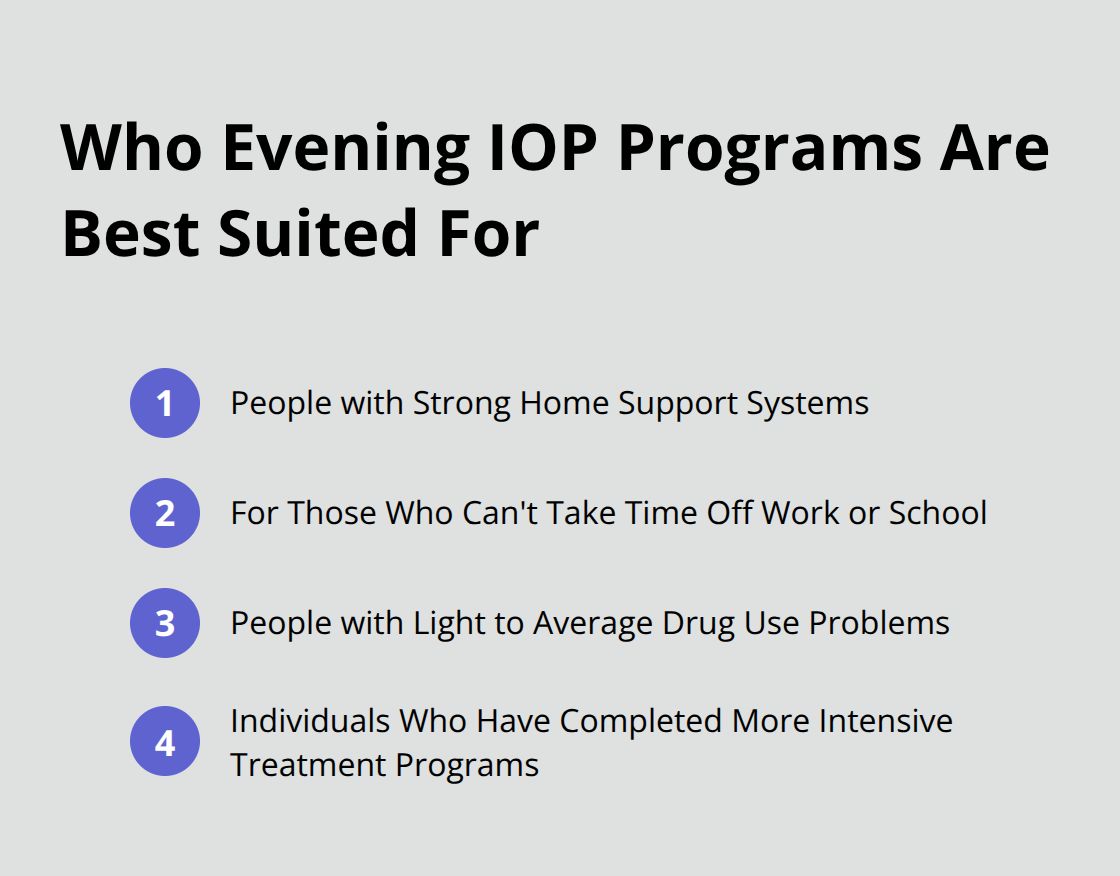
People with Strong Home Support Systems
Having a strong support system at home is one of the key factors that can contribute to the success of Evening IOP. If you have family members, partners, or roommates who understand what you’re going through and actively support your recovery, it can make a big difference. These supportive people can help you stay on track between treatment sessions by maintaining a substance-free home, offering you encouragement when things get tough, and noticing any warning signs if you start to have difficulties.
The support network you create becomes an integral part of your treatment team, and they can help keep track of your progress and keep you accountable. Without this support, the independence that outpatient treatment provides can sometimes lead to a higher risk of relapse.
For Those Who Can’t Take Time Off Work or School
Evening IOP programs are made with the working professional or student in mind. If you need to keep your job or stay in school for financial or career reasons, an evening program lets you get the help you need without throwing a wrench in your work or school life.
Keeping this balance can actually help your recovery by keeping your usual routines and keeping your sense of purpose and accomplishment. Many people find that continuing to work while in treatment helps maintain self-esteem and provides structure that complements the recovery process.
People with Light to Average Drug Use Problems
The severity of drug addiction greatly influences treatment suggestions. Evening IOP is usually suitable for those with light to average drug use disorders who don’t need medical detox or constant monitoring. If you can stay sober between sessions and handle cravings with help, outpatient care might offer enough structure.
If you’ve tried substances or have developed unhealthy habits but aren’t seriously physically dependent, this might be the right setting for you. The most important thing is whether or not you can stay sober during the hours when you’re not in treatment.
Individuals Who Have Completed More Intensive Treatment Programs
Evening IOP is frequently used as a step-down level of care for individuals who have completed residential treatment or partial hospitalization programs. Evening IOP is designed to help ease the transition back to independent living after having built a solid foundation in a more intensive setting. This allows for a gradual decrease in the intensity of treatment, giving you the opportunity to apply the skills you learned in recovery to real-world situations while still having the safety net of a clinical setting.
Several treatment programs are designed to include this gradual transition through different stages of care. This is because they acknowledge that recovery is a process that needs varying forms of assistance at different points. The ongoing responsibility of Evening IOP helps to strengthen the progress made in more intensive stages of care.
When You Need Residential Treatment
Evening IOP has its benefits, but there are times when you need residential treatment. You need to be able to identify these times to make the best treatment decisions for your recovery.
Intense Substance Addiction That Requires Detoxification
When addiction to substances is intense, the process of withdrawal can be not just uncomfortable, but potentially harmful or even fatal. Conditions such as alcohol withdrawal syndrome, benzodiazepine addiction, or severe opioid addiction often necessitate medical supervision during detoxification. Residential programs with medical capabilities can offer round-the-clock monitoring, medication management, and immediate intervention if complications occur. For those seeking flexible treatment options, evening IOP options might provide an alternative approach.
When you first stop using substances, you’re entering a risky period where having professional help can make a big difference. Residential treatment provides the medical care you need during this important time, and then smoothly transitions you into therapy.
Current Environment Puts You at High Risk of Relapse
Where you live can greatly affect your ability to stay sober, especially in the early stages of recovery. If you live with people who are still using substances, if drugs or alcohol are readily available in your home, or if the people you live with don’t support your recovery, it’s going to be much harder to stay sober while living there. Going to residential treatment takes you out of that environment and gives you a safe place to start building the skills you need for recovery.
Even if you’re highly motivated, the environment around you can hinder your early attempts at recovery. Sometimes, you need a temporary break from a high-risk environment. This gives you the protected space you need to learn how to cope before you have to face these challenges again.
Mental Health Conditions That Occur Together
When mental health conditions like major depression, bipolar disorder, trauma disorders, or severe anxiety occur together with substance use disorders, the complexity of treatment increases substantially. Residential programs are usually better equipped to handle these dual challenges simultaneously. They have specialized staff, psychiatric services, medication management, and therapeutic approaches designed for co-occurring disorders.
When mental health symptoms and substance use combine, they often create a complicated cycle that requires an intensive intervention. Residential treatment offers a comprehensive approach and the clinical resources necessary to effectively address both aspects.
Past Unsuccessful Outpatient Attempts
If you’ve tried outpatient treatment before and haven’t been able to maintain your sobriety, this is an important clue about the level of care you might need. If you’ve tried lower levels of care multiple times and it hasn’t worked, it might be time to consider a more intensive approach.
Unpredictable Living Conditions
- Homelessness or unstable housing
- Living with people who are currently using substances
- Unsafe relationships or domestic violence
- No dependable way to get to treatment
- Environmental triggers that lead to substance use
Unpredictable living conditions can make outpatient treatment very difficult. It’s nearly impossible to focus on recovery when you’re not sure if you’ll have a safe place to sleep. Residential treatment solves this problem by giving you a stable, supportive place to live. This allows you to focus completely on getting better.
Several residential programs also collaborate with you on discharge planning that deals with housing stability, making them especially useful for those dealing with housing insecurity. This all-encompassing method guarantees that the progress made in treatment isn’t instantly compromised by returning to unstable living conditions.
Residential treatment is a safe haven for those in abusive or unstable relationships, offering specialized therapy to address the relationship dynamics that may contribute to substance use. This short-term separation allows for personal healing and the evaluation of relationship patterns with professional help.
Financial Aspects of Evening IOP and Residential Treatment
Deciding on the right treatment involves considering the financial implications of each option. Knowing the cost of Evening IOP compared to residential treatment can help you plan more effectively. Although the value of recovery is immeasurable, being realistic about the financial aspects can increase your chances of successfully completing treatment.
Common Cost Ranges Without Insurance
Evening IOP programs generally run between $250-500 per session, with total treatment costs falling between $7,000-12,000 for a typical 8-12 week program. On the other hand, residential treatment costs a lot more—around $20,000-35,000 for a 30-day program, due to the all-inclusive services, round-the-clock staffing, housing, meals, and extensive therapy provided. These numbers can change a lot depending on location, facility amenities, and specific clinical services offered.
Differences in Insurance Coverage
Insurance plans typically cover more of the cost for Evening IOP than residential treatment, which usually means lower out-of-pocket costs and less red tape. This is because insurance companies prefer to pay for less expensive care. However, if it can be shown that residential treatment is medically necessary—for example, if outpatient treatment hasn’t worked, if medical detox is needed, or if there are serious co-occurring disorders—insurance may cover a large part of the cost of residential treatment, once deductibles and co-insurance requirements have been met.
Queries for Your Insurance Provider
Prior to settling on a treatment choice, reach out to your insurance provider with these particular inquiries: Are both Evening IOP and residential treatment included in my plan? How is medical necessity determined? What are my expected out-of-pocket expenses for each option? How many days/sessions will be authorized at first? What paperwork is required from my provider to justify my treatment needs? What is the procedure if more treatment time is needed beyond the initial authorization? Having straightforward responses to these inquiries can help avoid unforeseen financial shocks during the treatment process.
Many treatment providers provide insurance verification services to help you understand your specific coverage and out-of-pocket responsibilities before making treatment decisions. Using these services ensures you can focus on recovery rather than unexpected financial concerns.
5 Questions to Help You Choose Between Evening IOP and Residential Treatment
Deciding on the right treatment for you involves a lot of self-reflection and consideration of many different factors. Use these questions to help guide your thoughts and discussions with healthcare providers as you figure out the best level of care for your circumstances.
These questions aren’t just a theoretical exercise. They’re the same questions that treatment professionals ask when they’re deciding what level of care to recommend. Your answers help identify the treatment environment that will provide the right balance of support and independence for your needs.
It’s important to keep in mind that there’s no one-size-fits-all solution to recovery. The “right” treatment choice is the one that caters to your unique combination of clinical needs, personal circumstances, and recovery goals.
1. How Serious Are Your Symptoms?
How often and how much you use substances, as well as the severity of your symptoms, are crucial factors in determining the right level of care. Think about it: Do you get withdrawal symptoms when you stop using? How often do you use substances and in what amounts? Can you control your use or stop once you’ve started? Have you had blackouts, serious health issues, or been in dangerous situations because of your use?
If you’re dealing with more severe issues, such as physical dependence that requires medical detoxification, daily heavy use, inability to maintain even brief periods of abstinence, or substance use that has led to serious consequences, it’s often recommended that you start with residential treatment.
If your usage is more sporadic or less severe, particularly if you’re not physically dependent, you might do well with Evening IOP. The main thing to consider is if you can stay sober between treatment sessions on your own, or if you need the around-the-clock support that a residential setting provides.
2. How Strong Is Your Support Network?
Your treatment success can be greatly influenced by the strength of your support network. Take a moment to consider your own support network: Do you have family members or friends who are actively supporting your sobriety? Is your home environment free from substances and triggers? Do you have people who can provide emotional support, transportation to treatment, or assistance with responsibilities during recovery?
Evening IOP is more likely to work for you if you have a robust support system. If you live with family members who are supportive of your recovery, they can help you remember what you learned in treatment, point out behaviors that are concerning, and encourage you between sessions. On the other hand, if you live alone, with people who are still using, or with people who don’t support your recovery, you might need the round-the-clock support of residential treatment to get sober initially.
3. What Are Your Work and Family Obligations?
Practical life circumstances significantly influence treatment decisions. Consider your non-negotiable responsibilities: Are you the primary caregiver for children or other family members? Would taking leave from work create financial hardship or career setbacks? Do you have educational commitments that cannot be paused? Evening IOP programs are specifically designed to accommodate these continuing responsibilities, while residential treatment requires temporary arrangements for work leave, childcare, and other obligations. Some employers offer short-term disability or FMLA leave that can facilitate residential treatment when needed, but these practical considerations must be realistically addressed in your decision.
4. What Is Your Treatment History?
Your past treatment experiences can provide valuable insight into what might work for you now. If you’ve tried outpatient programs several times and haven’t found long-term success, it may be an indication that you need a higher level of care. On the other hand, if you’re transitioning from residential treatment or hospitalization, Evening IOP might be the right level of continued support for you. The progressive nature of addiction often means that what worked in early recovery attempts may not be enough as the condition worsens, requiring more intensive interventions. Your treatment history can help create a roadmap to avoid repeating methods that haven’t produced lasting results for your specific situation.
5. What is the Opinion of Your Treatment Team?
Professional clinical evaluations offer unbiased advice that supplements your self-assessment. Addiction experts assess factors such as substance use habits, mental health symptoms, medical needs, past treatment responses, and support systems to suggest suitable care levels. These suggestions are based on recognized clinical criteria and professional experience with similar cases. While personal preferences and practical considerations are important, clinical suggestions should play a major role in your decision, especially regarding safety issues like withdrawal management or suicide risk that necessitate specific monitoring and intervention levels.
Deciding on Your Treatment and Taking the Next Step
Once you’ve taken all of these factors into account, it’s time to proceed with a treatment plan. Keep in mind that the perfect conditions are rare, and waiting for them can postpone necessary treatment. The best strategy often involves starting at the suggested level of care, even if it requires overcoming practical challenges, and then adjusting as you go along. Many paths to recovery actually involve several levels of care in order – perhaps starting with residential treatment for stabilization, then transitioning to Evening IOP for ongoing support while transitioning back into everyday life.
Once you’ve made your decision, act on it right away. Treatment centers can help with insurance verification, transportation arrangements, coordinating with employers for medical leave, and other logistical issues. Addiction Resource Center offer same-day admission services and can help with these practical arrangements, turning your decision to get treatment into action. The most important thing is to start the process, even if you’re not sure about some parts of what’s to come.
Common Questions
When you are evaluating your treatment choices, there are usually a few logistical questions that come up. Knowing the answers to these questions can help you get ready for treatment and set practical expectations for the process.
Often, people find that having answers to these questions can help reduce the anxiety of entering treatment and can help with making the necessary arrangements. If you have questions that we haven’t addressed here, our treatment admissions counselors can provide personalized answers that are specific to your situation.
What is the usual duration of Evening IOP treatment?
Evening IOP programs usually last from 8 to 12 weeks. However, this can change depending on the individual’s progress and needs. Most programs start with a more intensive schedule (3-4 evenings per week) and slowly decrease the frequency as the individual shows progress in recovery. The total duration can depend on factors such as symptom severity, co-occurring conditions, response to treatment, and insurance authorization.
Evening IOP often offers more flexibility in pacing than residential programs with fixed lengths of stay. Some people find it beneficial to extend the program beyond the standard timeframe, especially when dealing with ongoing challenges or needing extra support during stressful life transitions. Your clinical team will regularly check on your progress and recommend the right treatment duration.
Is it possible to transition from residential to Evening IOP?
Yes, it is not only possible to transition from residential to Evening IOP, but it is often a planned part of the treatment strategy. This staged approach allows for intensive stabilization, followed by continued support as the individual reintegrates back into their daily life. Many treatment providers, including Addiction Resource Center, offer both levels of care specifically to facilitate these transitions. Your treatment team will assess your readiness to transition based on your clinical progress, development of coping skills, and the stability of your home environment, coordinating the timing to maintain continuity of care throughout your recovery journey.
Will I be able to keep my job if I choose residential treatment?
Many employees are eligible for job-protected leave under the Family and Medical Leave Act (FMLA) when they seek addiction treatment. FMLA offers up to 12 weeks of unpaid leave while protecting your job and benefits if you work for a covered employer, have worked there for at least 12 months, and meet hour requirements. In addition, the Americans with Disabilities Act (ADA) may offer protections for those seeking treatment for substance use disorders. To take advantage of these protections, you’ll usually need documentation from healthcare providers about your need for treatment, but you don’t need to share specific details about your condition with your employer. If you’re struggling to find time for addiction treatment, evening IOP options might be worth exploring.
What if I have a setback during Evening IOP treatment?
Having a setback during Evening IOP doesn’t mean you’ve failed. Instead, it prompts a reevaluation of your treatment plan. Your clinical team will look at what led to the setback and might suggest changes like more frequent sessions, extra one-on-one therapy, changes in medication, or temporarily moving to a more intensive level of care. The focus is on finding and dealing with any issues in your recovery support, not on punishing you or kicking you out of treatment.
A lot of programs see relapse as a chance to bolster recovery abilities and pinpoint triggers that weren’t sufficiently dealt with. Being honest with your treatment team about any substance use is crucial, as it allows for necessary changes before patterns get out of hand. This cooperative method acknowledges recovery as a process that frequently includes drawbacks as well as advancements.
How can I find out if my insurance covers either treatment?
The best way to find out about your insurance coverage is to go through the benefits verification process. Addiction Resource Center, along with other treatment providers, offer free insurance verification services. They will contact your insurance company to find out exactly what your coverage is for both Evening IOP and residential treatment. They will also explain your benefits, including deductibles, co-payments, coverage limitations, and any requirements for pre-authorization.
If you want to check for yourself, you can call the behavioral health or substance abuse treatment number on your insurance card (it’s usually separate from the medical benefits). Ask them specifically about coverage for substance use disorder treatment for both outpatient and inpatient, what facilities are in their network, how long they typically authorize, and what you would be responsible for paying. Make sure to write down the name of the representative, the reference number for the call, and the specific coverage details that you talked about.
Many insurance plans offer better coverage for Evening IOP than residential treatment, but coverage for either option varies widely between plans. When a medical need can be proven, many plans cover significant parts of treatment costs after deductibles are met. In addition, many treatment centers offer financing options, sliding scale fees, or payment plans to make treatment more accessible regardless of insurance coverage.
Insurance confusion should never be a barrier to seeking help. Admissions specialists at treatment centers know the ins and outs of these systems and can help you figure out the most affordable options for your unique situation. Keep in mind that investing in effective treatment now can often prevent much higher costs—both financial and personal—that come with untreated addiction.
No matter if you select Evening IOP or residential treatment, the most important thing is that you’re taking that initial step towards recovery. Addiction Resource Center offers both of these treatment options and can assist in deciding which one is the best fit for your needs, giving you the appropriate amount of support for your individual recovery journey.