


Addiction treatment shouldn’t require you to choose between recovery and your career. At EveningIOP, we’ve seen how insured telemedicine addiction care removes the financial and logistical obstacles that keep people from getting help.
When insurance covers your sessions, treatment becomes accessible on your schedule-not someone else’s.
What Insurance Actually Covers for Telemedicine Addiction Treatment
We at EveningIOP work with major insurance providers including Aetna, Anthem, Cigna, UnitedHealthcare, Blue Cross Blue Shield, Humana, Kaiser Permanente, Molina, Optum, Magellan, and Tufts Managed Health Network. Medicaid and Medicare also cover telemedicine addiction services, though coverage varies by state and plan. The shift toward telehealth reimbursement happened fast. According to a 2025 analysis in JAMA Network Open covering claims from Medicaid managed care, Medicare Advantage, and commercial plans across all 50 states, average monthly telehealth substance use disorder treatment services exploded from 44.6 in 2019 to 10,974.3 by 2023. That growth signals payers now treat telemedicine as standard care, not experimental.
When your plan covers a session, you pay only your copay or coinsurance, not the full session fee. Most treatment facilities charge $150 to $400 per hour for addiction counseling in-person; insured telehealth sessions reduce your out-of-pocket responsibility to $20 to $50 per visit depending on your plan design. Veterans access coverage through TRICARE and VA Community Care options, removing another major barrier for a population with high substance use disorder rates.
Insurance Coverage Solves the Rural Access Problem
Rural populations faced the steepest barriers to addiction care before telehealth expanded. Geographic isolation meant driving hours to reach a licensed provider, or not seeking treatment at all. Insurance coverage for telehealth changed this reality. The same 2025 JAMA Network Open study found rural areas saw an 89.9% increase in overall substance use disorder treatment services between 2019 and 2023, compared to only 48.7% growth in urban areas.

Rural patients using insured telemedicine no longer lose a full workday to travel. Telehealth eliminates that friction entirely. Your insurance covers the session from your home, eliminating transportation costs and time away from work or caregiving responsibilities. This matters because financial barriers and lack of insurance coverage were identified as core obstacles in research spanning 526 addiction treatment studies. When insurance removes the cost and travel burden simultaneously, treatment becomes feasible for people who previously had no realistic options.
How to Verify Your Coverage Before Starting
Call your insurance company directly or use your online member portal to confirm telemedicine addiction treatment coverage. Ask specifically whether your plan covers substance use disorder treatment via video, whether limits on sessions per year apply, and what your copay or coinsurance will be. Many facilities offer a coverage verification tool on their website; you provide your insurance information and receive a breakdown of what your plan will pay within 24 hours. This step prevents surprises at billing time.
Some plans require prior authorization before you start treatment, meaning your provider must obtain approval from your insurer first. Others allow you to start immediately and submit claims afterward. Knowing this distinction upfront saves weeks of delays. If you have Medicaid, coverage is generally strong for telemedicine addiction services, though the state you live in determines specifics. Medicare Advantage plans show the highest telehealth adoption rates for addiction care, according to the 2025 JAMA data, making this an especially accessible option for older adults in recovery.
What Happens After You Verify Coverage
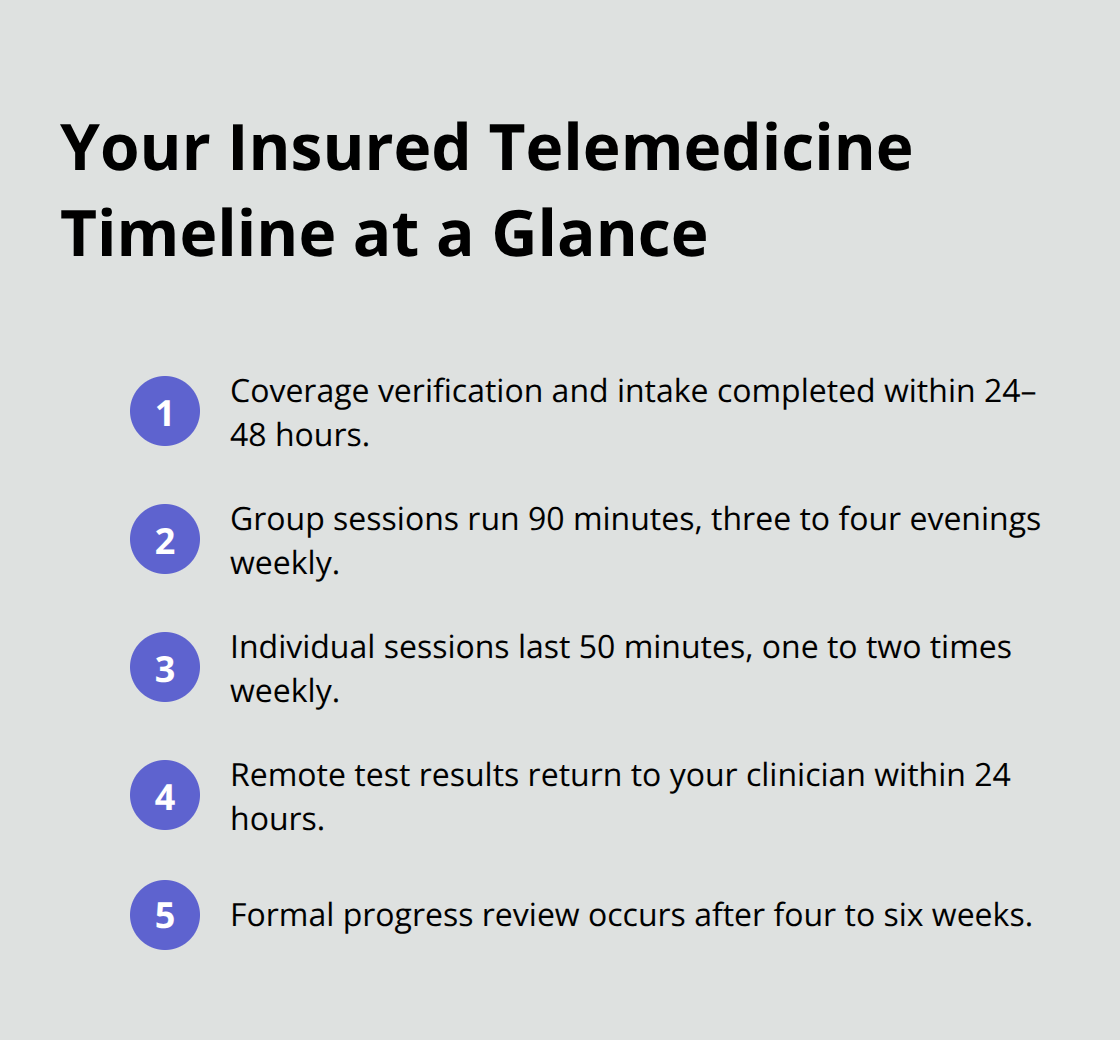
Once you confirm your insurance covers telemedicine addiction treatment, the next step involves connecting with a provider that accepts your plan. Your insurance company’s website lists in-network addiction treatment providers in your area. You can also contact facilities directly to ask whether they accept your specific plan. Most providers conduct an online intake form to gather your information and insurance details before your first session. This process typically takes 24 to 48 hours, and staff members confirm your coverage details during this time. Licensed clinicians then conduct your initial assessment and develop a treatment plan tailored to your needs and recovery goals.
Recovery Without Sacrificing Your Career
Evening Sessions Fit Around Your Work Schedule
Addiction treatment during standard business hours assumes you have the luxury of taking time off work. Most people in recovery don’t have that option. Evening sessions eliminate the need to request time off, reschedule client meetings, or explain absences to your employer. A professional managing a demanding job can complete an intensive outpatient program without colleagues noticing a pattern of missing afternoons. This matters for job security and career progression, especially for people early in their recovery when employment stability directly supports long-term sobriety.

Evening treatment also reduces the stress of juggling competing demands. You handle work responsibilities fully, then transition to treatment in the same way you’d attend any evening commitment. No mental energy gets spent on logistics or anxiety about work piling up while you’re in a session. This structural simplicity keeps your focus on recovery itself, not on the operational complexity of accessing care.
Telehealth Eliminates Travel Time and Hidden Costs
Travel time to treatment facilities represents a hidden but substantial barrier that most addiction care discussions overlook. If your provider is 45 minutes away and sessions run twice weekly, you spend nearly four hours monthly in transit, plus the cost of gas or rideshare. Telehealth eliminates this entirely. You log in from home or your office, saving that four hours for actual recovery work, family time, or work productivity.
For rural patients, this advantage multiplies. Telehealth expanded substance use disorder treatment access in rural areas, addressing longstanding distance barriers that prevent people from accessing care.
Flexibility Strengthens Treatment Consistency
Flexible scheduling within evening hours reduces no-shows. If a session runs at 6 PM and you’re stuck in traffic or a meeting runs late, you can join from your car or office without losing the session entirely. In-person programs require you to arrive at a specific location by a specific time, which creates friction points where life’s unpredictability derails treatment.
Telemedicine’s flexibility means you attend more sessions consistently, which research consistently shows strengthens treatment outcomes. People who maintain their jobs during recovery report higher completion rates because they preserve their sense of identity and purpose outside the treatment process. Consistency builds the therapeutic relationship with your clinician and reinforces the behavioral patterns that support recovery. When you show up reliably, your provider develops a deeper understanding of your specific challenges and can tailor interventions more effectively. This regularity transforms treatment from something you squeeze into your schedule into something that becomes part of your routine-and that shift matters enormously for long-term success.
What Happens When You Start Insured Telemedicine Treatment
The first three days after you decide to pursue treatment matter more than most people realize. Your insurance company needs to confirm coverage, your provider needs to understand your specific situation, and you need clarity on what sessions will actually look like. Knowing what happens behind the scenes helps you move faster.
Verify Your Coverage Before Your First Session
Contact your insurance provider’s customer service to ask specific questions about coverage for therapy and medication-assisted treatment. Ask whether your plan covers substance use disorder treatment via video, if there are annual session limits, and what your copay or coinsurance per visit is. Most representatives answer these questions in under five minutes. If your plan requires prior authorization, your provider’s intake coordinator handles this paperwork and typically receives approval within 24 to 48 hours. Do not assume your coverage is active until your provider confirms it in writing. Some patients start sessions only to discover later that their plan denied claims because authorization never went through. Verification upfront prevents this entirely.
Complete Your Intake Assessment
Once coverage is confirmed, your provider sends an online intake form that takes 10 to 15 minutes to complete. This form captures your medical history, current substance use patterns, any medications you take, and your treatment goals. Licensed clinicians review this information before your first session and develop an initial assessment that identifies your specific needs and risk factors. This assessment determines whether you start with group therapy only, one-on-one counseling only, or a combination of both. Treatment plans are not generic. Your clinician considers your work schedule, your family situation, your previous treatment experiences, and your stated recovery goals when designing your program structure.
Understand Your Treatment Model
The actual treatment model combines group and individual sessions because research shows this hybrid approach improves outcomes compared to either modality alone. Group therapy sessions run 90 minutes and typically meet three to four times weekly during evening hours. You participate in real-time discussion with five to eight other participants and a licensed therapist, working through challenges like managing cravings, rebuilding relationships, and handling workplace stress without substances. One-on-one sessions last 50 minutes and occur one to two times weekly, depending on your treatment plan. These sessions focus on issues specific to your situation that need deeper exploration than group settings allow. If you face legal complications related to your substance use, your individual clinician can coordinate with your attorney. If family conflict drives your addiction, your clinician can recommend family sessions or teach you communication strategies tailored to your relationships. If you struggle with depression or anxiety alongside substance use, your clinician can refer you to a psychiatrist for medication management while continuing your addiction-focused counseling.
Track Progress Through Remote Testing and Regular Reviews
Telemedicine treatment integrates remote drug and alcohol testing to provide objective accountability. You receive notice of testing days and complete tests from home using a testing kit, with results available to your clinician within 24 hours. This removes the shame and logistics of in-person testing while maintaining clinical integrity. Your treatment plan evolves as you progress. After four to six weeks, your clinician conducts a formal progress review and adjusts your schedule, intensity, or focus areas based on your actual performance and emerging needs.
This flexibility means treatment responds to your reality, not a predetermined template.
Final Thoughts
Insured telemedicine addiction care removes the two obstacles that have historically prevented working professionals from seeking treatment: cost and logistics. When your insurance covers sessions, you pay a fraction of the full fee and access care from home without travel time or scheduling conflicts. Rural patients gain access to licensed clinicians they previously couldn’t reach, and working parents maintain their employment and family responsibilities while pursuing recovery.
Professional recovery is achievable without sacrificing your career or family. Evening sessions fit around your work schedule, telehealth eliminates commute time, and flexible scheduling means you attend sessions consistently. This consistency strengthens your relationship with your clinician and reinforces the behavioral patterns that support long-term sobriety. You preserve your identity as a working professional, parent, or caregiver while addressing your substance use disorder.
Finding a provider that accepts your insurance takes three straightforward actions: contact your insurance company to confirm coverage for substance use disorder treatment via video and ask about your copay or coinsurance, search your insurer’s website for in-network addiction treatment providers in your area, and contact providers directly to confirm they accept your specific plan. Start your insured telemedicine addiction care journey with EveningIOP, where we offer live evening Intensive Outpatient Programs designed specifically for working professionals and families. Most facilities complete intake and coverage verification within 24 to 48 hours, meaning you can start treatment quickly once you’ve confirmed your benefits.