


Choosing a treatment program means trusting that your care meets real standards. At EveningIOP, we’re LegitScript certified, which means we’ve passed rigorous verification checks that protect you from unqualified providers.
Regulated nighttime recovery isn’t just safer-it’s designed for people like you who can’t pause their careers. Our accreditation proves we deliver clinical quality while fitting your actual life.
What LegitScript Certification Actually Protects
LegitScript certification isn’t a marketing badge-it’s a verification that your program meets standards set by Google, Meta, Microsoft, and Nextdoor before they’ll let addiction treatment providers advertise at all. These platforms demand proof of state licensing, legal compliance, staff credentials, and transparent advertising because unregulated operators exploit vulnerable people seeking recovery. When a program displays the LegitScript seal, independent auditors have checked that the facility address exists, services match what’s advertised, clinicians hold valid licenses, and privacy policies comply with HIPAA. This matters because SAMHSA data show that roughly 20 percent of people with substance use disorder seek treatment, yet many avoid programs after encountering predatory operators who overpromise results or hide costs.

The Verification Process Stops Deception
LegitScript reviews 16 core standards before certification, including whether staff qualifications are legitimate, whether advertising claims match actual services, and whether the program prohibits conflicts of interest like undisclosed ties to lead generators. Providers must disclose any criminal, regulatory, or civil violations from the past ten years, and ongoing monitoring catches compliance drift after certification. This systematic approach stops common scams: facilities claiming board-certified staff without verification, overstating success rates without data, or using stock photos instead of actual facility images. The certification process costs facilities roughly $1,395 to $1,595 to apply and $2,550 to $3,095 annually, creating a financial barrier that weeds out fly-by-night operators without legitimate infrastructure.
Licensed Clinicians Meet Regulatory Standards
A certified program signals that treatment intensity and clinical protocols meet regulatory standards equivalent to daytime programs. Cognitive behavioral therapy and dialectical behavior therapy require licensed clinicians trained in these approaches, not counselors working outside their scope. Remote drug and alcohol testing, integrated into certified programs, provides objective progress tracking rather than subjective assessments alone. When you enter a LegitScript-certified evening program, you join a regulated environment where your clinician’s license can be verified through your state board, where your data privacy receives legal protection, and where the program’s advertising matches its actual operations.
What Verification Means for Your Treatment
The LegitScript seal tells you that someone independent has verified the program’s legitimacy before you invest time and money in recovery. You avoid wasting resources on operators who misrepresent credentials, hide their actual facility location, or claim success rates they can’t support with evidence. Certified programs maintain transparent pricing, disclose all incentives to patients, and operate under ongoing monitoring that catches problems before they harm your treatment. This verification layer protects not just your recovery journey but also your employment status, financial stability, and trust in the care you receive.
Working professionals need more than just evening hours-they need assurance that their program operates with the same clinical rigor and accountability standards that regulated daytime programs maintain.
How Evening Programs Work for People Who Work
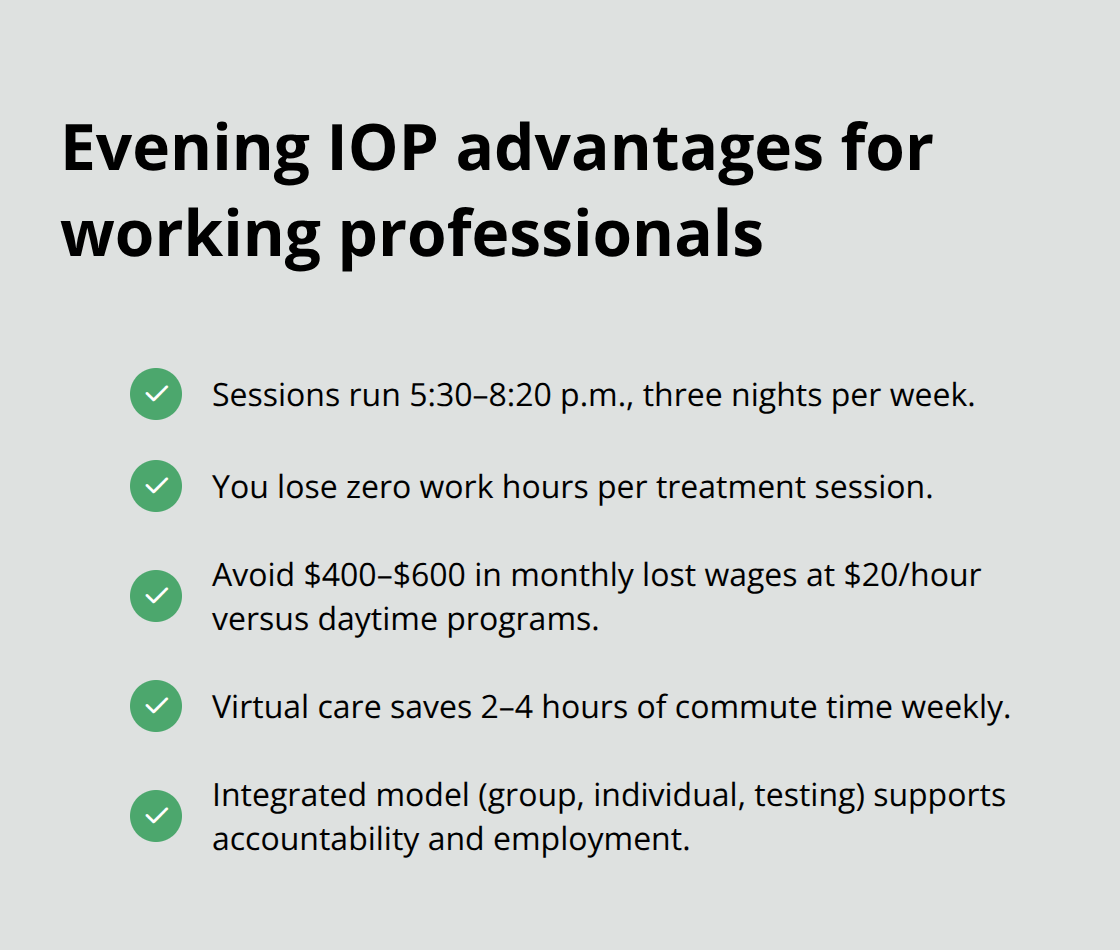
Recovery shouldn’t force you to choose between your paycheck and your health. SAMHSA data show that the majority of people with substance use disorder are employed, yet roughly 80 percent never seek treatment because daytime programs demand they stop working. Evening programs eliminate this barrier by running after typical work hours, usually five to eight-thirty in the evening, three nights per week. Sessions run on evenings from five-thirty to eight-twenty p.m., which means you attend treatment after work and still show up to your job the next morning without gaps in your employment history. This scheduling protects your income stability in concrete ways: you lose zero work hours per treatment session compared to daytime programs that demand four to six hours weekly during business hours. If you earn twenty dollars per hour, a daytime program costs you roughly four hundred to six hundred dollars monthly in lost wages before you count transportation, childcare, or time away from clients or projects. Evening programs eliminate that hidden cost entirely.
Clinical Intensity Stays the Same When Hours Shift
The clinical intensity doesn’t drop because the schedule shifts. Licensed clinicians deliver the same evidence-based treatment protocols including cognitive behavioral therapy and dialectical behavior therapy in structured group sessions, individual therapy addressing your specific recovery goals, and remote drug and alcohol testing that tracks progress objectively. Remote testing matters for working professionals because you complete tests at home or at a lab near your workplace rather than missing hours to attend testing appointments. Joint Commission accreditation and DHCS licensing mean the program meets the same regulatory standards as inpatient and daytime outpatient programs, not a watered-down evening alternative. When you verify that a program holds these credentials and displays LegitScript certification, you know the clinicians are actually licensed, the treatment protocols are evidence-based, and the program operates under ongoing regulatory oversight.
Virtual Delivery Protects Your Work Schedule
Virtual delivery further protects your work schedule by eliminating commute time, which can add two to four hours weekly for people traveling to physical facilities. You attend sessions from home, which also means you can practice the coping skills learned in group therapy immediately at work the next day, reinforcing progress in real-world conditions rather than in a clinic environment disconnected from your actual stressors. This flexibility matters most when your work situation changes-you can shift between virtual and in-person sessions without losing continuity of care. The integrated model (group therapy, individual sessions, and testing) reinforces accountability and supports employment during recovery without forcing you to sacrifice either one.
The question shifts now from whether you can fit treatment into your life to whether your program actually delivers the clinical quality that working professionals deserve.
What Makes Regulated Programs Clinically Equivalent to Daytime Care
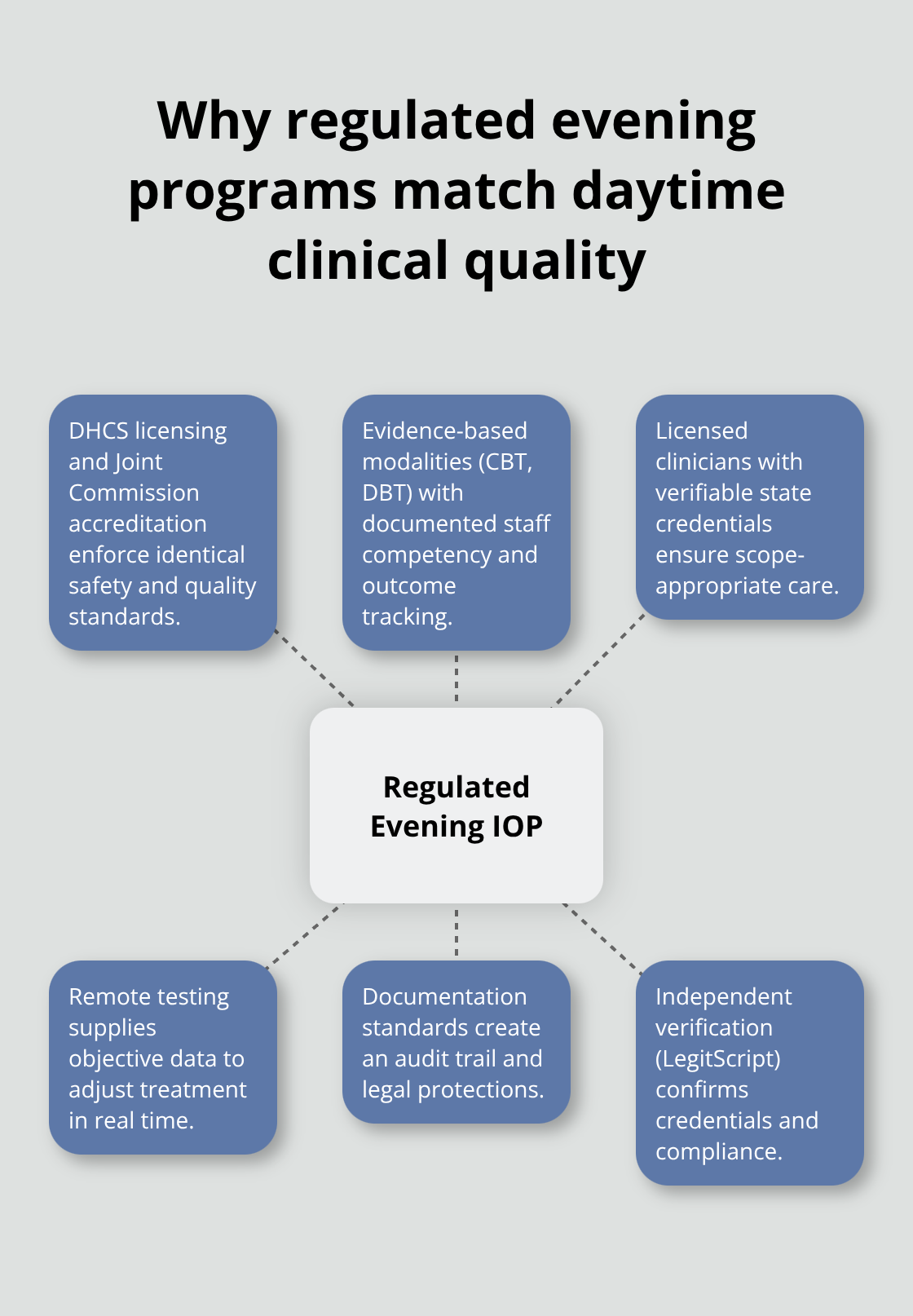
Regulatory accreditation isn’t paperwork that sits in a filing cabinet-it’s the framework that ensures your evening program delivers the same clinical intensity as daytime treatment. DHCS licensing in California and Joint Commission accreditation mean your program meets identical standards for clinician qualifications, treatment protocols, documentation, and patient safety regardless of when sessions run. Joint Commission accreditation specifically requires programs to maintain evidence-based treatment modalities, staff competency standards, and outcome tracking that apply equally to evening and daytime schedules. When you choose a LegitScript-certified program, you select one that has passed independent verification of these regulatory credentials, not one that claims accreditation without proof.
Licensed Clinicians Meet State Board Standards
Licensed clinicians who deliver cognitive behavioral therapy and dialectical behavior therapy must hold active licenses through your state board-you can verify this yourself on your state’s licensing website rather than trusting the program’s word. Your state board maintains public records of every licensed clinician, their credential status, and any disciplinary actions. This verification step takes five minutes and protects you from programs that misrepresent staff qualifications. Regulated evening programs employ clinicians who meet the exact same credential requirements as those running daytime programs elsewhere, which means your evening sessions receive the same clinical expertise regardless of scheduling.
Remote Testing Tracks Real Progress
Remote drug and alcohol testing transforms accountability from a compliance checkbox into a practical tool for tracking your actual progress. Testing happens at home or at labs near your workplace, eliminating the half-day appointments that daytime programs require, and results inform your clinician’s treatment adjustments in real time rather than weeks later. If your results show increased substance use, your clinician adjusts your treatment intensity, medication management, or coping strategies immediately rather than waiting for the next scheduled review. This objective data also protects your employment-you demonstrate concrete progress to employers or family members through measurable results, not subjective reporting.
Documentation Creates Legal Protection
Regulated programs document these results in your clinical file, creating an audit trail that protects you legally if disputes arise with employers or family. The combination of licensed clinicians, evidence-based protocols, regulatory oversight, and integrated testing means your evening recovery program operates under the same accountability standards that make daytime programs effective, with the scheduling flexibility that lets you keep your job. DHCS licensing and Joint Commission accreditation apply identical documentation requirements to evening and daytime programs, so your clinical records receive the same legal protections regardless of when you attend sessions.
Final Thoughts
Regulated care produces measurable outcomes because accountability runs through every layer of treatment. When you enter a LegitScript certified IOP program, you join a system where licensed clinicians maintain active state credentials, treatment protocols follow evidence-based standards, and remote drug and alcohol testing provides objective progress data that adjusts your care in real time. This verification framework stops the guesswork that undermines recovery in unregulated settings.
Safety in telehealth treatment depends on HIPAA-compliant platforms with encryption and clear privacy policies, paired with clinicians who deliver cognitive behavioral therapy and dialectical behavior therapy effectively through screens. Regulated programs maintain these standards because DHCS licensing and Joint Commission accreditation require them, not because they’re optional extras. Your clinical records receive the same legal protections whether you attend sessions in person or virtually, which means your data privacy and treatment confidentiality remain intact.
Verified credentials reduce relapse risk because your clinician’s license appears on your state board, their training in evidence-based modalities is documented, and their treatment decisions follow clinical protocols rather than profit incentives. When your program integrates remote testing with individual therapy and group sessions, your clinician catches early warning signs of relapse before they escalate into full episodes. Schedule a no-cost assessment to verify that regulated nighttime recovery actually works for your situation.