

Addiction doesn’t follow a 9-to-5 schedule, and neither should your recovery. If you’re working full-time or managing family responsibilities, finding time for treatment feels impossible.
Night time addiction therapy changes that equation. At EveningIOP, we’ve built our programs around your life, not the other way around.
Why Evening Treatment Removes Scheduling Barriers
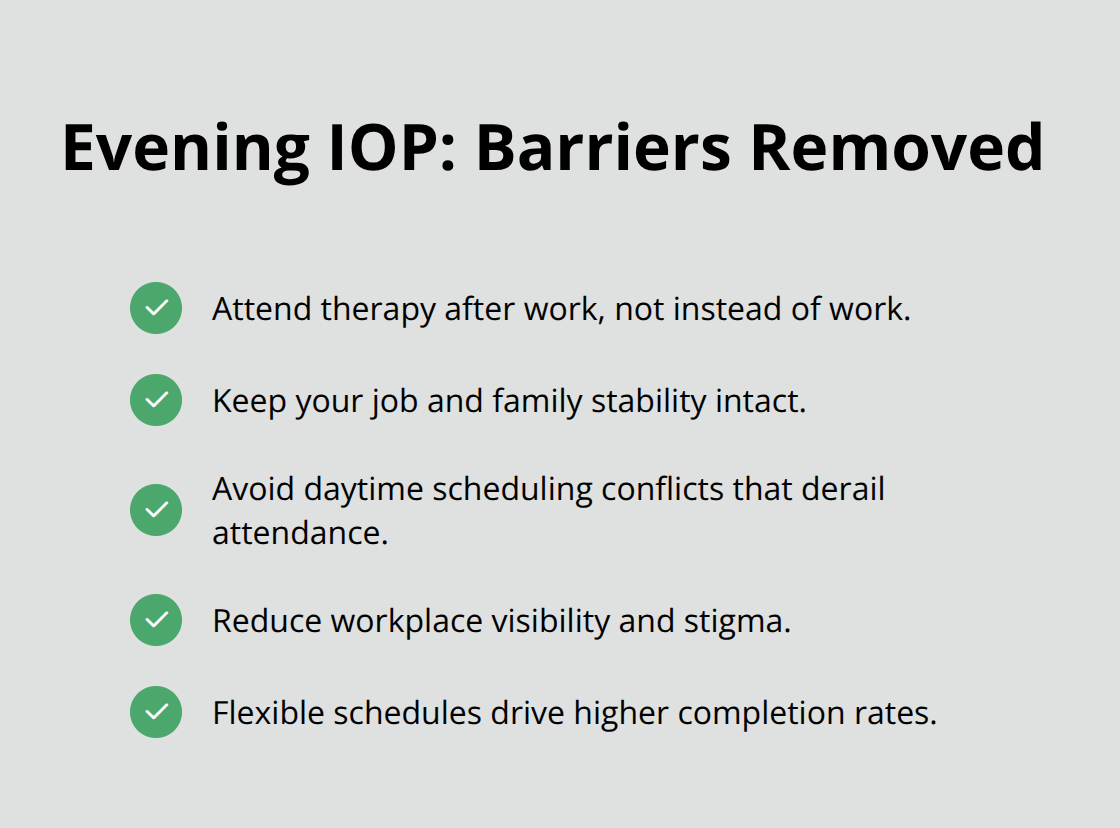
Daytime treatment programs force a choice most working professionals can’t make: miss work or skip recovery. That’s a false choice, and evening programs eliminate it entirely. People who tried daytime programs and failed often did so simply because the timing made consistency impossible. Treatment adherence drops significantly when scheduling conflicts force people to choose between employment and care. Evening programs remove that barrier entirely. You attend therapy after work, not instead of work. This isn’t a minor convenience; it’s the difference between staying employed and losing your job, between maintaining family stability and watching it collapse. Flexible scheduling increases treatment completion rates compared to rigid daytime-only programs.
That’s not because evening therapy is somehow more effective clinically-it’s because people actually show up.
How Attendance Shapes Recovery Outcomes
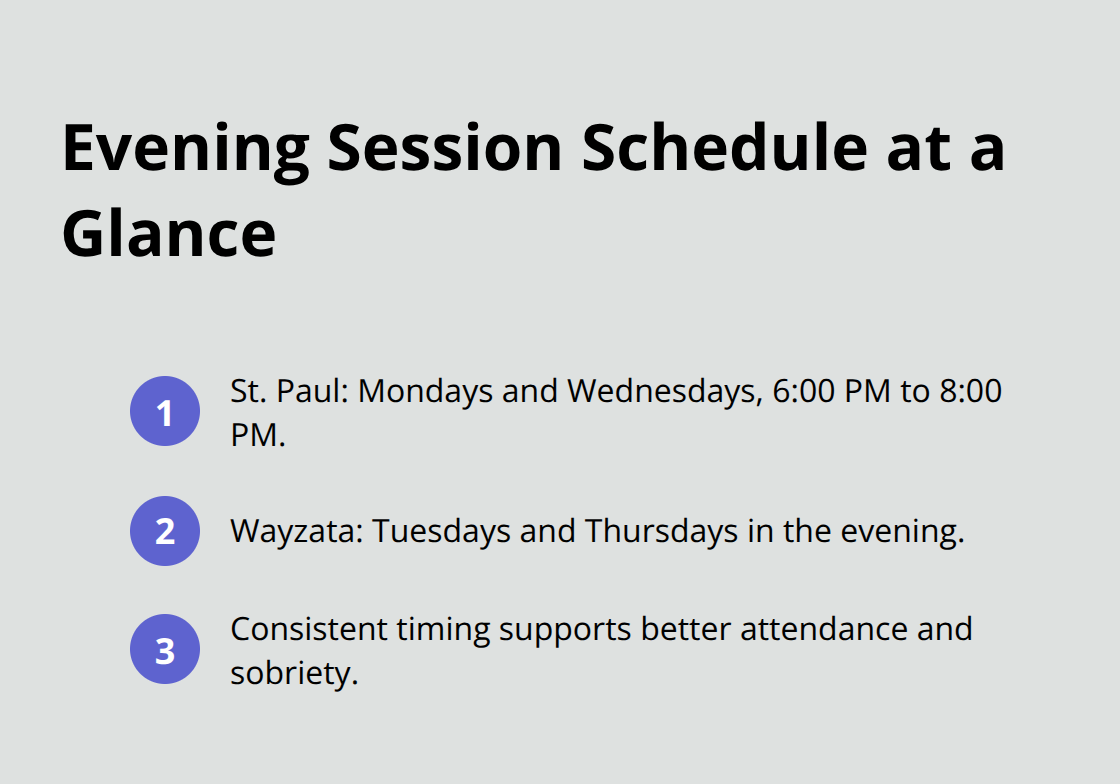
Missing sessions derails recovery faster than almost anything else. Each missed appointment creates a gap where doubt creeps in, where old habits feel closer, where the structure you’re building starts to crack. Evening programs eliminate the logistical excuses that kill attendance. You don’t need to leave work early, arrange childcare during school hours, or burn through paid time off. Sessions run at times when you naturally transition from work-Mondays and Wednesdays from 6:00 PM to 8:00 PM in St. Paul, and Tuesdays and Thursdays in Wayzata. That consistency matters enormously. Evening outpatient programs help participants maintain longer periods of continuous sobriety compared to those in daytime programs.
Privacy Reduces the Stigma Factor
Evening attendance means fewer coworkers notice your absence, fewer explanations needed, fewer sideways glances when you return. That privacy removes a real psychological barrier that keeps people from seeking help in the first place. When treatment happens after work hours, your recovery stays separate from your professional life. This separation protects your job security and your reputation at work. The ability to keep treatment private often determines whether someone reaches out for help at all. Evening programs acknowledge this reality and work with it, not against it. As you move forward with evening treatment, understanding what actually happens in these sessions becomes the next critical piece of your decision.
What Happens in Evening IOP Sessions
Group Therapy: Real Strategies for Real Obstacles
Group therapy in evening programs works differently than you might expect. You sit in structured sessions where licensed clinicians guide discussions around relapse prevention, coping strategies, and real obstacles you face at work and home. Live interactive group sessions bring together people navigating the same evening-to-recovery transition, which matters because your peers understand exactly why you can’t take time off work. The group becomes accountability in real time. When someone shares that they nearly used after a stressful client meeting, others offer concrete tactics they’ve tested.
This peer-to-peer exchange moves recovery skills from theory into your actual life. Group therapy combined with individual counseling produces better outcomes than either approach alone. Evening timing means you bring the day’s real challenges directly into the room, where they matter most.
One-on-One Clinical Work: Addressing What Triggered Your Use
Individual sessions with licensed clinicians happen separately, allowing you to address personal trauma, medication management, or co-occurring mental health issues that group settings can’t touch. These sessions tackle what triggered your use in the first place and build a recovery plan specific to your circumstances. Your clinician works with you to identify patterns, test new responses, and adjust your approach as you progress through treatment.
Remote Testing: Accountability Without Friction
Remote drug and alcohol testing removes another barrier: you don’t need to arrange time away from work or family to provide samples. Testing happens at home through secure, monitored processes that fit your evening schedule, keeping you accountable without creating logistical friction.
How Structure Replaces Intensity
Structure and consistency matter more than intensity when you balance work and recovery. Evening IOP delivers the clinical rigor of more intensive programs without requiring you to step away from your job or responsibilities. You attend sessions two to four times weekly depending on your program phase, which provides enough frequency to interrupt old patterns without overwhelming your schedule.
The combination of group work, individual therapy, and accountability testing creates a framework where missing even one session becomes noticeable to your clinician and your peers, which strengthens your commitment. This isn’t about making you feel guilty; it’s about leveraging social structure to keep you moving forward when motivation wavers. Evening programs work because they meet you where you actually are instead of asking you to reconstruct your entire life around treatment. How you apply these skills outside the session room determines whether recovery sticks, which is exactly what the next section explores.
Evening IOP Versus Daytime Programs: Why Timing Changes Everything
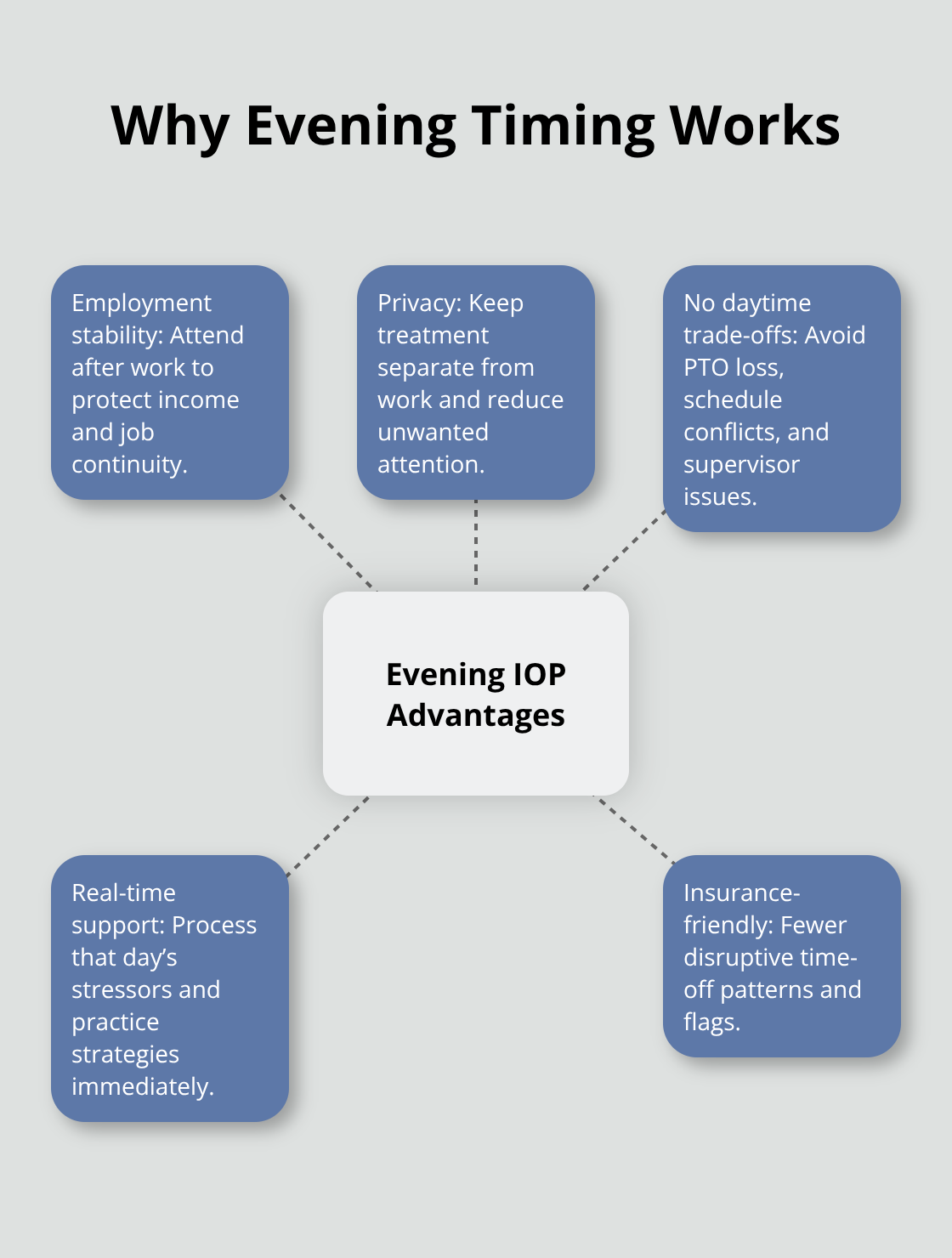
Daytime programs operate on an assumption that doesn’t match reality: that you can stop working to recover. Traditional outpatient treatment typically runs from 9 AM to 3 PM, which means you either take unpaid leave, lose your job, or skip sessions. Research shows treatment adherence drops when scheduling conflicts force this choice, and daytime-only programs see higher no-show rates as a result. Evening IOP flips this entirely. Sessions run after work ends, meaning you attend therapy without sacrificing income or employment stability. Your boss never needs to know you’re in treatment. Your paycheck stays intact. Your health insurance doesn’t get flagged for sudden time-off patterns.
This isn’t a minor difference-it’s the foundation that allows recovery to actually happen. When you’re not panicking about losing your job, you can focus on the work of getting sober.
Employment Stability Matters More Than You Think
Daytime programs create invisible costs that add up fast. Taking two hours off work twice weekly means burning through paid time off or explaining absences to supervisors. Some employers grow suspicious after repeated afternoon departures, which creates stress that directly triggers relapse. Others cut your hours or pass you over for promotions when they notice the pattern. Evening programs eliminate this entirely because your recovery happens on your own time. You leave work at 5 PM, attend a session from 6 PM to 8 PM, and return home. No explanations. No paper trail. No employment risk. For people with inflexible jobs-retail, healthcare, construction-daytime treatment is simply impossible. Evening IOP acknowledges this reality and builds around it. The clinical quality doesn’t suffer; you still work with licensed clinicians and participate in evidence-based group therapy. The only difference is the clock shows 6 PM instead of 2 PM.
Real-World Triggers Require Real-Time Support
Daytime programs teach coping strategies in isolation. You learn relapse prevention techniques in the morning, then face actual triggers later when you’re back at work with no support. Evening treatment reverses this timing advantage. You attend sessions after experiencing the day’s real stressors-the difficult client, the argument with a family member, the moment you nearly used. You bring those situations directly into the therapy room where they’re fresh and immediate. Your clinician helps you process what just happened and test new responses before you go home. The next morning, you’re implementing strategies you practiced last night. Group members share what they faced that afternoon, creating immediate peer support for the exact obstacles you’re navigating. Structured post-treatment plans, especially those emphasizing early warning signs of relapse, generate lower rates of heavy drinking and make evening treatment substantially more practical than daytime alternatives.
Final Thoughts
Evening programs eliminate the false choice between recovery and employment that prevents most people from seeking help. You don’t sacrifice your job to get sober-night time addiction therapy works because it meets you where you actually are instead of demanding you restructure your entire life around treatment schedules. Licensed clinicians still deliver evidence-based group therapy and individual counseling at the same clinical standard as daytime programs, and you maintain employment stability while building recovery.
This combination of clinical rigor and practical flexibility separates evening programs from traditional daytime treatment. You receive the same quality of care without sacrificing your paycheck, your job security, or your family responsibilities (the structure keeps you accountable while the timing keeps you employed). EveningIOP delivers this exact model through DHCS-licensed, Joint Commission-accredited evening Intensive Outpatient Programs that combine live interactive group therapy, one-on-one sessions with licensed clinicians, and remote drug and alcohol testing.
The barriers that stopped you from seeking help before no longer apply. Recovery is possible without losing your job, without explaining absences to your boss, without watching your life fall apart while you wait for a daytime appointment slot. Reach out to explore whether evening treatment fits your situation.