


Caregivers often face an impossible choice: pursue recovery or maintain their responsibilities at work and home. Traditional treatment programs demand daytime attendance, forcing people to choose between getting help and keeping their lives stable.
Evening IOP for caregivers changes that equation. We at EveningIOP designed our programs specifically so you can access clinical care, group therapy, and licensed clinicians during evening hours-without sacrificing your job, your family time, or your role as a caregiver.
Why Daytime Treatment Doesn’t Work for Working Caregivers
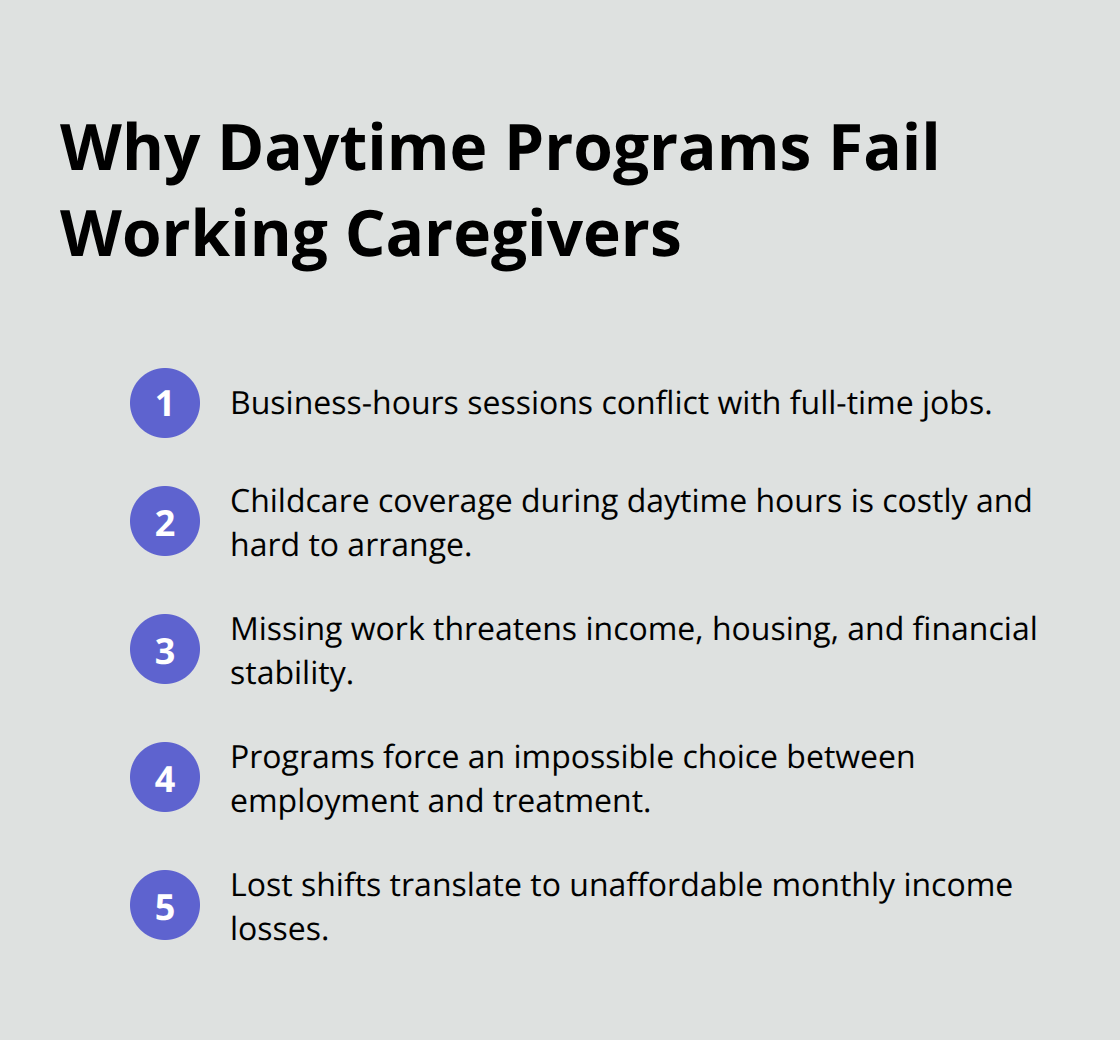
Daytime treatment programs operate on a schedule designed decades ago when fewer people juggled work and caregiving. Standard intensive outpatient programs meet during business hours-typically 9 a.m. to 3 p.m.-which forces people to take time off work, arrange childcare coverage, or abandon treatment altogether. For a single parent working full-time, this isn’t flexibility; it’s an impossible choice. Research shows that employment is one of the strongest predictors of sustained recovery, yet traditional programs force people to sacrifice their jobs to get help. A caregiver managing both work and family responsibilities faces compounding pressure: missing work sessions risks job loss, which destabilizes housing and finances at precisely the moment they need stability most. The financial hit is brutal. Losing even one shift per week translates to hundreds of dollars monthly in lost income, making treatment unaffordable for people already stretched thin.
The Childcare Trap During Treatment Hours
Parents in recovery face an additional barrier that programs rarely acknowledge: daytime treatment requires finding and paying for childcare during the exact hours when programs operate. Full-time daycare costs average between $10,000 and $25,000 annually depending on location, according to the U.S. Department of Health and Human Services. Adding treatment program hours on top of work hours creates a scheduling puzzle that most families cannot solve without family support they may not have. Evening programs eliminate this friction entirely. When treatment happens after 5 p.m., a parent can manage school pickup, dinner, and household routines, then attend therapy while a partner handles evening duties or children are asleep. This schedule respects actual family life instead of forcing families to reorganize around treatment. For caregivers supporting aging parents or disabled relatives, daytime programs create similar conflicts. The person needing treatment cannot attend appointments because their caregiving duties don’t pause for business hours.
When Treatment Timing Matches Real-Life Stress
Therapists often work with clients on stress management and coping skills during daytime sessions, then clients return to their actual stressors-work pressure, family conflict, financial strain-without immediate support. Evening IOP changes this timing fundamentally. When treatment happens during the hours when cravings and stress typically intensify, clients learn and practice coping skills in real-time context. Someone struggling with evening stress after work can attend group therapy that same night, process what happened, and develop immediate strategies. The clinical team works with the actual schedule that defines the person’s life, not an artificial daytime framework. This alignment between treatment timing and life stress produces better outcomes than waiting until the next daytime session to address crisis moments. The gap between when stress hits and when support arrives shrinks dramatically, which means people actually apply what they learn instead of losing momentum between sessions.
How Evening IOP Fits Into Your Actual Life
Treatment Sessions Match Your Work Schedule
Evening IOP sessions run between 5 p.m. and 8:30 p.m., typically three to four evenings per week for two to three hours per session. This timing aligns with how working adults and caregivers structure their days. A parent working a standard 9-to-5 job attends sessions after work without requesting time off or fabricating reasons to leave early. Someone managing caregiving duties coordinates evening handoffs with a partner or family member, keeping household responsibilities intact. The clinical content remains intensive-group therapy, individual counseling with licensed clinicians, and medication management all stay the same. What changes is that you access these services when your life allows it, not when a program designed decades ago decided treatment should happen.
Real Clinical Intensity in Compressed Evening Hours
HRI Hospital’s evening IOP in Massachusetts runs Monday, Tuesday, and Thursday from 5:30 to 8:20 p.m., delivering three structured groups per session: a check-in period, a DBT group focused on skills, and a CBT group addressing thoughts and behaviors. This compressed evening format delivers the same clinical intensity as a daytime program without forcing you to choose between recovery and employment. Licensed clinicians lead each component, and the structure ensures you work through evidence-based therapies during evening hours that fit your actual schedule. The program doesn’t sacrifice quality for convenience-it simply relocates quality care to times when working people can actually attend.
Telehealth Extends Flexibility Beyond Evening Sessions
Telehealth medication management and brief check-ins extend flexibility further. Instead of attending every session in person, many evening programs offer remote options for medication reviews or crisis consultations, reducing transportation barriers and allowing you to maintain treatment continuity even when scheduling conflicts arise. A caregiver managing an aging parent attends three evening group sessions in person while handling medication discussions via video call on the week’s remaining nights, eliminating the need to arrange extra childcare or transportation. Individual therapy slots often accommodate evening appointments as well, meaning you work one-on-one with a licensed clinician at times that don’t disrupt your work schedule or family dinner. This hybrid approach-combining in-person group work with telehealth flexibility-acknowledges that real recovery happens in real life, not in a clinical bubble.
Why This Schedule Works When Others Don’t
For people already stretched thin by work and family obligations, evening IOP removes the false choice between getting help and keeping your life functional. The practical effect is significant: you maintain employment, preserve family routines, and access the same clinical rigor that daytime programs provide. Transportation barriers shrink, childcare logistics simplify, and you show up to treatment without sacrificing the stability that recovery actually requires. This structural alignment between treatment timing and real life creates the conditions where people stay engaged long enough for therapy to work. When you can attend sessions without destabilizing your job or family, you actually complete the program instead of dropping out after a few weeks.
How Caregivers Actually Manage Work, Family, and Recovery
The Marketing Manager: Maintaining Career While Attending Treatment
A marketing manager in Boston attends evening IOP on Monday, Tuesday, and Thursday from 5:30 to 8:20 p.m. She leaves her office at 5 p.m., drives to the program, and completes group therapy by 8:30 p.m. On Wednesday nights when she has no in-person session, she joins a telehealth medication check-in from home while her partner handles dinner cleanup. Her employer knows she leaves early three days weekly but doesn’t know the reason, and she doesn’t need to disclose it. The structure works because the timing doesn’t force her to invent excuses or sacrifice income. She kept her job, her health insurance stayed active, and her clinical team adjusted her treatment based on real-world stress she reported during evening sessions.
The Single Father: Coordinating Treatment Around Parenting Duties
A single father with two children under age ten manages evening IOP differently. He attends sessions after his children are asleep, coordinating with his mother who stays at his house on treatment nights. He works a retail shift that ends at 5 p.m., picks up his kids from school by 5:45 p.m., feeds them dinner, handles homework and bedtime routines, then leaves for his 7 p.m. group session. His treatment plan includes individual therapy slots on Saturday mornings when childcare is easier to arrange, plus one telehealth session on a weeknight when his mother can supervise the children remotely. This hybrid schedule keeps him present for his children’s daily lives while accessing intensive clinical care. He told his employer he needed three evenings per week for personal commitments without elaborating further. The program doesn’t demand that he sacrifice parenting to recover.
The Married Couple: Using Treatment Structure to Strengthen Partnership
A married couple where one partner needed treatment created a different arrangement. The partner in recovery attended evening sessions four nights weekly for eight weeks, then stepped down to three nights as stability improved. During the intensive phase, the other partner managed evening household tasks and bedtime routines. They used the structure to communicate more clearly about roles and expectations, and family therapy sessions at the program gave them tools to discuss how recovery affects both of them. The partner not in treatment attended two family sessions to understand the clinical framework and coping strategies being taught. This involvement reduced resentment about the schedule change and created shared accountability for recovery. Neither partner had to take time off work, and they protected their weekend time together. The program’s evening format meant treatment didn’t consume their days or force one person to become a solo caregiver during the week.
The Adult Child Caregiver: Balancing Parental Care and Personal Recovery
A woman supporting her aging mother while managing her own recovery attended evening IOP while her mother attended an adult day program from 8 a.m. to 3 p.m. The overlap meant she could attend treatment sessions without hiring overnight care or disrupting her mother’s routine. She coordinated medication management through telehealth on one evening when her brother covered caregiving duties via phone. Her treatment plan accounted for the specific stress of caregiving, and her group therapists understood that her triggers included evening fatigue combined with caregiving pressure. The evening timing meant group members discussing similar stress could offer real strategies instead of theoretical advice.
Why Workable Solutions Matter More Than Perfect Ones
These caregivers didn’t find perfect solutions; they found workable ones. Evening IOP succeeds because it acknowledges that recovery happens within actual lives, not in clinical bubbles designed around business hours. The caregivers who engage longest are the ones whose treatment schedule doesn’t force impossible choices.
Final Thoughts
The caregivers in this article made a deliberate choice: they stopped waiting for treatment to fit their lives and instead found treatment that actually does. Evening IOP for caregivers removes the structural barriers that have kept people trapped between recovery and responsibility for decades. You no longer have to choose between attending therapy and keeping your job, between getting help and staying present for your children, or between accessing clinical care and maintaining the stability that recovery requires.
Employment predicts sustained recovery, family involvement strengthens outcomes, and consistent attendance matters more than any single therapy technique. Evening IOP delivers all three by aligning treatment with how people actually live. When sessions happen after work instead of during it, when medication management happens via telehealth instead of requiring another appointment, and when group therapy addresses the stress you experienced that same evening instead of waiting until tomorrow, recovery becomes possible within real life instead of despite it.
Delay serves no one-every week you wait is another week managing stress without support, another week your family navigates uncertainty, and another week your job remains at risk. We at EveningIOP understand this reality and offer DHCS-licensed, Joint Commission-accredited programs that combine interactive online group therapy, one-on-one sessions with licensed clinicians, and remote drug and alcohol testing specifically designed for people who work and care for others. Your recovery and your responsibilities do not have to compete anymore.