


Choosing an online treatment program is one of the most important decisions you’ll make for your recovery. At EveningIOP, we believe that verification matters-which is why LegitScript certification and other credentials should be your first checkpoint.
Fraudulent providers exist, and they can derail your progress or put your health at risk. This guide shows you exactly what to look for and how to verify that a program is legitimate before you enroll.
Why LegitScript Certification Protects Your Recovery
LegitScript certification is Google’s trusted verification badge for addiction treatment providers. Google, Meta, Microsoft, and Nextdoor only allow LegitScript-certified centers to advertise on their platforms. This matters because it means a program has passed a rigorous third-party review that confirms legal compliance, qualified staff, accurate service descriptions, and patient safety measures. The certification process requires providers to submit facility ownership records, business licenses, practitioner licensure documents, DEA certificates, and proof of privacy policy compliance. Reviewers examine whether websites truthfully describe services and locations, verify that staff hold proper credentials, and check that centers operate within all applicable laws. Without this verification layer, predatory providers can advertise freely, making it nearly impossible for patients to distinguish legitimate treatment from scams that promise unrealistic outcomes or use unapproved medications.
What Certified Programs Must Prove
Programs pursuing LegitScript certification must meet 16 core standards that cover licensure, staff qualifications, privacy compliance, medication-assisted treatment protocols, and advertising integrity. A certified center must employ a medical director and clinical staff with documented addiction treatment expertise. Websites must disclose facility addresses, describe actual services offered, and post a HIPAA-compliant privacy policy. If a program offers medication-assisted treatment, medications must be approved by regulatory authorities. Advertising claims cannot mislead patients about outcomes, locations, or services. The certification process takes weeks and costs between $1,395 and $1,595 for an application fee per facility, plus $2,550 to $3,095 annually for ongoing compliance monitoring. This financial and administrative commitment signals that a provider is serious about legitimacy. Facilities that skip certification often do so because they cannot meet these standards or do not want external oversight of their practices.
Why Verification Prevents Harm
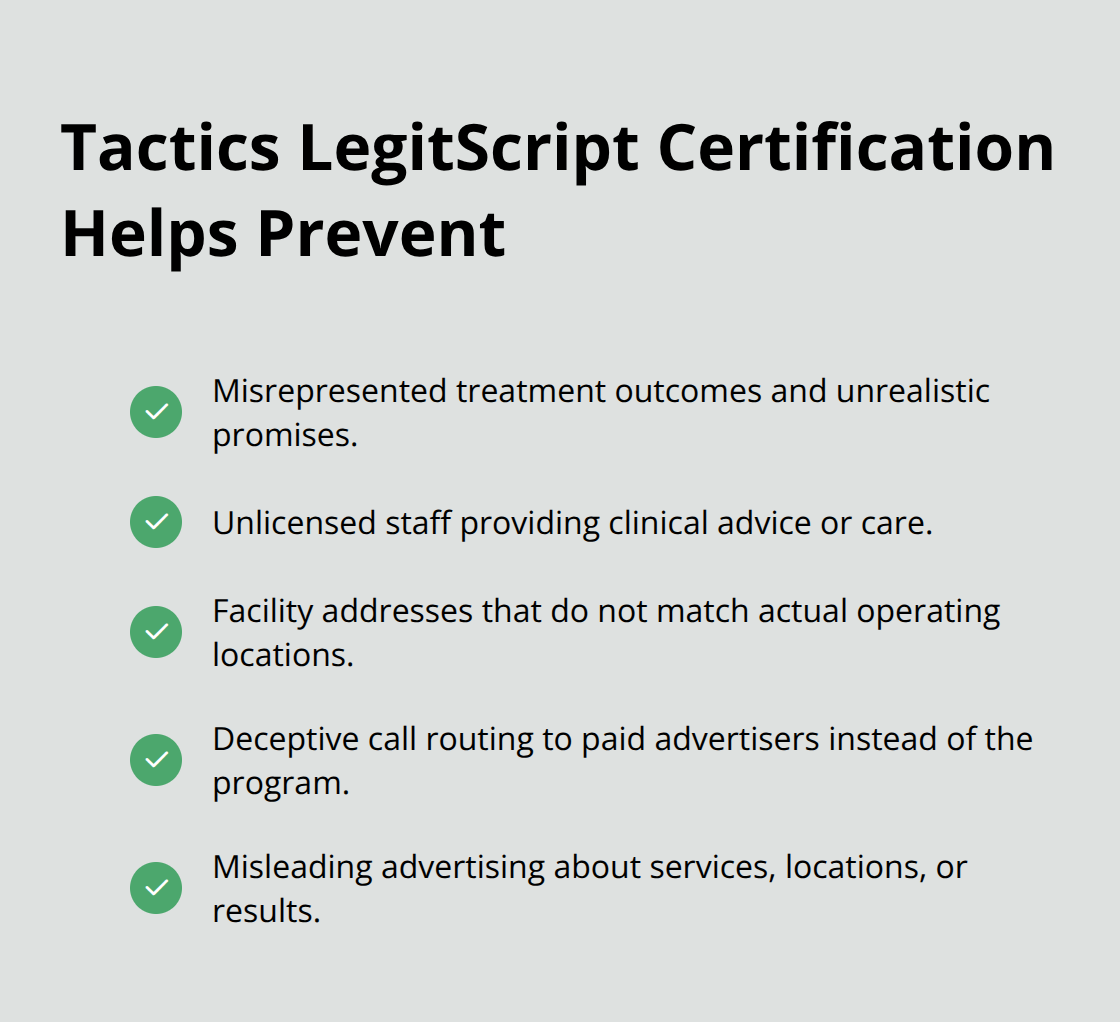
Substance use disorder treatment attracts opportunistic operators who exploit vulnerable patients seeking recovery. Some centers misrepresent outcomes, employ unlicensed staff, or operate from addresses that do not match their advertised locations. Others use deceptive marketing to funnel patients to call centers that route calls to paid advertisers rather than the treatment program itself. LegitScript certification eliminates these tactics because certified programs submit to ongoing monitoring and lose their certification if they violate standards.
When you verify a provider’s credentials before enrolling, you confirm that clinical staff are qualified, that treatment follows evidence-based protocols (such as cognitive behavioral therapy or dialectical behavior therapy), and that your personal health information will be protected. You also confirm that the program operates under proper licensing and accreditation, such as Joint Commission accreditation or state DHCS licensing.
What Credentials Tell You About a Program
A program’s credentials reveal whether it can actually deliver treatment. LegitScript certification confirms that a center has passed independent verification of its legal status, staff qualifications, and advertising practices. Joint Commission accreditation indicates that a program meets national standards for clinical care and patient safety. DHCS licensing (in California) or equivalent state licensing in other states verifies that a facility operates under state regulatory oversight. Programs that hold all three credentials (LegitScript, Joint Commission, and state licensing) demonstrate a commitment to accountability at multiple levels. When you check these credentials before enrolling, you protect yourself from wasting time in a program that cannot deliver results or worse, puts your health at risk. The next section shows you exactly how to verify these credentials online.
How to Verify a Provider’s Credentials
Check the LegitScript Directory First
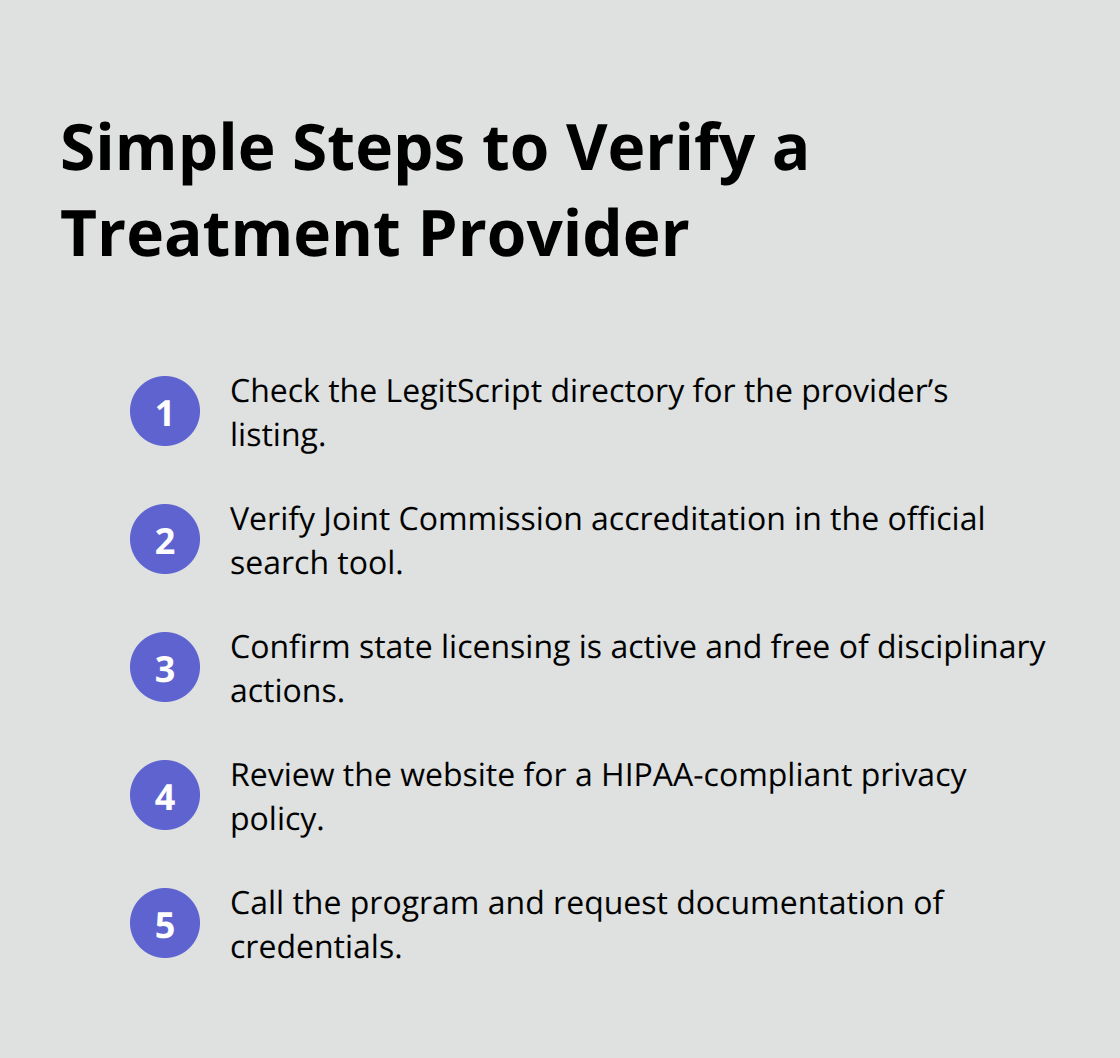
Start with the LegitScript directory. Visit legitscript.com and search for your provider by name or location. A legitimate program will display the LegitScript seal on its website and appear in the official directory. If a program claims certification but does not appear in the search results, it is not certified, regardless of what its website states.
This single step filters out most fraudulent operators immediately.
Confirm Joint Commission Accreditation and State Licensing
Verify Joint Commission accreditation through the Joint Commission’s official website. Search for the facility by name and state. Joint Commission accreditation confirms that a program meets national standards for clinical care, patient safety, and outcomes measurement. Programs accredited by Joint Commission undergo on-site surveys every three years, meaning their standards remain actively monitored.
For state-level licensing, search your state’s Department of Health Care Services (DHCS) or equivalent regulatory agency. In California, DHCS maintains a public database of licensed addiction treatment facilities. Other states operate comparable licensing boards. Verify that the license is current and that no disciplinary actions appear against the facility. These three credentials (LegitScript, Joint Commission, and state licensing) create multiple verification layers that protect you.
Review Privacy Policies and Contact the Program Directly
Check the provider’s website privacy policy next. A legitimate program posts a HIPAA-compliant privacy policy that explains how patient data is collected, stored, and protected. If you cannot find a privacy policy or it reads vaguely, that signals a problem. Contact the program directly and ask about its certifications and licensing. Legitimate providers answer these questions readily and provide documentation. If staff becomes evasive or cannot clearly explain their credentials, move on to another option.
Identify Red Flags That Indicate Fraud
Red flags appear when programs claim certifications they cannot verify. If a provider says it is LegitScript certified but does not appear in the directory, the claim is false. Similarly, if a website displays a Joint Commission logo but the facility does not appear in the Joint Commission search tool, the accreditation is fabricated. Other warning signs include vague descriptions of services, missing facility addresses, unlicensed staff offering clinical advice, and promises of guaranteed recovery outcomes.
Programs that route calls through third-party call centers rather than connecting you directly to clinical staff often obscure their actual location or credentials. If a program cannot clearly name its medical director or describe its clinical approach, question whether qualified clinicians are actually on staff. Pressure to enroll quickly without verifying credentials is another red flag. Programs with multiple credentials make verification simple because you can check each one independently and confirm legitimacy across different systems.
What You Actually Get in a Certified IOP Program
A certified Intensive Outpatient Program operates under multiple layers of oversight that directly shape how treatment works. When you enroll in a program with LegitScript certification, Joint Commission accreditation, and state licensing, you enter a system where clinical standards are enforced, staff qualifications are verified, and outcomes are measured. Liberty Bay Recovery Center in Portland, Maine demonstrates this structure: their IOP requires 15 hours of group therapy per week alongside weekly individual sessions, uses evidence-based therapies including Cognitive Behavioral Therapy and Dialectical Behavior Therapy, and integrates trauma therapy and family counseling to address co-occurring conditions. This specificity matters because it means your treatment plan is not generic. The program has documented protocols for how sessions run, what outcomes are tracked, and how clinicians adjust your care if progress stalls. Certified programs also employ medical directors and clinical psychologists with documented addiction treatment expertise-not just counselors without formal credentials. This staffing requirement, mandated by LegitScript’s 16 core standards, means someone with prescribing authority or advanced clinical training oversees your case. When you call a certified program and ask about the medical director’s credentials or the clinical approach, staff can answer immediately because these roles are built into the program’s structure.
How Accountability Shapes Your Treatment Experience
Certified programs undergo ongoing monitoring that directly affects how they treat you. Joint Commission accreditation requires on-site surveys every three years, meaning national inspectors physically visit the facility to verify that documented standards match actual practice. DHCS licensing in California and equivalent state oversight in other states creates a second accountability layer where patients can file complaints if a program violates standards.
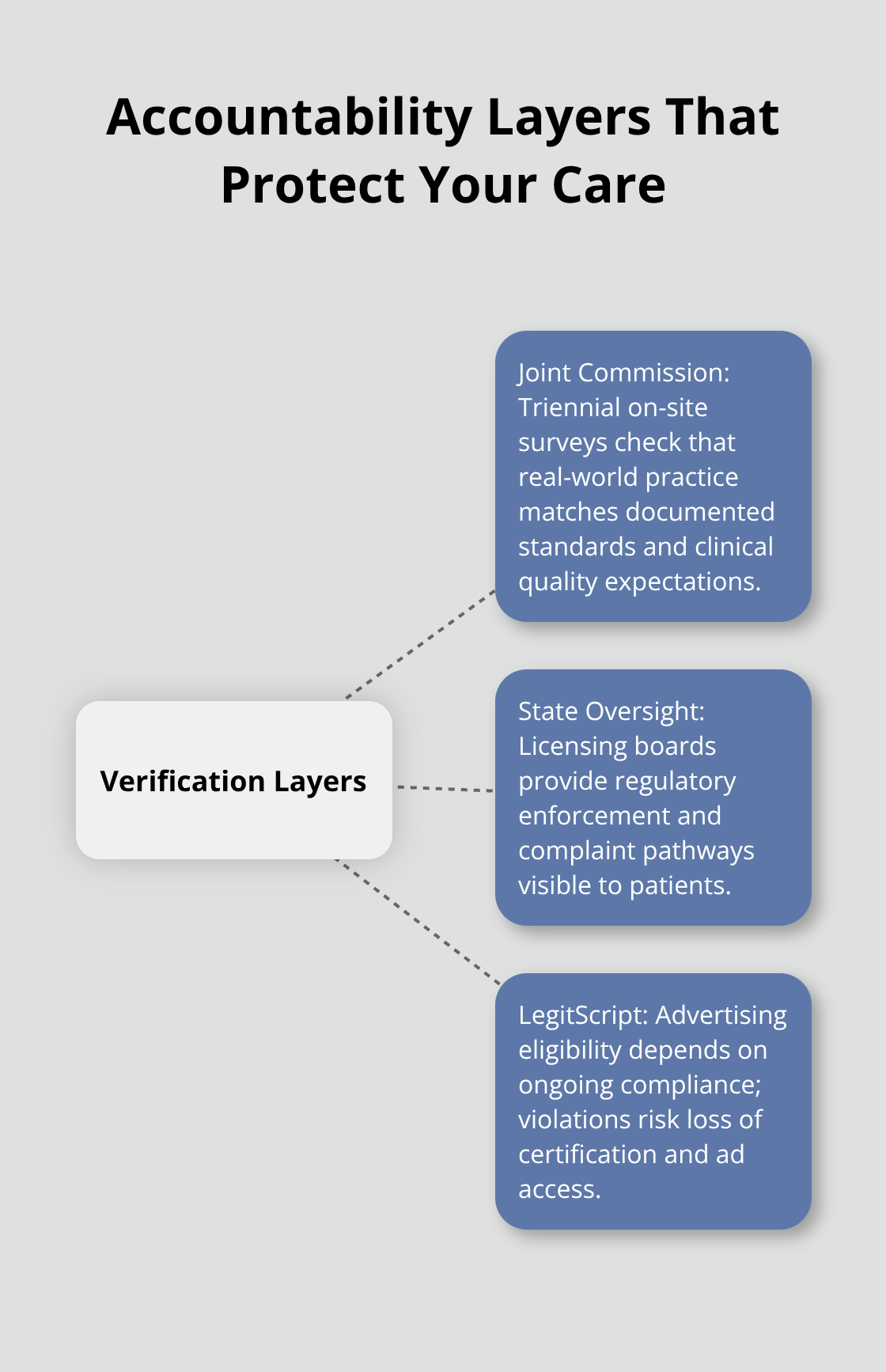
LegitScript certification adds a third: if a program makes false advertising claims or violates any of the 16 core standards, it loses the certification badge that allows it to advertise on Google, Meta, and other major platforms. This financial consequence-losing advertising access-creates real incentive to maintain standards. Programs that hold all three credentials cannot hide poor outcomes or unqualified staff because multiple external bodies audit them. Ask any program you consider how it tracks outcomes and modifies treatment if you are not improving. Certified programs have documented answers because measurement is required, not optional.
What Privacy Protection Looks Like in Practice
A certified program’s privacy policy is not just legal boilerplate-it determines how your health information moves through the system. HIPAA-compliant policies, required for LegitScript certification, specify who can access your treatment records, how long records are retained, and what happens if you request your information. When you contact a certified program, ask whether it stores records electronically and who has access to them. Programs offering telehealth must encrypt video sessions and secure any recordings to meet HIPAA standards. Ask whether the program uses third-party call centers or connects you directly to clinical staff, because call centers sometimes collect your information before routing you to treatment, creating an extra data transfer point that increases breach risk. Certified programs disclose these practices upfront because transparency is a core standard. If a program cannot clearly explain its privacy practices or becomes vague when you ask specific questions about data handling, that signals it has not built privacy compliance into its operations. Legitimate providers see privacy protection as competitive advantage, not a compliance checkbox.
Evidence-Based Treatment Standards
Certified programs document which therapies they use and why. Liberty Bay’s IOP integrates Cognitive Behavioral Therapy, Dialectical Behavior Therapy, EMDR, trauma therapy, and family counseling-each chosen because research supports its effectiveness for substance use disorders and co-occurring mental health conditions. When you enroll, the program does not assign you to a generic treatment track; instead, clinicians assess your specific needs (anxiety, depression, PTSD, bipolar disorder, or other conditions) and match you to the therapies that address them. This individualized approach is not optional in certified programs-it is mandated by accreditation standards that require documented treatment plans. Ask potential programs to explain which evidence-based therapies they offer and how they select therapies for each client. Programs that cannot answer this question clearly have not built clinical rigor into their operations.
Staff Qualifications and Clinical Oversight
The medical director requirement separates legitimate programs from operations run by unlicensed staff. A medical director holds a medical license or advanced clinical credential and has documented addiction treatment expertise. This person reviews your case, approves treatment modifications, and ensures that any medications (such as buprenorphine for opioid use disorder) are prescribed appropriately. Clinical psychologists with addiction training provide additional oversight. When you call a certified program, ask for the medical director’s name and credentials. Legitimate programs answer immediately. If staff cannot name the medical director or describes the role vaguely, the program likely does not have qualified clinical leadership.
Final Thoughts
Choosing a LegitScript certified IOP program means protecting your recovery by selecting a program that has proven it meets rigorous standards for clinical care, staff qualifications, and patient safety. The credentials matter because they represent independent verification that a program operates legally, employs qualified clinicians, and will not exploit your vulnerability. When you verify LegitScript certification, Joint Commission accreditation, and state licensing before enrolling, you eliminate the programs that cut corners or make false promises.
Your recovery deserves a program built on accountability, not just good intentions. Certified programs undergo ongoing monitoring that keeps standards in place long after you enroll, and external bodies catch it if outcomes slip or staff practices drift. This matters because recovery is hard enough without worrying whether your program is legitimate or whether your personal health information stays secure.
If you balance recovery with work or family responsibilities, an evening IOP offers the flexibility you need without sacrificing clinical rigor. Contact us to verify your program’s credentials and ask about its medical director, clinical approach, and privacy practices-legitimate programs answer these questions clearly.