


Work and recovery don’t have to compete. Many people skip treatment because traditional daytime programs clash with their jobs, and that barrier shouldn’t exist.
At EveningIOP, we built nighttime therapy programs specifically for working professionals who need mental health and addiction treatment on their own schedule. Evening sessions mean you keep your job, your income, and your dignity while getting the clinical care that works.
Why Daytime Treatment Fails Working Professionals
The Mismatch Between Traditional Schedules and Real Work Life
Traditional mental health and addiction programs operate on a nine-to-five schedule that assumes you can step away from work for two to four hours multiple times per week. That assumption is disconnected from reality for most working people. Missing afternoon appointments means lost wages, suspicious questions from managers, or burning through paid time off that you’d rather use for actual recovery. Work conflicts rank among the top three reasons people delay or avoid mental health care entirely, according to research on treatment barriers. The structure of conventional daytime programs was built for a workforce that no longer exists, and the result is clear: people choose their paychecks over their health because the system forces that choice.
How Evening Programs Change Retention and Engagement
The shift toward evening and weekend mental health services reflects a hard truth that treatment providers finally acknowledge. Working professionals, parents managing childcare, and people holding multiple jobs need clinical care delivered on their actual schedule, not on some outdated template. Evening sessions from roughly 6 to 9 p.m. paired with telehealth options remove the false choice between recovery and financial stability. Evening Intensive Outpatient Programs consistently show that participants maintain employment during treatment.
What Evening Care Actually Looks Like in Practice
Remote drug and alcohol testing, live group therapy conducted online, and one-on-one sessions with licensed clinicians all happen after work hours, which means you attend treatment without announcing it to your employer or sacrificing income. The data supports what makes intuitive sense: when treatment fits into your life instead of demanding you reorganize your life around it, you actually show up and stay engaged long enough for clinical outcomes to improve. That difference between programs people complete and programs people abandon matters enormously. Evening care delivers the same clinical intensity as daytime models but removes the structural barriers that cause people to quit before recovery takes hold.
Understanding what evening IOP actually involves-the sessions, the testing, the clinical support-helps you evaluate whether this model fits your situation and what to expect when you start.
What Evening IOP Actually Delivers
How Evening Programs Structure Treatment Around Your Work Schedule
Evening Intensive Outpatient Programs run three to five nights per week, typically from 6 to 9 p.m., with each session lasting two to three hours. This structure lets you attend group therapy, individual clinical sessions, and accountability monitoring without taking time off work or rearranging your schedule around treatment.
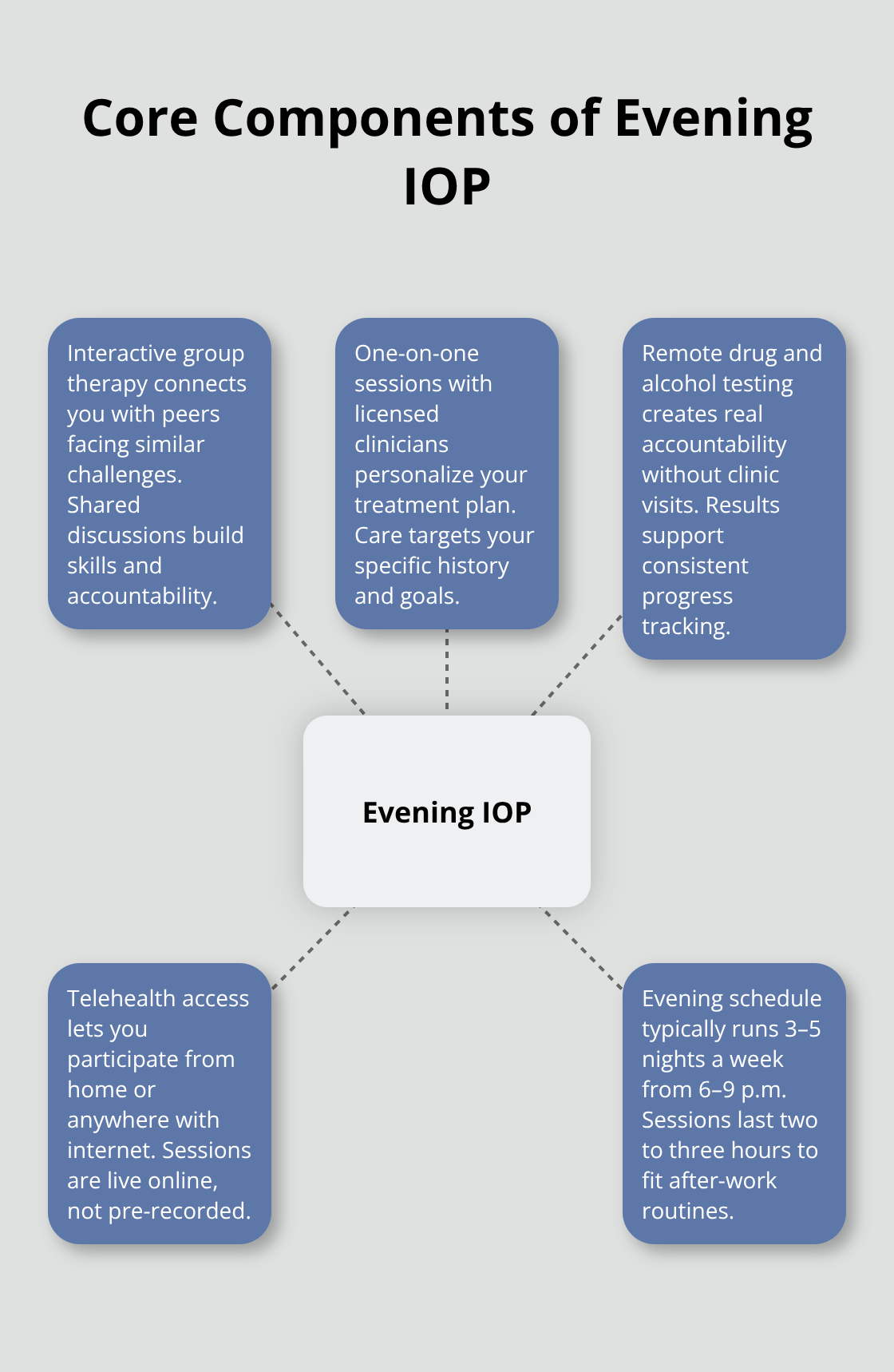
All sessions happen live online through telehealth, so you participate from home or anywhere with an internet connection. The program combines three core components that work together: interactive group therapy where you connect with peers facing similar challenges, one-on-one sessions with licensed clinicians who build a personalized treatment plan specific to your situation, and remote drug and alcohol testing that creates real accountability without requiring clinic visits.
Why Retention Rates Climb When Treatment Fits Your Life
Research on flexible outpatient programs shows that treatment schedules aligning with actual work and family commitments improve outcomes compared to rigid daytime models. This difference matters because people who complete treatment see measurably better outcomes than those who drop out early. The evening timing actually strengthens group cohesion because participants are already home, more relaxed, and less stressed about work deadlines. Licensed facilitators guide discussions on emotion regulation, coping strategies, and recovery skills in live online sessions rather than sterile clinic waiting rooms.
Personalized Clinical Support Outside Group Sessions
One-on-one clinical support happens separately from group sessions, allowing your licensed clinician to address your specific history, co-occurring mental health conditions, and personal recovery goals. These sessions typically occur once or twice weekly and form the foundation of your personalized treatment approach. Remote testing removes the inconvenience of traveling to a clinic for drug screens while maintaining the accountability that supports sustained recovery. You complete tests from home on a schedule your clinician sets, and results feed directly into your treatment progress tracking.
Clinical Rigor Remains Identical Regardless of Timing
The clinical effectiveness of evening programs matches traditional daytime intensity because the content and clinical rigor remain identical-only the timing changes. Licensed clinicians deliver evidence-based treatment using cognitive behavioral therapy, trauma-informed care, and motivational interviewing regardless of whether sessions occur at 2 p.m. or 7 p.m. The real advantage is that evening participants actually complete treatment more often because the schedule does not force them to choose between recovery and employment. Flexible outpatient programs typically last 90 days to 18 months, often starting with three to six months of intensive evening sessions before tapering frequency as your skills strengthen and relapse risk decreases.
Getting Started: Speed and Credentials Matter
Intake moves quickly at most evening programs, with assessments completed within one to three business days and potential urgent starts within 24 to 48 hours for people in crisis. This speed matters because the window when someone decides to seek treatment often closes fast if barriers block the path forward. Programs carrying DHCS licensing, Joint Commission accreditation, and LegitScript certification meet rigorous clinical and operational standards. These credentials signal that licensed clinicians deliver care, that safety protocols protect your privacy, and that the program operates with the oversight serious treatment requires.
Understanding what evening IOP actually involves-the sessions, the testing, the clinical support-helps you evaluate whether this model fits your situation. The next step is knowing what to look for when you compare programs and how to identify the credentials and capabilities that separate quality providers from those cutting corners.
Choosing the Right Evening Treatment Program
Verify Accreditation and Licensing Standards
Accreditation and licensing separate programs operating under clinical oversight from those cutting corners on clinician qualifications or safety protocols. DHCS licensing in California, Joint Commission accreditation, and LegitScript certification carry real weight in evening treatment. DHCS licensing means the program meets state standards for clinical staffing, treatment protocols, and client safety. Joint Commission accreditation requires programs to demonstrate measurable clinical outcomes, staff competency verification, and regular external audits. LegitScript certification vets that telehealth platforms meet federal privacy standards and that clinicians hold valid, active licenses.
To find safe medical detox support, verify accreditation and licensing standards by requesting documentation directly from any program rather than accepting claims without verification. California’s Department of Social Services publishes a public database of licensed providers, and you can cross-reference any program’s license status in minutes. Many programs claim credentials without holding them, so verify through the issuing body. Programs that hesitate to share accreditation details or lack these three credentials operate outside the oversight that protects you.
Evaluate Telehealth Infrastructure and Testing Methods
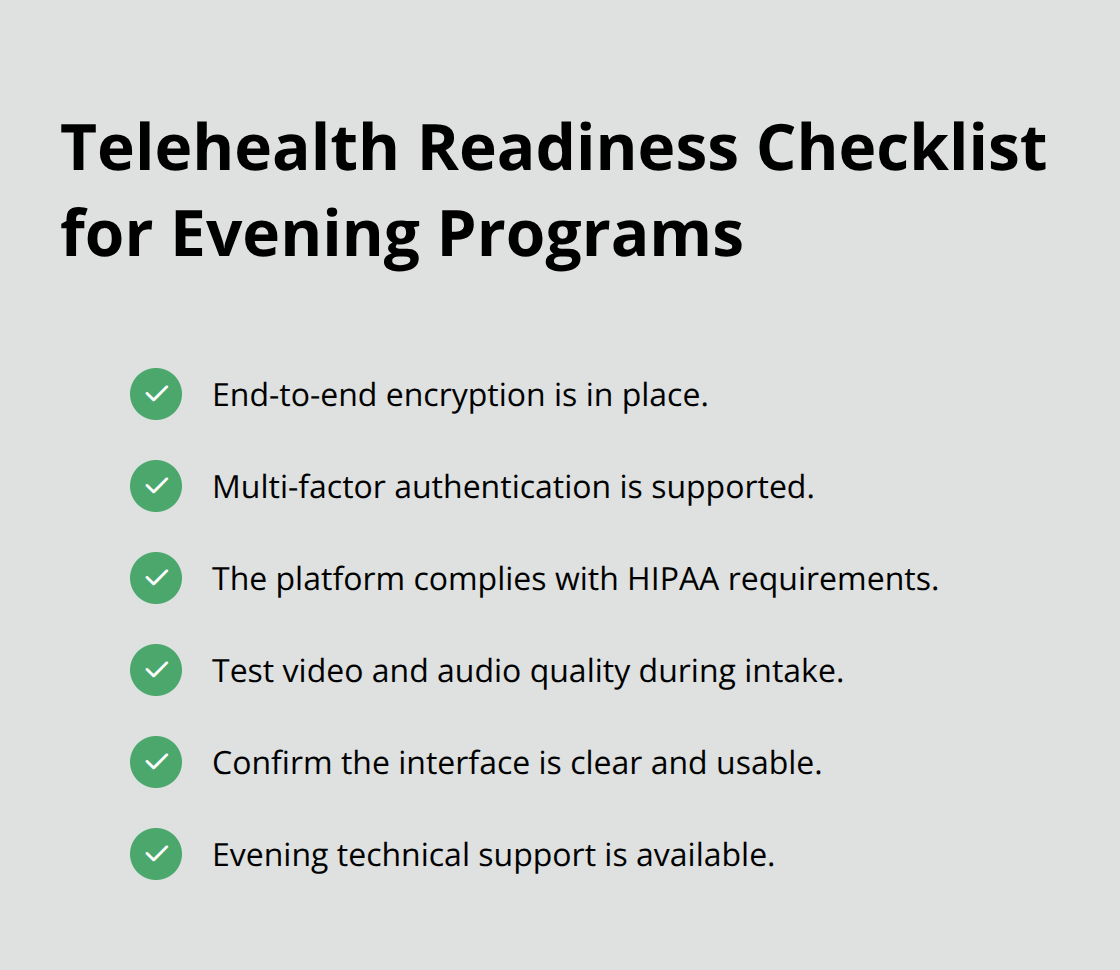
Telehealth infrastructure matters more for evening programs than traditional clinics because your entire treatment depends on consistent, secure technology. Ask whether the platform uses end-to-end encryption, supports multi-factor authentication, and complies with HIPAA requirements. Test the platform during intake-if video quality drops, audio cuts out, or the interface confuses you, those problems will persist during actual treatment sessions. Programs should offer technical support during evening hours since sessions happen after standard business hours when most IT support closes.
Remote drug and alcohol testing requires that samples are verified through certified laboratories and results integrate directly into your clinical record without manual errors. Evaluate whether the program uses lab-verified testing versus cheaper mail-in options that lack chain-of-custody protocols. The program should specify which testing methods they use, the laboratory they partner with, and how quickly results reach your clinician. Speed matters because delayed results create gaps in accountability that undermine treatment. Programs that bundle testing with group sessions rather than separating them often rush through results to stay on schedule, which defeats the purpose of accountability monitoring.
Assess Treatment Flexibility and Personalization
Program flexibility extends beyond evening hours to how clinicians adjust treatment when your circumstances change. Strong programs offer multiple session times within their evening window-some people need 6 p.m. starts, others need 8 p.m.-and they accommodate that without forcing you onto a waitlist. Ask whether the program adjusts session frequency based on progress rather than locking you into a fixed schedule for 12 weeks. Research on flexible outpatient programs shows that tapering from intensive to standard frequency as your recovery stabilizes improves long-term outcomes compared to abrupt program exits.
Personalized treatment approaches mean your clinician modifies therapy methods based on your specific diagnosis, trauma history, and what actually works for you rather than running everyone through identical curriculum. The program should explain their assessment process during intake and show you how assessment results shape your individual plan. Programs using cognitive behavioral therapy, trauma-informed care, and motivational interviewing deliver evidence-based methods, but the clinician’s skill in applying those methods to your situation determines real outcomes.
Verify Clinician Qualifications and Experience
Request information about clinician credentials beyond licensure-board certifications, specialized training in your diagnosis, and years of experience matter significantly. A licensed clinician with five years of addiction treatment experience brings different capacity than one with five months. Programs should answer questions about clinician qualifications without defensiveness, and if they deflect or offer vague responses, that signals they may not prioritize staffing quality. The program should specify whether clinicians remain consistent throughout your treatment or rotate frequently, since therapeutic relationships strengthen outcomes in evening care where you work with the same people over weeks or months.
Final Thoughts
Evening programs remove the structural barriers that have kept people from treatment for decades. When recovery doesn’t demand you sacrifice your job, your income, or your family time, the decision to seek help becomes possible instead of impossible. Nighttime therapy programs work because they acknowledge how people actually live, not how treatment administrators wish they lived.
Finding quality care means verifying credentials before you commit. DHCS licensing, Joint Commission accreditation, and LegitScript certification separate programs operating under real clinical oversight from those cutting corners. Ask about clinician qualifications, test the telehealth platform during intake, and confirm that remote testing uses certified laboratories with proper chain-of-custody protocols (programs that answer these questions directly and provide documentation deserve your trust).
We at EveningIOP built our program around what working professionals actually need. Live online group therapy, one-on-one sessions with licensed clinicians, and remote drug and alcohol testing all happen during evening hours so you attend treatment without announcing it to your employer or sacrificing income. Contact EveningIOP if evening care fits your schedule, or use the standards outlined here to evaluate any program you consider.